AQA A Level Biology
Topic 2 Cells
Model answer notes by @biologywitholivia (updated for 2025)
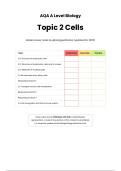
Topic Understand Memorise Practise
2.1.1 Structure of eukaryotic cells
2.1.2 Structure of prokaryotic cells and of viruses
2.1.3 Methods of studying cells
2.2 All cells arise from other cells
Required practical 2
2.3 Transport across cell membranes
Required practical 3
Required practical 4
2.4 Cell recognition and the immune system
These notes are for PERSONAL USE ONLY. Redistribution,
reproduction, or sale of any portion of this material is prohibited.
For enquiries, please email
,More GCSE & A Level Biology resources available at stan.store/biologywitholivia Copyright © 2025 Biology with Olivia
2.1 Cell structure
2.1.1 Structure of eukaryotic cells
What are the distinguishing features of eukaryotic cells?
● Cytoplasm containing membrane-bound organelles
● So DNA enclosed in a nucleus
Describe the general structure of eukaryotic cells
Algal and fungal cells are similar to plant cells - see differences above.
Describe the structure of the cell-surface membrane
More detail covered in 2.3 Transport across cell membranes.
Describe the function of the cell-surface membrane
● Selectively permeable → enables control of passage of substances in / out of cell
● Molecules / receptors / antigens on surface → allow cell recognition / signalling
2
,More GCSE & A Level Biology resources available at stan.store/biologywitholivia Copyright © 2025 Biology with Olivia
Describe the structure of the nucleus
Describe the function of the nucleus
● Holds / stores genetic information which codes for polypeptides (proteins)
● Site of DNA replication
● Site of transcription (part of protein synthesis), producing mRNA
● Nucleolus makes ribosomes / rRNA
Describe the structure of a ribosome
● Made of ribosomal RNA and protein (two subunits)
● Not a membrane-bound organelle
Describe the function of a ribosome
Site of protein synthesis (translation)
Describe the structure of rough (rER) & smooth endoplasmic reticulum (sER)
Describe the function of rER and sER
rER ● Ribosomes on surface synthesise proteins
● Proteins processed / folded / transported inside rER
● Proteins packaged into vesicles for transport eg. to Golgi apparatus
sER ● Synthesises, processes, transports and packages lipids & carbohydrates
● Eg. cholesterol and steroid hormones
3
, More GCSE & A Level Biology resources available at stan.store/biologywitholivia Copyright © 2025 Biology with Olivia
Describe the structure of Golgi apparatus and Golgi vesicles
Describe the function of Golgi apparatus and Golgi vesicles
Golgi ● Modifies protein, eg. adds carbohydrates to produce glycoproteins
apparatus ● Modifies lipids, eg. adds carbohydrates to make glycolipids
● Packages proteins / lipids into Golgi vesicles
● Produces lysosomes (a type of Golgi vesicle)
Golgi ● Transports proteins / lipids to their required destination
vesicles ● Eg. moves to and fuses with cell-surface membrane
Describe the structure of lysosomes
Describe the function of lysosomes
● Release hydrolytic enzymes (eg. lysozymes)
● To break down / hydrolyse pathogens or worn-out cell components
Describe the structure of mitochondria
Describe the function of mitochondria
● Site of aerobic respiration
● To produce ATP for energy release (from respiratory substrates)
● Eg. for protein synthesis / vesicle movement / active transport
4
Topic 2 Cells
Model answer notes by @biologywitholivia (updated for 2025)
Topic Understand Memorise Practise
2.1.1 Structure of eukaryotic cells
2.1.2 Structure of prokaryotic cells and of viruses
2.1.3 Methods of studying cells
2.2 All cells arise from other cells
Required practical 2
2.3 Transport across cell membranes
Required practical 3
Required practical 4
2.4 Cell recognition and the immune system
These notes are for PERSONAL USE ONLY. Redistribution,
reproduction, or sale of any portion of this material is prohibited.
For enquiries, please email
,More GCSE & A Level Biology resources available at stan.store/biologywitholivia Copyright © 2025 Biology with Olivia
2.1 Cell structure
2.1.1 Structure of eukaryotic cells
What are the distinguishing features of eukaryotic cells?
● Cytoplasm containing membrane-bound organelles
● So DNA enclosed in a nucleus
Describe the general structure of eukaryotic cells
Algal and fungal cells are similar to plant cells - see differences above.
Describe the structure of the cell-surface membrane
More detail covered in 2.3 Transport across cell membranes.
Describe the function of the cell-surface membrane
● Selectively permeable → enables control of passage of substances in / out of cell
● Molecules / receptors / antigens on surface → allow cell recognition / signalling
2
,More GCSE & A Level Biology resources available at stan.store/biologywitholivia Copyright © 2025 Biology with Olivia
Describe the structure of the nucleus
Describe the function of the nucleus
● Holds / stores genetic information which codes for polypeptides (proteins)
● Site of DNA replication
● Site of transcription (part of protein synthesis), producing mRNA
● Nucleolus makes ribosomes / rRNA
Describe the structure of a ribosome
● Made of ribosomal RNA and protein (two subunits)
● Not a membrane-bound organelle
Describe the function of a ribosome
Site of protein synthesis (translation)
Describe the structure of rough (rER) & smooth endoplasmic reticulum (sER)
Describe the function of rER and sER
rER ● Ribosomes on surface synthesise proteins
● Proteins processed / folded / transported inside rER
● Proteins packaged into vesicles for transport eg. to Golgi apparatus
sER ● Synthesises, processes, transports and packages lipids & carbohydrates
● Eg. cholesterol and steroid hormones
3
, More GCSE & A Level Biology resources available at stan.store/biologywitholivia Copyright © 2025 Biology with Olivia
Describe the structure of Golgi apparatus and Golgi vesicles
Describe the function of Golgi apparatus and Golgi vesicles
Golgi ● Modifies protein, eg. adds carbohydrates to produce glycoproteins
apparatus ● Modifies lipids, eg. adds carbohydrates to make glycolipids
● Packages proteins / lipids into Golgi vesicles
● Produces lysosomes (a type of Golgi vesicle)
Golgi ● Transports proteins / lipids to their required destination
vesicles ● Eg. moves to and fuses with cell-surface membrane
Describe the structure of lysosomes
Describe the function of lysosomes
● Release hydrolytic enzymes (eg. lysozymes)
● To break down / hydrolyse pathogens or worn-out cell components
Describe the structure of mitochondria
Describe the function of mitochondria
● Site of aerobic respiration
● To produce ATP for energy release (from respiratory substrates)
● Eg. for protein synthesis / vesicle movement / active transport
4