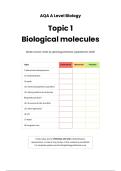
AQA A Level Biology
Topic 1
Biological molecules
Model answer notes by @biologywitholivia (updated for 2025)
Topic Understand Memorise Practise
1.1 Monomers and polymers
1.2 Carbohydrates
1.3 Lipids
1.4.1 General properties of proteins
1.4.2 Many proteins are enzymes
Required practical 1
1.5.1 Structure of DNA and RNA
1.5.2 DNA replication
1.6 ATP
1.7 Water
1.8 Inorganic ions
These notes are for PERSONAL USE ONLY. Redistribution,
reproduction, or sale of any portion of this material is prohibited.
For enquiries, please email
,More GCSE & A Level Biology resources available at stan.store/biologywitholivia Copyright © 2025 Biology with Olivia
1.1 Monomers and polymers
What are monomers and polymers?
● Monomers - smaller, repeating molecules / units from which larger molecules / polymers are made
● Polymers - molecules made from many (a large number of) identical / similar monomer molecules
What happens in condensation and hydrolysis reactions?
Condensation ● 2 molecules join together Hydrolysis ● 2 molecules separated
reaction ● Forming a chemical bond reaction ● Breaking a chemical bond
● Releasing a water molecule ● Using a water molecule
Give examples of polymers and the monomers from which they’re made
Exam insight: common mistakes ❌
Mistake Explanation
“Monomers are building blocks.” This isn’t wrong, but isn’t specific enough to get the mark.
“A polymer is made of 2 or more monomers.” ‘Poly’ means many. Two monomers joined is a dimer.
*Mixing up hydrolysis and ‘C’ for condensation; ‘C’ for connecting molecules. Imagine
condensation reactions.* condensation on a window to remember water is released.
*Forgetting to include H2O in diagrams of H2O is released for every condensation reaction and
condensation and hydrolysis reactions.* H2O is used for every hydrolysis reaction.
“Lipids are polymers.” Lipids are not made from repeating monomers, so aren’t.
“Two molecules with the chemical formula H2O is released during condensation, so the chemical formula
C6H12O6 combine to form C12H24O12.” of the molecule produced in this case is C12H22O11.
2
, More GCSE & A Level Biology resources available at stan.store/biologywitholivia Copyright © 2025 Biology with Olivia
1.2 Carbohydrates
What are monosaccharides? Give 3 common examples
● Monomers from which larger carbohydrates are made
● Glucose, fructose, galactose
Describe the structure of α-glucose
● Left - full structure, carbon
atoms labelled
● Right - simplified structure
as in the specification to be
memorised for exam
Describe the difference between the structure of α-glucose and β-glucose
● Isomers - same molecular formula but differently arranged atoms
● OH group is below carbon 1 in α-glucose but above carbon 1 in β-glucose
What are disaccharides and how are they formed?
● Two monosaccharides joined together with a glycosidic bond
● Formed by a condensation reaction, releasing a water molecule
List 3 common disaccharides & monosaccharides from which they’re made
Disaccharide Monosaccharides
Maltose Glucose + glucose
Sucrose Glucose + fructose
Lactose Glucose + galactose
Draw a diagram to show how two monosaccharides are joined together
What are polysaccharides and how are they formed?
● Many monosaccharides joined together with glycosidic bonds
● Formed by many condensation reactions, releasing many water molecules
3
Topic 1
Biological molecules
Model answer notes by @biologywitholivia (updated for 2025)
Topic Understand Memorise Practise
1.1 Monomers and polymers
1.2 Carbohydrates
1.3 Lipids
1.4.1 General properties of proteins
1.4.2 Many proteins are enzymes
Required practical 1
1.5.1 Structure of DNA and RNA
1.5.2 DNA replication
1.6 ATP
1.7 Water
1.8 Inorganic ions
These notes are for PERSONAL USE ONLY. Redistribution,
reproduction, or sale of any portion of this material is prohibited.
For enquiries, please email
,More GCSE & A Level Biology resources available at stan.store/biologywitholivia Copyright © 2025 Biology with Olivia
1.1 Monomers and polymers
What are monomers and polymers?
● Monomers - smaller, repeating molecules / units from which larger molecules / polymers are made
● Polymers - molecules made from many (a large number of) identical / similar monomer molecules
What happens in condensation and hydrolysis reactions?
Condensation ● 2 molecules join together Hydrolysis ● 2 molecules separated
reaction ● Forming a chemical bond reaction ● Breaking a chemical bond
● Releasing a water molecule ● Using a water molecule
Give examples of polymers and the monomers from which they’re made
Exam insight: common mistakes ❌
Mistake Explanation
“Monomers are building blocks.” This isn’t wrong, but isn’t specific enough to get the mark.
“A polymer is made of 2 or more monomers.” ‘Poly’ means many. Two monomers joined is a dimer.
*Mixing up hydrolysis and ‘C’ for condensation; ‘C’ for connecting molecules. Imagine
condensation reactions.* condensation on a window to remember water is released.
*Forgetting to include H2O in diagrams of H2O is released for every condensation reaction and
condensation and hydrolysis reactions.* H2O is used for every hydrolysis reaction.
“Lipids are polymers.” Lipids are not made from repeating monomers, so aren’t.
“Two molecules with the chemical formula H2O is released during condensation, so the chemical formula
C6H12O6 combine to form C12H24O12.” of the molecule produced in this case is C12H22O11.
2
, More GCSE & A Level Biology resources available at stan.store/biologywitholivia Copyright © 2025 Biology with Olivia
1.2 Carbohydrates
What are monosaccharides? Give 3 common examples
● Monomers from which larger carbohydrates are made
● Glucose, fructose, galactose
Describe the structure of α-glucose
● Left - full structure, carbon
atoms labelled
● Right - simplified structure
as in the specification to be
memorised for exam
Describe the difference between the structure of α-glucose and β-glucose
● Isomers - same molecular formula but differently arranged atoms
● OH group is below carbon 1 in α-glucose but above carbon 1 in β-glucose
What are disaccharides and how are they formed?
● Two monosaccharides joined together with a glycosidic bond
● Formed by a condensation reaction, releasing a water molecule
List 3 common disaccharides & monosaccharides from which they’re made
Disaccharide Monosaccharides
Maltose Glucose + glucose
Sucrose Glucose + fructose
Lactose Glucose + galactose
Draw a diagram to show how two monosaccharides are joined together
What are polysaccharides and how are they formed?
● Many monosaccharides joined together with glycosidic bonds
● Formed by many condensation reactions, releasing many water molecules
3