CM 4223: Strategy Review, Evaluation And Control
– Accurate Solutions For Every Question
Save
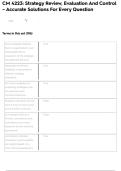
Terms in this set (106)
Most strategists believe True
that an organization's well-
being depends on
evaluation of the strategic-
management process.
Adequate and timely true
feedback is important to
effective strategy
evaluation.
Too much emphasis on True
evaluating strategies may
be expensive and
counterproductive.
Strategy evaluation should False
have a long-run focus and
avoid a short-run focus.
According to Richard False
Rumelt, consonance and
consistency are mostly
based on a firm's external
assessment.
According to Rumelt, True
consistency and feasibility
are largely based on a
firm's internal assessment.
,Consistency, False
distinctiveness, advantage,
and feasibility are Richard
Rumelt's four criteria for
evaluating a strategy.
Strategy evaluation is False
becoming increasingly
easier with the passage of
time, given technological
advances.
The decreasing time span True
for which planning can be
done with any degree of
certainty is a reason
strategy evaluation is more
difficult today.
Strategies may be True
inconsistent if policy
problems and issues
continue to be brought to
the top for resolution.
Competitive advantages False
normally are the result of
superiority in one of three
areas: feasibility,
consistency, or
consonance.
Regardless of the size of True
the organization, a certain
amount of "management by
wandering around" at all
levels is essential to
effective strategy
evaluation.
, Evaluating strategies on a true
continuous rather than on a
periodic basis allows
benchmarks of progress to
be established and more
effectively monitored.
It is most effective to False
conduct strategy
evaluation annually, at the
end of the fiscal year.
Changes in the False
organization's
management, marketing,
finance and accounting,
production and operations,
research and development
(R&D), and management
information systems (MIS)
strengths and weaknesses
should all be the focus of a
revised EFE matrix in
strategy evaluation.
In strategy evaluation, a False
revised IFE matrix should
indicate how effective a
firm's strategies have been
in response to key
opportunities and threats.
Strengths, weaknesses, True
opportunities, cost and
threats should continually
be monitored for change
because it is not really a
question of whether these
factors will change, but
rather when they will
change and in what ways.
– Accurate Solutions For Every Question
Save
Terms in this set (106)
Most strategists believe True
that an organization's well-
being depends on
evaluation of the strategic-
management process.
Adequate and timely true
feedback is important to
effective strategy
evaluation.
Too much emphasis on True
evaluating strategies may
be expensive and
counterproductive.
Strategy evaluation should False
have a long-run focus and
avoid a short-run focus.
According to Richard False
Rumelt, consonance and
consistency are mostly
based on a firm's external
assessment.
According to Rumelt, True
consistency and feasibility
are largely based on a
firm's internal assessment.
,Consistency, False
distinctiveness, advantage,
and feasibility are Richard
Rumelt's four criteria for
evaluating a strategy.
Strategy evaluation is False
becoming increasingly
easier with the passage of
time, given technological
advances.
The decreasing time span True
for which planning can be
done with any degree of
certainty is a reason
strategy evaluation is more
difficult today.
Strategies may be True
inconsistent if policy
problems and issues
continue to be brought to
the top for resolution.
Competitive advantages False
normally are the result of
superiority in one of three
areas: feasibility,
consistency, or
consonance.
Regardless of the size of True
the organization, a certain
amount of "management by
wandering around" at all
levels is essential to
effective strategy
evaluation.
, Evaluating strategies on a true
continuous rather than on a
periodic basis allows
benchmarks of progress to
be established and more
effectively monitored.
It is most effective to False
conduct strategy
evaluation annually, at the
end of the fiscal year.
Changes in the False
organization's
management, marketing,
finance and accounting,
production and operations,
research and development
(R&D), and management
information systems (MIS)
strengths and weaknesses
should all be the focus of a
revised EFE matrix in
strategy evaluation.
In strategy evaluation, a False
revised IFE matrix should
indicate how effective a
firm's strategies have been
in response to key
opportunities and threats.
Strengths, weaknesses, True
opportunities, cost and
threats should continually
be monitored for change
because it is not really a
question of whether these
factors will change, but
rather when they will
change and in what ways.