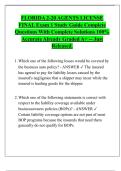
Portage Learning CHEM 121 Final Exam Study Guide –
Questions and Answers | Fall 2025/2026 Update |
100% Correct
I. Standard Physical Constants and
Conversion Factors
For calculation-intensive sections of the examination, students are advised to utilize the
following standard values and conversion factors, ensuring all intermediate calculations
are performed with appropriate precision before rounding the final answer based on
significant figure rules.
Table 1: Standard Physical Constants and Conversion Factors
Constant/Factor Value Unit
Gas Constant (R) 0.08206 L \cdot atm / (mol \cdot K)
Avogadro’s Number (N_A) 6.022 \times 10^{23} particles / mol
Standard Temperature and 0^\circ C and 1.00 atm N/A
Pressure (STP)
Standard Molar Volume at STP 22.4 L / mol
Conversion: 1 \text{ atm} 760 mmHg or torr
Conversion: 1 \text{ pound} 453.6 grams
Conversion: 1 \text{ L} 1.06 quarts \ (qt)
Conversion: 0^\circ C 273.15 K
Note: Atomic masses utilized in calculations are rounded to the nearest tenth of a gram
per mole (g/mol), unless otherwise specified.
II. CHEM 121 Comprehensive Final Examination
(Q1–Q65)
,A. Foundational Concepts and Atomic Structure
1. A laboratory measurement of 3.56 \text{ grams} is divided by 1.8 \times 10^{-2} \text{ mL}
and then added to 9.50 \text{ g/mL}. Report the final answer, ensuring correct application
of significant figure rules for combined operations.
2. A sample of gas is measured at 345 \text{ Kelvin}. What is this temperature in degrees
Celsius (\circ C) and degrees Fahrenheit (\circ F)?
3. The density of a newly synthesized liquid is 1.25 \text{ g/mL}. Calculate the volume, in
quarts, that a 250.0 \text{ g} sample of this liquid would occupy.
4. Determine the number of protons, neutrons, and electrons in the iron(II) ion,
\text{Fe}^{2+}, assuming the most common isotope of iron (\text{Fe}-56).
5. Write the ground state electron configuration for the element Chromium (\text{Cr}, Z=24).
Explain why this configuration deviates from the expected Aufbau principle order.
6. Which of the following sets of quantum numbers (n, l, m_l, m_s) describes a permissible
orbital designation? a) (3, 3, -2, +1/2) b) (2, 1, 0, -1/2) c) (4, 2, -3, +1/2) d) (1, 1, 0, -1/2)
7. An electron is excited to the n=4 energy level. Calculate the energy, in Joules, emitted
when this electron transitions back to the ground state (n=1) in a hydrogen atom.
(Rydberg constant R_H = 2.18 \times 10^{-18} J).
B. Periodic Trends and Chemical Bonding
1. Explain the variation in atomic radius observed when moving from left to right across
Period 3 (Na to Ar) and when moving down Group 1 (Li to Cs).
2. Predict which element in each pair has the higher first ionization energy and provide a
physical justification: a) Potassium (\text{K}) or Bromine (\text{Br}) b) Fluorine (\text{F})
or Chlorine (\text{Cl})
3. Compare the relative size of a neutral sodium atom (\text{Na}) and its corresponding ion
(\text{Na}^+). Provide a structural explanation for this size change.
4. Provide the systematic chemical name for the following compounds: a)
\text{Mg}(\text{OH})_2 b) \text{Fe}(\text{NO}_3)_3 c) \text{P}_2\text{O}_5
5. Write the chemical formula for the following compounds: a) Aluminum carbonate b)
Hydrofluoric acid c) Ammonium sulfate
6. Draw the Lewis electron structure for the chlorate ion (\text{ClO}_3^-) and use VSEPR
theory to determine the electron geometry and the molecular geometry around the
central chlorine atom.
7. Determine the molecular geometry and predict the polarity (polar or nonpolar) of the sulfur
tetrafluoride molecule (\text{SF}_4).
8. What are the electron geometry and molecular geometry of Xenon Tetrafluoride
(\text{XeF}_4)?
9. Arrange the following substances in order of increasing boiling point and justify the
ranking based on the intermolecular forces (IMFs) present: propane
(\text{C}_3\text{H}_8), dimethyl ether (\text{CH}_3\text{OCH}_3), and water
(\text{H}_2\text{O}).
C. Quantitative Chemistry: Stoichiometry and Solutions
1. Calculate the molar mass of magnesium phosphate, \text{Mg}_3(\text{PO}_4)_2.
, 2. A compound is analyzed and found to contain 85.6\% Carbon (\text{C}) and 14.4\%
Hydrogen (\text{H}) by mass. Determine the empirical formula of the compound.
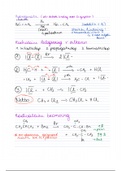
3. Balance the following chemical equation using the smallest whole-number coefficients
and identify the reaction type:
4. Balance the following oxidation-reduction reaction in an acidic solution:
5. Write the complete ionic and net ionic equations for the reaction between aqueous silver
nitrate (\text{AgNO}_3) and aqueous potassium phosphate (\text{K}_3\text{PO}_4).
6. How many grams of potassium hydroxide (\text{KOH}) are required to prepare 400.0 \text{
mL} of a 0.550 \text{ M} solution?
7. A chemical reaction produces 5.02 \times 10^{24} molecules of water. Calculate the
number of moles of water produced.
8. Consider the reaction between aluminum oxide (\text{Al}_2\text{O}_3) and carbon
(\text{C}): If 60.0 \text{ g} of \text{Al}_2\text{O}_3 and 30.0 \text{ g} of \text{C} are mixed,
determine the limiting reactant.
9. Using the masses and reaction from Question 24, calculate the maximum theoretical yield
of aluminum (\text{Al}) in grams.
10.If the actual yield of aluminum in the experiment described in Question 24 was 25.5 \text{
g}, calculate the percent yield of the reaction.
11.Calculate the molarity of a commercial nitric acid solution (\text{HNO}_3) if it has a density
of 1.42 \text{ g/cm}^3 and is 70.0\% \text{HNO}_3 by mass.
12.A stock solution of 1.50 \text{ M } \text{NaOH} is available. What volume of this stock
solution is required to prepare 300. \text{ mL} of a 0.200 \text{ M } \text{NaOH} solution?
13.A solution is prepared by dissolving 125.6 \text{ g} of sodium fluoride (\text{NaF}) in water
to make 1.00 \text{ L} of solution. If 180. \text{ mL} of this solution is taken and diluted to a
final volume of 500. \text{ mL}, calculate the molarity of the resulting diluted solution.
14.Calculate the final concentration, in molarity, of chloride ions (\text{Cl}^-) if 100. \text{ mL}
of 2.00 \text{ M } \text{KCl} is mixed with 50.0 \text{ mL} of 1.50 \text{ M } \text{CaCl}_2.
Assume volumes are additive.
D. Gases and Thermochemistry
1. A sample of chlorine gas (\text{Cl}_2) is loaded into a 0.25 \text{ L} container at STP.
Calculate the mass of \text{Cl}_2 gas, in grams, contained in the bottle.
2. A rigid 5.00 \text{ L} chamber contains 1.28 \text{ grams} of solid carbon dioxide (dry ice)
that completely sublimes into the gas phase. If the chamber is maintained at 35.1^\circ
C, what is the final pressure inside the chamber in atmospheres?
3. Calculate the molar mass of an unknown gas if 3.50 \text{ g} of the gas occupies 1.50
\text{ L} at 745 \text{ torr} and 25.0^\circ C.
4. Compare the rates of effusion for butane gas (\text{C}_4\text{H}_{10}) and iodine gas
(\text{I}_2) using Graham's Law. Which gas effuses faster and by what factor?
5. The First Law of Thermodynamics states that the change in internal energy (\Delta E) of a
system is equal to the heat flow (q) plus the work done (w). If a system absorbs 250 \text{
J} of heat and performs 120 \text{ J} of work on the surroundings, calculate \Delta E for
the system.
6. Calculate the heat (q) required to raise the temperature of 50.0 \text{ g} of water from
25.0^\circ C to 55.0^\circ C. (Specific heat capacity of water is 4.184 \text{ J/g} \cdot ^\circ
C).
7. Explain the two conditions of temperature and pressure under which a real gas deviates
Questions and Answers | Fall 2025/2026 Update |
100% Correct
I. Standard Physical Constants and
Conversion Factors
For calculation-intensive sections of the examination, students are advised to utilize the
following standard values and conversion factors, ensuring all intermediate calculations
are performed with appropriate precision before rounding the final answer based on
significant figure rules.
Table 1: Standard Physical Constants and Conversion Factors
Constant/Factor Value Unit
Gas Constant (R) 0.08206 L \cdot atm / (mol \cdot K)
Avogadro’s Number (N_A) 6.022 \times 10^{23} particles / mol
Standard Temperature and 0^\circ C and 1.00 atm N/A
Pressure (STP)
Standard Molar Volume at STP 22.4 L / mol
Conversion: 1 \text{ atm} 760 mmHg or torr
Conversion: 1 \text{ pound} 453.6 grams
Conversion: 1 \text{ L} 1.06 quarts \ (qt)
Conversion: 0^\circ C 273.15 K
Note: Atomic masses utilized in calculations are rounded to the nearest tenth of a gram
per mole (g/mol), unless otherwise specified.
II. CHEM 121 Comprehensive Final Examination
(Q1–Q65)
,A. Foundational Concepts and Atomic Structure
1. A laboratory measurement of 3.56 \text{ grams} is divided by 1.8 \times 10^{-2} \text{ mL}
and then added to 9.50 \text{ g/mL}. Report the final answer, ensuring correct application
of significant figure rules for combined operations.
2. A sample of gas is measured at 345 \text{ Kelvin}. What is this temperature in degrees
Celsius (\circ C) and degrees Fahrenheit (\circ F)?
3. The density of a newly synthesized liquid is 1.25 \text{ g/mL}. Calculate the volume, in
quarts, that a 250.0 \text{ g} sample of this liquid would occupy.
4. Determine the number of protons, neutrons, and electrons in the iron(II) ion,
\text{Fe}^{2+}, assuming the most common isotope of iron (\text{Fe}-56).
5. Write the ground state electron configuration for the element Chromium (\text{Cr}, Z=24).
Explain why this configuration deviates from the expected Aufbau principle order.
6. Which of the following sets of quantum numbers (n, l, m_l, m_s) describes a permissible
orbital designation? a) (3, 3, -2, +1/2) b) (2, 1, 0, -1/2) c) (4, 2, -3, +1/2) d) (1, 1, 0, -1/2)
7. An electron is excited to the n=4 energy level. Calculate the energy, in Joules, emitted
when this electron transitions back to the ground state (n=1) in a hydrogen atom.
(Rydberg constant R_H = 2.18 \times 10^{-18} J).
B. Periodic Trends and Chemical Bonding
1. Explain the variation in atomic radius observed when moving from left to right across
Period 3 (Na to Ar) and when moving down Group 1 (Li to Cs).
2. Predict which element in each pair has the higher first ionization energy and provide a
physical justification: a) Potassium (\text{K}) or Bromine (\text{Br}) b) Fluorine (\text{F})
or Chlorine (\text{Cl})
3. Compare the relative size of a neutral sodium atom (\text{Na}) and its corresponding ion
(\text{Na}^+). Provide a structural explanation for this size change.
4. Provide the systematic chemical name for the following compounds: a)
\text{Mg}(\text{OH})_2 b) \text{Fe}(\text{NO}_3)_3 c) \text{P}_2\text{O}_5
5. Write the chemical formula for the following compounds: a) Aluminum carbonate b)
Hydrofluoric acid c) Ammonium sulfate
6. Draw the Lewis electron structure for the chlorate ion (\text{ClO}_3^-) and use VSEPR
theory to determine the electron geometry and the molecular geometry around the
central chlorine atom.
7. Determine the molecular geometry and predict the polarity (polar or nonpolar) of the sulfur
tetrafluoride molecule (\text{SF}_4).
8. What are the electron geometry and molecular geometry of Xenon Tetrafluoride
(\text{XeF}_4)?
9. Arrange the following substances in order of increasing boiling point and justify the
ranking based on the intermolecular forces (IMFs) present: propane
(\text{C}_3\text{H}_8), dimethyl ether (\text{CH}_3\text{OCH}_3), and water
(\text{H}_2\text{O}).
C. Quantitative Chemistry: Stoichiometry and Solutions
1. Calculate the molar mass of magnesium phosphate, \text{Mg}_3(\text{PO}_4)_2.
, 2. A compound is analyzed and found to contain 85.6\% Carbon (\text{C}) and 14.4\%
Hydrogen (\text{H}) by mass. Determine the empirical formula of the compound.
3. Balance the following chemical equation using the smallest whole-number coefficients
and identify the reaction type:
4. Balance the following oxidation-reduction reaction in an acidic solution:
5. Write the complete ionic and net ionic equations for the reaction between aqueous silver
nitrate (\text{AgNO}_3) and aqueous potassium phosphate (\text{K}_3\text{PO}_4).
6. How many grams of potassium hydroxide (\text{KOH}) are required to prepare 400.0 \text{
mL} of a 0.550 \text{ M} solution?
7. A chemical reaction produces 5.02 \times 10^{24} molecules of water. Calculate the
number of moles of water produced.
8. Consider the reaction between aluminum oxide (\text{Al}_2\text{O}_3) and carbon
(\text{C}): If 60.0 \text{ g} of \text{Al}_2\text{O}_3 and 30.0 \text{ g} of \text{C} are mixed,
determine the limiting reactant.
9. Using the masses and reaction from Question 24, calculate the maximum theoretical yield
of aluminum (\text{Al}) in grams.
10.If the actual yield of aluminum in the experiment described in Question 24 was 25.5 \text{
g}, calculate the percent yield of the reaction.
11.Calculate the molarity of a commercial nitric acid solution (\text{HNO}_3) if it has a density
of 1.42 \text{ g/cm}^3 and is 70.0\% \text{HNO}_3 by mass.
12.A stock solution of 1.50 \text{ M } \text{NaOH} is available. What volume of this stock
solution is required to prepare 300. \text{ mL} of a 0.200 \text{ M } \text{NaOH} solution?
13.A solution is prepared by dissolving 125.6 \text{ g} of sodium fluoride (\text{NaF}) in water
to make 1.00 \text{ L} of solution. If 180. \text{ mL} of this solution is taken and diluted to a
final volume of 500. \text{ mL}, calculate the molarity of the resulting diluted solution.
14.Calculate the final concentration, in molarity, of chloride ions (\text{Cl}^-) if 100. \text{ mL}
of 2.00 \text{ M } \text{KCl} is mixed with 50.0 \text{ mL} of 1.50 \text{ M } \text{CaCl}_2.
Assume volumes are additive.
D. Gases and Thermochemistry
1. A sample of chlorine gas (\text{Cl}_2) is loaded into a 0.25 \text{ L} container at STP.
Calculate the mass of \text{Cl}_2 gas, in grams, contained in the bottle.
2. A rigid 5.00 \text{ L} chamber contains 1.28 \text{ grams} of solid carbon dioxide (dry ice)
that completely sublimes into the gas phase. If the chamber is maintained at 35.1^\circ
C, what is the final pressure inside the chamber in atmospheres?
3. Calculate the molar mass of an unknown gas if 3.50 \text{ g} of the gas occupies 1.50
\text{ L} at 745 \text{ torr} and 25.0^\circ C.
4. Compare the rates of effusion for butane gas (\text{C}_4\text{H}_{10}) and iodine gas
(\text{I}_2) using Graham's Law. Which gas effuses faster and by what factor?
5. The First Law of Thermodynamics states that the change in internal energy (\Delta E) of a
system is equal to the heat flow (q) plus the work done (w). If a system absorbs 250 \text{
J} of heat and performs 120 \text{ J} of work on the surroundings, calculate \Delta E for
the system.
6. Calculate the heat (q) required to raise the temperature of 50.0 \text{ g} of water from
25.0^\circ C to 55.0^\circ C. (Specific heat capacity of water is 4.184 \text{ J/g} \cdot ^\circ
C).
7. Explain the two conditions of temperature and pressure under which a real gas deviates