

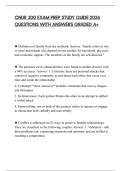
CNUR 300 EXAM PREP STUDY GUIDE 2026
QUESTIONS WITH ANSWERS GRADED A+
◉ Definition of family from the textbook: Answer: "family refers to two
or more individuals who depend on one another for emotional, physical,
and economic support. The members of the family are self-directed."
◉ The presence of (4) characteristics were found to predict divorce with
a 94% accuracy: Answer: 1. Criticism: these are personal attacks that
consist of negative comments, to and about each other, that occur over
time and erode the relationship
2. Contempt: *most corrosive* includes comments that convey disgust
and disrespect
3. Defensiveness: Each partner blames the other in an attempt to deflect
a verbal attack
4. Stonewalling: one or both of the partners refuse to interact or engage
in interaction both verbally and nonverbally
◉ Conflict is addressed in (3) ways in positive, healthy relationships.
They are classified as the following couples: Answer: 1. Validators - talk
their problems out, expressing emotions and opinions, and are skilled at
reaching a compromise
,2. Volatiles - two partners who view each other as equals, as they engage
in loud, passionate, explosive interactions that are balanced by a caring,
loving, relationship
3. Avoiders - simply agree not to engage in conflicts, thus minimizing
the corrosive effects of negative conflict resolution
◉ What are the (4) approach to family nursing ( in order ) Answer: 1.
Family as the context for individual development
2. Family as a client
3. Family as a system
4. Family as a component of society
◉ Describe "family as the context for individual development" approach
Answer: -individual is the foreground and the family is the background
-family serves as a context for the individual as either a resource or a
stressor to the individual's health and illness
-nurse may ask: "how will you provide for child care when you have
back surgery?"
◉ Describe "family as the client" approach Answer: -centers on
assessment of all family members
-family nurse is interested in the way all the family members by the
health event of one family member
-all family members are in the foreground
,-family is seen as the sum of all individual family members
-nurse assesses and provides healthcare for all individual members of the
family
-nurse may ask "how has your diagnosis affected other members of the
family?"
◉ Describe "family as a system" approach Answer: -family as a whole is
the client
-interactional system where the whole is more than the sum of it's parts
-interactions between family members become the target for nursing
interventions
-focus on the individual and family simultaneously
-emphasis on interaction between family members
-nurse may ask "what has changed between you and your spouse since
your child has been diagnosed with juvenile diabetes?"
◉ Describe "family as a component of society" Answer: -family is
viewed as one of the many institutions within society
-family is a basic/primary unit of society, and part of the larger system of
society
-family interacts with other institutions to exchange, receive, or give
communication and services
-nurse may ask: "what issues has the family been experiencing since you
made the school aware of your son's diagnosis of HIV?"
, ◉ what is a "nuclear dyad" Answer: married couple, no children
◉ nuclear fam? Answer: husband, wife, children (may or may not be
married)
◉ binuclear family? Answer: two postdivorce families with children as
members of both
◉ Commune? Answer: group of men, women, and children
◉ Cohabitation? Answer: domestic partners, a man and a woman
sharing a household
◉ role strain Answer: lack of competence in role performance
◉ family rituals vs family routines Answer: -Family Rituals: formal
celebrations, traditions, and religious observances with *symbolic
meanings* (eg barmitzfas, weddings, and funerals)
-Family Routines: *patterned behaviors* or interactions that closely link
to daily or regular activities (eg mealtimes or treatment of guests)
◉ The reason co-habitating has increased so much with unmarried
couples: Answer: -increased uncertainty about stability of marriage
QUESTIONS WITH ANSWERS GRADED A+
◉ Definition of family from the textbook: Answer: "family refers to two
or more individuals who depend on one another for emotional, physical,
and economic support. The members of the family are self-directed."
◉ The presence of (4) characteristics were found to predict divorce with
a 94% accuracy: Answer: 1. Criticism: these are personal attacks that
consist of negative comments, to and about each other, that occur over
time and erode the relationship
2. Contempt: *most corrosive* includes comments that convey disgust
and disrespect
3. Defensiveness: Each partner blames the other in an attempt to deflect
a verbal attack
4. Stonewalling: one or both of the partners refuse to interact or engage
in interaction both verbally and nonverbally
◉ Conflict is addressed in (3) ways in positive, healthy relationships.
They are classified as the following couples: Answer: 1. Validators - talk
their problems out, expressing emotions and opinions, and are skilled at
reaching a compromise
,2. Volatiles - two partners who view each other as equals, as they engage
in loud, passionate, explosive interactions that are balanced by a caring,
loving, relationship
3. Avoiders - simply agree not to engage in conflicts, thus minimizing
the corrosive effects of negative conflict resolution
◉ What are the (4) approach to family nursing ( in order ) Answer: 1.
Family as the context for individual development
2. Family as a client
3. Family as a system
4. Family as a component of society
◉ Describe "family as the context for individual development" approach
Answer: -individual is the foreground and the family is the background
-family serves as a context for the individual as either a resource or a
stressor to the individual's health and illness
-nurse may ask: "how will you provide for child care when you have
back surgery?"
◉ Describe "family as the client" approach Answer: -centers on
assessment of all family members
-family nurse is interested in the way all the family members by the
health event of one family member
-all family members are in the foreground
,-family is seen as the sum of all individual family members
-nurse assesses and provides healthcare for all individual members of the
family
-nurse may ask "how has your diagnosis affected other members of the
family?"
◉ Describe "family as a system" approach Answer: -family as a whole is
the client
-interactional system where the whole is more than the sum of it's parts
-interactions between family members become the target for nursing
interventions
-focus on the individual and family simultaneously
-emphasis on interaction between family members
-nurse may ask "what has changed between you and your spouse since
your child has been diagnosed with juvenile diabetes?"
◉ Describe "family as a component of society" Answer: -family is
viewed as one of the many institutions within society
-family is a basic/primary unit of society, and part of the larger system of
society
-family interacts with other institutions to exchange, receive, or give
communication and services
-nurse may ask: "what issues has the family been experiencing since you
made the school aware of your son's diagnosis of HIV?"
, ◉ what is a "nuclear dyad" Answer: married couple, no children
◉ nuclear fam? Answer: husband, wife, children (may or may not be
married)
◉ binuclear family? Answer: two postdivorce families with children as
members of both
◉ Commune? Answer: group of men, women, and children
◉ Cohabitation? Answer: domestic partners, a man and a woman
sharing a household
◉ role strain Answer: lack of competence in role performance
◉ family rituals vs family routines Answer: -Family Rituals: formal
celebrations, traditions, and religious observances with *symbolic
meanings* (eg barmitzfas, weddings, and funerals)
-Family Routines: *patterned behaviors* or interactions that closely link
to daily or regular activities (eg mealtimes or treatment of guests)
◉ The reason co-habitating has increased so much with unmarried
couples: Answer: -increased uncertainty about stability of marriage

