Understanding Qualitative Research and Ethnomethodology
Chapter 1 – Qualitative Methods in Social Research
With research, consideration of methods is relevant ‘from beginning to end’. In qualitative research,
‘methods’ should be treated as heuristic possibilities that need to be adapted to local circumstances
and project-specific purposes. ‘Research’ refers to all kinds of knowledge production that involve the
inspection of empirical evidence. ‘Social research’ focusses on phenomena related to people living
together. Here, with regards to ‘social science’, research without a strictly scientific purpose.
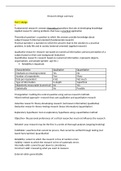
Social research involves a dialogue between ideas and evidence.
o Analytic frames are deduced from general ideas and specified for the topic of the research.
o Images are inductively constructed from the evidence, in the terms provided by an analytic
framework.
These are combined in a ‘double fitting’
process (retroduction) to construct a
representation of social life.
Figure 1. A simple model of social research (Ragin’s model)
Based on their general goals and specific research strategies, three types of social research are
distinguished.
1. Qualitative: to study common properties, small number of cases, many aspects are taken into
account.
2. Comparative: diversity (similarities and differences), moderate number of cases,
comprehensive (but not as much as qualitative).
3. Quantitative: to identify patterns of covariation, large number of cases, small number of
features are studied.
For qualitative research, many more features can be added: the phenomena of interest are not
countable, it is based on an ‘interpretative’ approach and reporting findings in terms of a typology or
even a contrast.
Qualitative research offers a wide variety of styles (methods, aims, approaches).
o Interview studies: interviewing a number of individuals (one-to-one or a group discussion) in
a (non-)structured way to collect their (extensive) ideas and experiences. It is a minimal
investment in terms of time and social effort to collect a large amount of on-target
information.
o Using documents: studying documents of various kinds, any preservable record of text,
image, sound, or a combination of these; naturalistic of producing his/her own records.
o Ethnography: observation of natural situations while minimizing the impact of the
researcher’s presence on their subjects’ actions (‘fieldwork’ or ‘participant observation’). It
takes a lot of time, capacity to interact with various people and the management of an
ambiguous role.
1
, Ways in which qualitative researchers conceive the analytic function of the evidence they collect, can
be distinguished.
o Factist perspective
‘The world out there vs. the claims made about it.’ The research material is only studied so far as
it can be used as evidence for happenings and conditions elsewhere (a reality outside the
research), therefore the characteristics of language and of the situation are only taken into
account as possible noise in the channel. ( Interview materials as a resource.)
o Specimen perspective
‘Research material is a part of the reality being studied.’ The focus may be on properties as the
actual interaction, like the evasion of questions of the way stories are told. ( Interview
materials as a topic.)
A closely related issue concerns the theoretical conception of the phenomena which are the object of
the research project’s interests. Often, the object and its theoretical features are not clearly defined
at the start, but ‘are allowed to emerge’ in the research process. However, quite often no clear and
consistent theoretical object* is defined in any phase of the project research gets based on some
current version of common sense.
* The sense of a theoretical object depends on the set of ideas in which it is embedded: a theoretical
framework.
What is expected of empirical social research can be summarized as: surmounting the ‘limitations’ of
the localized and time-bound character of the evidence, that is general knowledge, and at the same
time warranting such knowledge on the basis of such ‘limited’ evidence.
Documentation is a basic operation that allows the dialogue of ideas and evidence to take place and
it is only through the transformation into documents that research can aspire to produce knowledge
of wider relevance: documentation allows the research to be ‘travel’ to/between places.
In qualitative research, ideas and evidence should be treated as ‘mutable’ in an analytic sense:
changing in meaning as the dialogue proceeds. In contrast to quantitative research, where ideas and
evidence is a ‘given’.
Qualitative research is exploratory, adventurous and its methods should therefore be used in
a flexible way. The topic(s) of the research, and the questions asked about it or them, should
be allowed to change as the researcher is learning what is at stake in the exanimated field.
Chapter 2 – Ethnomethodology’s Perspective
Ethnomethodology (EM) is a special kind of social inquiry, dedicated to explicating the ways in which
collectivity members create and maintain a sense of order and intelligibility in social life. Facts are
treated as accomplishments – seen as being produced in and through members’ practical activities.
For sociology, and social research in general, the interest in the factual status of ‘social facts’
is limited to technical and practical issues of getting those facts right, in a methodologically
sound way, and at a reasonable costs.
By following professional practices in detail, ethnomethodology can do two things at the same time.
1. Show how a professional practice is embedded in quite ordinary competences, and;
2. Elaborate how it is special, in the sense of being part of a particular local version of a more
generalized professional culture.
2
Chapter 1 – Qualitative Methods in Social Research
With research, consideration of methods is relevant ‘from beginning to end’. In qualitative research,
‘methods’ should be treated as heuristic possibilities that need to be adapted to local circumstances
and project-specific purposes. ‘Research’ refers to all kinds of knowledge production that involve the
inspection of empirical evidence. ‘Social research’ focusses on phenomena related to people living
together. Here, with regards to ‘social science’, research without a strictly scientific purpose.
Social research involves a dialogue between ideas and evidence.
o Analytic frames are deduced from general ideas and specified for the topic of the research.
o Images are inductively constructed from the evidence, in the terms provided by an analytic
framework.
These are combined in a ‘double fitting’
process (retroduction) to construct a
representation of social life.
Figure 1. A simple model of social research (Ragin’s model)
Based on their general goals and specific research strategies, three types of social research are
distinguished.
1. Qualitative: to study common properties, small number of cases, many aspects are taken into
account.
2. Comparative: diversity (similarities and differences), moderate number of cases,
comprehensive (but not as much as qualitative).
3. Quantitative: to identify patterns of covariation, large number of cases, small number of
features are studied.
For qualitative research, many more features can be added: the phenomena of interest are not
countable, it is based on an ‘interpretative’ approach and reporting findings in terms of a typology or
even a contrast.
Qualitative research offers a wide variety of styles (methods, aims, approaches).
o Interview studies: interviewing a number of individuals (one-to-one or a group discussion) in
a (non-)structured way to collect their (extensive) ideas and experiences. It is a minimal
investment in terms of time and social effort to collect a large amount of on-target
information.
o Using documents: studying documents of various kinds, any preservable record of text,
image, sound, or a combination of these; naturalistic of producing his/her own records.
o Ethnography: observation of natural situations while minimizing the impact of the
researcher’s presence on their subjects’ actions (‘fieldwork’ or ‘participant observation’). It
takes a lot of time, capacity to interact with various people and the management of an
ambiguous role.
1
, Ways in which qualitative researchers conceive the analytic function of the evidence they collect, can
be distinguished.
o Factist perspective
‘The world out there vs. the claims made about it.’ The research material is only studied so far as
it can be used as evidence for happenings and conditions elsewhere (a reality outside the
research), therefore the characteristics of language and of the situation are only taken into
account as possible noise in the channel. ( Interview materials as a resource.)
o Specimen perspective
‘Research material is a part of the reality being studied.’ The focus may be on properties as the
actual interaction, like the evasion of questions of the way stories are told. ( Interview
materials as a topic.)
A closely related issue concerns the theoretical conception of the phenomena which are the object of
the research project’s interests. Often, the object and its theoretical features are not clearly defined
at the start, but ‘are allowed to emerge’ in the research process. However, quite often no clear and
consistent theoretical object* is defined in any phase of the project research gets based on some
current version of common sense.
* The sense of a theoretical object depends on the set of ideas in which it is embedded: a theoretical
framework.
What is expected of empirical social research can be summarized as: surmounting the ‘limitations’ of
the localized and time-bound character of the evidence, that is general knowledge, and at the same
time warranting such knowledge on the basis of such ‘limited’ evidence.
Documentation is a basic operation that allows the dialogue of ideas and evidence to take place and
it is only through the transformation into documents that research can aspire to produce knowledge
of wider relevance: documentation allows the research to be ‘travel’ to/between places.
In qualitative research, ideas and evidence should be treated as ‘mutable’ in an analytic sense:
changing in meaning as the dialogue proceeds. In contrast to quantitative research, where ideas and
evidence is a ‘given’.
Qualitative research is exploratory, adventurous and its methods should therefore be used in
a flexible way. The topic(s) of the research, and the questions asked about it or them, should
be allowed to change as the researcher is learning what is at stake in the exanimated field.
Chapter 2 – Ethnomethodology’s Perspective
Ethnomethodology (EM) is a special kind of social inquiry, dedicated to explicating the ways in which
collectivity members create and maintain a sense of order and intelligibility in social life. Facts are
treated as accomplishments – seen as being produced in and through members’ practical activities.
For sociology, and social research in general, the interest in the factual status of ‘social facts’
is limited to technical and practical issues of getting those facts right, in a methodologically
sound way, and at a reasonable costs.
By following professional practices in detail, ethnomethodology can do two things at the same time.
1. Show how a professional practice is embedded in quite ordinary competences, and;
2. Elaborate how it is special, in the sense of being part of a particular local version of a more
generalized professional culture.
2