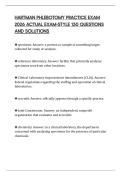
HARTMAN PHLEBOTOMY PRACTICE EXAM 150
QUESTIONS AND ANSWERS ALREADY GRADED
A+
Introduction
This practice examination replicates the scope, difficulty, and format of the national
phlebotomy certification tests referenced in Hartman’s core curriculum. The 150-item
set covers venipuncture technique, specimen collection and handling, patient
identification and communication, safety/infection control, medical terminology,
equipment selection, and legal/ethical responsibilities. All items are original and
mapped to 2024 standards (CLSI, OSHA, Joint Commission, NAACLS) to support
mastery-level performance.
General Instructions
• Choose the ONE best answer for each scenario.
• Each correct response is supported by a concise rationale citing current clinical
guidelines.
• Total length: 150 questions (all scored).
• Passing thresholds vary by certifying body; aim for ≥78 %.
Exam Items
Question 1
A phlebotomist observes a large hematoma forming during a routine venipuncture. The
first action is to:
A. Apply firm pressure for 2 min and continue draw
B. Immediately remove the needle and apply pressure
C. Redirect the needle to a deeper vein
D. Finish the draw quickly then apply ice
Answer: B. Immediately remove the needle and apply pressure
Solution: Continuing (A) or redirecting (C) worsens bleeding. Prompt removal and
direct pressure minimize hematoma expansion.
pg. 1
,Question 2
Which tube is drawn first when collecting blood cultures?
A. Lavender-top
B. Light-blue top
C. Yellow-top (SPS) blood-culture bottle
D. Red-top plain tube
Answer: C. Yellow-top (SPS) blood-culture bottle
Solution: CLSI M47 mandates blood-culture bottles first to reduce contamination risk;
additives in other tubes inhibit organism growth.
Question 3
The tourniquet should remain in place no longer than:
A. 30 s
B. 1 min
C. 2 min
D. 5 min
Answer: B. 1 min
Solution: Prolonged venous stasis (>1 min) falsely elevates analytes such as potassium
and lactate.
Question 4
A patient states, “I always faint when I get blood drawn.” The phlebotomist should:
A. Proceed with a 21-gauge butterfly while patient supine
B. Perform the draw with the patient seated and talking
C. Ask the patient to lie down and employ distraction techniques
D. Refuse to draw and request physician presence
Answer: C. Ask the patient to lie down and employ distraction techniques
Solution: Supine position reduces vasovagal syncope risk; distraction lowers anxiety.
Refusal (D) is unnecessary.
Question 5
Which angle is recommended for routine venipuncture with a straight needle?
A. 10°
B. 30°
C. 45°
D. 90°
pg. 2
,Answer: B. 30°
Solution: 15–30° allows smooth entry into the lumen without transfixing the posterior
wall.
Question 6
An evacuated tube does not fill. The phlebotomist checks for:
A. Tourniquet too tight
B. Needle bevel against vein wall
C. Wrong tube size
D. Alcohol still wet
Answer: B. Needle bevel against vein wall
Solution: Bevel occlusion prevents blood entry; repositioning restores flow. Wet alcohol
(D) causes hemolysis but not non-fill.
Question 7
Which site is preferred for capillary glucose testing in an 8-month-old?
A. Index finger tip
B. Great toe pulp
C. Lateral plantar heel
D. Posterior ear lobe
Answer: C. Lateral plantar heel
Solution: CLSI GP41-A6 recommends lateral heel in infants <1 yr to avoid digital nerve
injury.
Question 8
After a needlestick, the employee must:
A. Apply iodine and finish shift
B. Report to supervisor immediately and seek post-exposure evaluation
C. Wait until end of shift to document
D. Squeeze wound and apply saliva
Answer: B. Report to supervisor immediately and seek post-exposure evaluation
Solution: OSHA 1910.1030 mandates immediate washing, reporting, and medical
follow-up within 2 h ideally.
Question 9
Which additive prevents glycolysis in a gray-top tube?
A. Sodium fluoride
pg. 3
, B. Heparin
C. EDTA
D. Citrate
Answer: A. Sodium fluoride
Solution: Fluoride inhibits enolase, preserving glucose for up to 24 h.
Question 10
The correct order of draw for a basic metabolic panel and CBC is:
A. Red, lavender, light-blue
B. Light-blue, red, lavender
C. Lavender, red, light-blue
D. Light-blue, lavender, red
Answer: B. Light-blue, red, lavender
Solution: CLSI H3-A6 order: blood cultures → coagulation (blue) → serum (red) → EDTA
(lavender) to prevent additive carryover.
Question 11
A patient’s IV line is infusing D5W in the right arm. The phlebotomist should:
A. Draw below the IV site in the same vein
B. Use the left arm if possible
C. Turn off the IV for 5 min then draw above the site
D. Collect from a fingerstick on the right hand
Answer: B. Use the left arm if possible
Solution: Infusate dilutes analytes; opposite arm avoids contamination. Turning off IV
(C) requires physician order.
Question 12
Which tube must be inverted 8–10 times immediately after collection?
A. Red-top plain
B. Light-blue citrate
C. Lavender EDTA
D. All additive tubes
Answer: D. All additive tubes
Solution: Gentle inversion ensures proper additive-to-blood ratio and prevents clot
formation in anticoagulant tubes.
pg. 4
QUESTIONS AND ANSWERS ALREADY GRADED
A+
Introduction
This practice examination replicates the scope, difficulty, and format of the national
phlebotomy certification tests referenced in Hartman’s core curriculum. The 150-item
set covers venipuncture technique, specimen collection and handling, patient
identification and communication, safety/infection control, medical terminology,
equipment selection, and legal/ethical responsibilities. All items are original and
mapped to 2024 standards (CLSI, OSHA, Joint Commission, NAACLS) to support
mastery-level performance.
General Instructions
• Choose the ONE best answer for each scenario.
• Each correct response is supported by a concise rationale citing current clinical
guidelines.
• Total length: 150 questions (all scored).
• Passing thresholds vary by certifying body; aim for ≥78 %.
Exam Items
Question 1
A phlebotomist observes a large hematoma forming during a routine venipuncture. The
first action is to:
A. Apply firm pressure for 2 min and continue draw
B. Immediately remove the needle and apply pressure
C. Redirect the needle to a deeper vein
D. Finish the draw quickly then apply ice
Answer: B. Immediately remove the needle and apply pressure
Solution: Continuing (A) or redirecting (C) worsens bleeding. Prompt removal and
direct pressure minimize hematoma expansion.
pg. 1
,Question 2
Which tube is drawn first when collecting blood cultures?
A. Lavender-top
B. Light-blue top
C. Yellow-top (SPS) blood-culture bottle
D. Red-top plain tube
Answer: C. Yellow-top (SPS) blood-culture bottle
Solution: CLSI M47 mandates blood-culture bottles first to reduce contamination risk;
additives in other tubes inhibit organism growth.
Question 3
The tourniquet should remain in place no longer than:
A. 30 s
B. 1 min
C. 2 min
D. 5 min
Answer: B. 1 min
Solution: Prolonged venous stasis (>1 min) falsely elevates analytes such as potassium
and lactate.
Question 4
A patient states, “I always faint when I get blood drawn.” The phlebotomist should:
A. Proceed with a 21-gauge butterfly while patient supine
B. Perform the draw with the patient seated and talking
C. Ask the patient to lie down and employ distraction techniques
D. Refuse to draw and request physician presence
Answer: C. Ask the patient to lie down and employ distraction techniques
Solution: Supine position reduces vasovagal syncope risk; distraction lowers anxiety.
Refusal (D) is unnecessary.
Question 5
Which angle is recommended for routine venipuncture with a straight needle?
A. 10°
B. 30°
C. 45°
D. 90°
pg. 2
,Answer: B. 30°
Solution: 15–30° allows smooth entry into the lumen without transfixing the posterior
wall.
Question 6
An evacuated tube does not fill. The phlebotomist checks for:
A. Tourniquet too tight
B. Needle bevel against vein wall
C. Wrong tube size
D. Alcohol still wet
Answer: B. Needle bevel against vein wall
Solution: Bevel occlusion prevents blood entry; repositioning restores flow. Wet alcohol
(D) causes hemolysis but not non-fill.
Question 7
Which site is preferred for capillary glucose testing in an 8-month-old?
A. Index finger tip
B. Great toe pulp
C. Lateral plantar heel
D. Posterior ear lobe
Answer: C. Lateral plantar heel
Solution: CLSI GP41-A6 recommends lateral heel in infants <1 yr to avoid digital nerve
injury.
Question 8
After a needlestick, the employee must:
A. Apply iodine and finish shift
B. Report to supervisor immediately and seek post-exposure evaluation
C. Wait until end of shift to document
D. Squeeze wound and apply saliva
Answer: B. Report to supervisor immediately and seek post-exposure evaluation
Solution: OSHA 1910.1030 mandates immediate washing, reporting, and medical
follow-up within 2 h ideally.
Question 9
Which additive prevents glycolysis in a gray-top tube?
A. Sodium fluoride
pg. 3
, B. Heparin
C. EDTA
D. Citrate
Answer: A. Sodium fluoride
Solution: Fluoride inhibits enolase, preserving glucose for up to 24 h.
Question 10
The correct order of draw for a basic metabolic panel and CBC is:
A. Red, lavender, light-blue
B. Light-blue, red, lavender
C. Lavender, red, light-blue
D. Light-blue, lavender, red
Answer: B. Light-blue, red, lavender
Solution: CLSI H3-A6 order: blood cultures → coagulation (blue) → serum (red) → EDTA
(lavender) to prevent additive carryover.
Question 11
A patient’s IV line is infusing D5W in the right arm. The phlebotomist should:
A. Draw below the IV site in the same vein
B. Use the left arm if possible
C. Turn off the IV for 5 min then draw above the site
D. Collect from a fingerstick on the right hand
Answer: B. Use the left arm if possible
Solution: Infusate dilutes analytes; opposite arm avoids contamination. Turning off IV
(C) requires physician order.
Question 12
Which tube must be inverted 8–10 times immediately after collection?
A. Red-top plain
B. Light-blue citrate
C. Lavender EDTA
D. All additive tubes
Answer: D. All additive tubes
Solution: Gentle inversion ensures proper additive-to-blood ratio and prevents clot
formation in anticoagulant tubes.
pg. 4