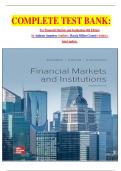
By Anthony Saunders (Author), Marcia Millon Cornett (Author)
Latest Update.
,Solution Manual For
Financial Markets And Institutions 8th Edition Anthony Saunders
Part I
Introduction And Overview Of Financial Markets
Chapter One
Introduction
I. Chapter Outline
1. Why Study Financial Markets And Institutions? Chapter Overview
2. Overview Of Financial Markets
a. Primary Markets Versus Secondary Markets
b. Money Markets Versus Capital Markets
c. Foreign Exchange Markets
d. Derivative Security Markets
e. Financial Market Regulation
3. Overview Of Financial Institutions
a. Unique Economic Functions Performed By Financial Institutions
b. Additional Benefits Fis Provide To Suppliers Of Funds
c. Economic Functions Fis Provide To The Financial System As A Whole
d. Risks Incurred By Financial Institutions
e. Regulation Of Financial Institutions
f. Trends In The United States
4. Globalization Of Financial Markets And Institutions
Appendix 1a: The Financial Crisis: The Failure Of Financial Institutions‘ Specialness
(Available Through Mcgraw Hill‘S Connect. Contact Your Mcgraw Hill Representative
For More Information On Making The Appendix Available To Your Students).
II. Learning Goals
1. Differentiate Between Primary And Secondary Markets.
2. Differentiate Between Money And Capital Markets.
3. Understand What Foreign Exchange Markets Are.
4. Understand What Derivative Securities Markets Are.
5. Distinguish Between The Different Types Of Financial Institutions.
6. Know The Services Financial Institutions Perform.
7. Know The Risks Financial Institutions Face.
8. Appreciate Why Financial Institutions Are Regulated.
9. Recognize That Financial Markets Are Becoming Increasingly Global.
Copyright © 2022 Mcgraw Hill Education. All Rights Reserved. No
Reproduction Or Distribution Without The Prior Written Consent Of Mcgraw
Hill.
1-1
,III. Chapter In Perspective
This Chapter Has Three Major Sections And One Minor Section. The Text
Provides A General Overview Of The Major Types Of U.S. Financial Markets, Focusing
Primarily On Terminology And Descriptions Of The Major Securities, Market Structures
And Regulators. Market Microstructure Is Not Discussed. Foreign Exchange
Transactions Are Also Briefly Introduced. Second, The Chapter Describes The Various
Types Of Financial Institutions And Explains The Risks They Face And The Services
They Provide To Funds‘ Users And Funds‘ Suppliers. The Financial Crisis Is Discussed
And The Impact Of Brexit Is Considered. The Final Section Of The Chapter Provides
Statistics About The Rapid Growth Of Globalization Of Both Markets And Institutions.
An Appendix Covering The Details Of The Financial Crisis And The Government
Intervention Programs, Including The Costs As Of Late 2009, Is Available Through
Mcgraw Hill‘S Connect. Contact Your Mcgraw Hill Representative For More
Information On Making The Appendix Available To Your Students.
IV. Key Concepts And Definitions To Communicate To Students
Financial Markets Primary Markets
Initial Public Offerings (Ipo) Secondary Markets
Derivative Security Liquidity
Money Markets Over-The-Counter (Otc) Markets
Capital Markets Derivative Security Markets
Financial Institutions Direct Transfer
Price Risk Indirect Transfer
Delegated Monitor Asset Transformers
Diversify Economies Of Scale
Enterprise Risk Management (Erm)
Appendix Terms Include:
Tarp Federal Reserve Rescue Efforts
Federal Stimulus Programs American International Group
Fdic Bank Takeovers Other Financial
Initiatives Other Housing Initiatives
Copyright © 2022 Mcgraw Hill Education. All Rights Reserved. No
Reproduction Or Distribution Without The Prior Written Consent Of Mcgraw
Hill.
1-1
, V. Teaching Notes
a. Why Study Financial Markets And Institutions?
For An Economy To Achieve Its Potential Growth Rate, Mechanisms Must Exist
To Effectively Allocate Capital (A Scarce Resource) To The Best Possible Uses While
Accounting For The Riskiness Of The Opportunities Available. Markets And Institutions
Have Been Created To Facilitate Transfers Of Funds From Economic Agents With
Surplus Funds To Economic Agents In Need Of Funds. For An Economy To Maximize
Its Growth Potential It Must Create Methods That Attract Savers‘ Excess Funds And
Then Put Those Funds To The Best Uses Possible, Otherwise Idle Cash Is Not Used As
Productively As Possible. The Funds Transfer Should Occur At As Low A Cost As
Possible To Ensure Maximum Economic Growth. Two Competing Alternative Methods
Exist: Direct And Indirect Financing. In Direct Financing The Ultimate Funds Supplier
Purchases A Claim From The Funds Demander With Or Without The Help Of An
Intermediary Such As An Underwriter. In This Case, Society Relies On Primary
Markets To Initially Price The Issue And Then Secondary Markets To Update The
Prices And Provide Liquidity. Trustees Are Appointed To Monitor Contractual
Obligations Of Issuers And Instigate Enforcement Actions For Breach Of Contract
Terms. In Indirect Financing, The Funds Demander Obtains Financing From A Financial
Intermediary. The Intermediary And The Borrower Negotiate The Terms And Cost. The
Intermediary Obtains Funds By Offering Different Claims To Fund Suppliers. In This
Case The Intermediary Is Usually Responsible For Monitoring The Contractual
Conditions Of The Financing Agreement And Perhaps Updating The Cost If
Appropriate.
Copyright © 2022 Mcgraw Hill Education. All Rights Reserved. No
Reproduction Or Distribution Without The Prior Written Consent Of Mcgraw
Hill.
1-2
Latest Update.
,Solution Manual For
Financial Markets And Institutions 8th Edition Anthony Saunders
Part I
Introduction And Overview Of Financial Markets
Chapter One
Introduction
I. Chapter Outline
1. Why Study Financial Markets And Institutions? Chapter Overview
2. Overview Of Financial Markets
a. Primary Markets Versus Secondary Markets
b. Money Markets Versus Capital Markets
c. Foreign Exchange Markets
d. Derivative Security Markets
e. Financial Market Regulation
3. Overview Of Financial Institutions
a. Unique Economic Functions Performed By Financial Institutions
b. Additional Benefits Fis Provide To Suppliers Of Funds
c. Economic Functions Fis Provide To The Financial System As A Whole
d. Risks Incurred By Financial Institutions
e. Regulation Of Financial Institutions
f. Trends In The United States
4. Globalization Of Financial Markets And Institutions
Appendix 1a: The Financial Crisis: The Failure Of Financial Institutions‘ Specialness
(Available Through Mcgraw Hill‘S Connect. Contact Your Mcgraw Hill Representative
For More Information On Making The Appendix Available To Your Students).
II. Learning Goals
1. Differentiate Between Primary And Secondary Markets.
2. Differentiate Between Money And Capital Markets.
3. Understand What Foreign Exchange Markets Are.
4. Understand What Derivative Securities Markets Are.
5. Distinguish Between The Different Types Of Financial Institutions.
6. Know The Services Financial Institutions Perform.
7. Know The Risks Financial Institutions Face.
8. Appreciate Why Financial Institutions Are Regulated.
9. Recognize That Financial Markets Are Becoming Increasingly Global.
Copyright © 2022 Mcgraw Hill Education. All Rights Reserved. No
Reproduction Or Distribution Without The Prior Written Consent Of Mcgraw
Hill.
1-1
,III. Chapter In Perspective
This Chapter Has Three Major Sections And One Minor Section. The Text
Provides A General Overview Of The Major Types Of U.S. Financial Markets, Focusing
Primarily On Terminology And Descriptions Of The Major Securities, Market Structures
And Regulators. Market Microstructure Is Not Discussed. Foreign Exchange
Transactions Are Also Briefly Introduced. Second, The Chapter Describes The Various
Types Of Financial Institutions And Explains The Risks They Face And The Services
They Provide To Funds‘ Users And Funds‘ Suppliers. The Financial Crisis Is Discussed
And The Impact Of Brexit Is Considered. The Final Section Of The Chapter Provides
Statistics About The Rapid Growth Of Globalization Of Both Markets And Institutions.
An Appendix Covering The Details Of The Financial Crisis And The Government
Intervention Programs, Including The Costs As Of Late 2009, Is Available Through
Mcgraw Hill‘S Connect. Contact Your Mcgraw Hill Representative For More
Information On Making The Appendix Available To Your Students.
IV. Key Concepts And Definitions To Communicate To Students
Financial Markets Primary Markets
Initial Public Offerings (Ipo) Secondary Markets
Derivative Security Liquidity
Money Markets Over-The-Counter (Otc) Markets
Capital Markets Derivative Security Markets
Financial Institutions Direct Transfer
Price Risk Indirect Transfer
Delegated Monitor Asset Transformers
Diversify Economies Of Scale
Enterprise Risk Management (Erm)
Appendix Terms Include:
Tarp Federal Reserve Rescue Efforts
Federal Stimulus Programs American International Group
Fdic Bank Takeovers Other Financial
Initiatives Other Housing Initiatives
Copyright © 2022 Mcgraw Hill Education. All Rights Reserved. No
Reproduction Or Distribution Without The Prior Written Consent Of Mcgraw
Hill.
1-1
, V. Teaching Notes
a. Why Study Financial Markets And Institutions?
For An Economy To Achieve Its Potential Growth Rate, Mechanisms Must Exist
To Effectively Allocate Capital (A Scarce Resource) To The Best Possible Uses While
Accounting For The Riskiness Of The Opportunities Available. Markets And Institutions
Have Been Created To Facilitate Transfers Of Funds From Economic Agents With
Surplus Funds To Economic Agents In Need Of Funds. For An Economy To Maximize
Its Growth Potential It Must Create Methods That Attract Savers‘ Excess Funds And
Then Put Those Funds To The Best Uses Possible, Otherwise Idle Cash Is Not Used As
Productively As Possible. The Funds Transfer Should Occur At As Low A Cost As
Possible To Ensure Maximum Economic Growth. Two Competing Alternative Methods
Exist: Direct And Indirect Financing. In Direct Financing The Ultimate Funds Supplier
Purchases A Claim From The Funds Demander With Or Without The Help Of An
Intermediary Such As An Underwriter. In This Case, Society Relies On Primary
Markets To Initially Price The Issue And Then Secondary Markets To Update The
Prices And Provide Liquidity. Trustees Are Appointed To Monitor Contractual
Obligations Of Issuers And Instigate Enforcement Actions For Breach Of Contract
Terms. In Indirect Financing, The Funds Demander Obtains Financing From A Financial
Intermediary. The Intermediary And The Borrower Negotiate The Terms And Cost. The
Intermediary Obtains Funds By Offering Different Claims To Fund Suppliers. In This
Case The Intermediary Is Usually Responsible For Monitoring The Contractual
Conditions Of The Financing Agreement And Perhaps Updating The Cost If
Appropriate.
Copyright © 2022 Mcgraw Hill Education. All Rights Reserved. No
Reproduction Or Distribution Without The Prior Written Consent Of Mcgraw
Hill.
1-2