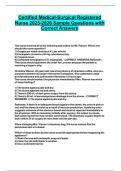
Certified Medical-Surgical Registered
Nurse 2025-2026 Sample Questions with
Correct Answers
The nurse receives all of the following stat orders for Mr. Palmer. Which one
should the nurse question?
1) Oxygen per nasal cannula at 4 L per minute.
2) Enoxaparin (Lovenox) 40 mg subcutaneously.
3) Troponin level.
4) Computed tomography (CT) angiogram. - CORRECT ANSWERS Rationale:
The nurse should questions the order for Lovenox because the patient is
receiving a heparin drip.
Christine Warren, 45 years old, has a long history of ulcerative colitis, and non-
surgical treatment no longer relieved her symptoms. She underwent a total
proctocolectomy and a permanent ileostomy 12 hours ago.
The nurse should contact the physician immediately if Mrs. Warren has which
of these findings?
1) The stoma appears pale and dry.
2) The stoma appears red and shiny.
3) There is 200 mL of dark green output from the stoma.
4) There is 50 mL of serosanguinous drainage from the stoma. - CORRECT
ANSWERS 1) The stoma appears pale and dry.
Rationale: If there is an adequate blood supply to the stoma, the color is pink or
red, and the stoma is moist as a result of mucous production. A pale dry color
suggests ischemia of the stoma or bowel and must be reported immediately to
the physician. With an ileostomy initially after surgery, the output is a loose,
dark green liquid that may contain some blood. The ileostomy usually begins to
drain within 24 of surgery at more than one liter per day.
When changing Mrs. Warren's ileostomy bag, the nurse notices that the
peristomal skin is irritated.
Which of these actions by the nurse would be appropriate before reapplying the
appliance?
1) Wash the area with antiseptic soap and water.
2) Clean the site with Dakin's solution.
3) Use a solid skin barrier.
,4) Obtain an order for a topical antibiotic. - CORRECT ANSWERS 3) Use a solid
skin barrier.
Rationale: The drainage from the stoma can quickly irritate the surrounding
tissue. Therefore, a solid skin barrier, with a pectin base or karaya wafer that
has a measurable thickness and hydrocolloid adhesive properties, should be
applied.
Which of these comments, if made by Mrs. Warren before her surgery, would
indicate that she had concerns about her body image?
1) "I will have to stop my aerobics classes."
2) "I'm so afraid I may not survive the surgery."
3) "I need to go shopping for some loose, baggy clothes."
4) "I'm concerned that this may be only the first of many surgeries." - CORRECT
ANSWERS 3) "I need to go shopping for some loose, baggy clothes."
Rationale:Body image refers to a person's perception of self and determines
how the person interacts with others. One does not need to purchase special
clothing after ileostomy surgery, although some minor adjustments may be
needed for comfort, e.g., stretch underwear or pantyhose for support.
To get TEST BANK for Medical-Surgical Nursing: Concepts for Clinical
Judgment and Collaborative Care 11th Edition by Donna D. Ignatavicius, All
chapters 1 - 74
email or copy these links to get the full test
banks. Each link has a different versions http://www.stuvia.com/doc/7290675
http://www.stuvia.com/doc/8342084
http://www.stuvia.com/doc/9267657
http://www.stuvia.com/doc/7153071
http://www.stuvia.com/doc/7069048 - CORRECT ANSWERS
http://www.stuvia.com/doc/7290675
Lewis Palmer, 45 years old, has a history of multiple myocardial infarctions and
is a heavy smoker. He takes warfarin sodium (Coumadin) daily. Two weeks ago,
he had a right femoral-popliteal bypass, which became occluded 24 hours ago.
He is admitted following an angioplasty of the femoral-popliteal bypass graft.
Mr. Palmer is receiving continuous IV heparin.
Because Mr. Palmer is receiving heparin, it is essential for the nurse to
1) monitor his prothrombin time.
,2) observe him for signs of pulmonary embolism.
3) limit his intake of foods high in vitamin K.
4) check the femoral puncture site at frequent intervals. - CORRECT ANSWERS
4) check the femoral puncture site at frequent intervals.
Rationale: Since bleeding is a common side effect of heparin, it is vital to check
the operative site, the femoral puncture area, for signs of bleeding.
Attempts to revascularize Mr. Palmer's leg are unsuccessful, and Mr. Palmer
has a below-knee amputation (BKA) of his right extremity and is returned to the
medical-surgical unit with an intravenous infusion in place. His orders include:
heparin drip, morphine sulfate 10 mg IV push q4h prn for pain, and ampicillin
sodium g 1 IV q6h.
Twelve hours postoperatively, Mr. Palmer is found to be short of breath and
diaphoretic. He says, "My chest hurts." His pulse is 140/min, compared to a
baseline of 80/min. His blood pressure is105/60 mm Hg, compared to a baseline
of 138/70 mm Hg. His respirations are 32/min, compared to a baseline of 16/min.
His O2 saturation is 85%. The nurse immediately calls for help. Which of the
following questions is most important for the nurse to ask?
1) "Have you ever had this type of chest pain before?"
2) "How long have you had this pain?"
3) "What pain medication do you usually take?"
4) "What - CORRECT ANSWERS 1) "Have you ever had this type of chest pain
before?"
Rationale: Because of the patient's symptoms and his history of myocardial
infarctions, the nurse should find out if the patient has had this time of pain
previously.
Maggie Clark, a 42-year-old female, was admitted with newly diagnosed type 2
diabetes mellitus. Her blood glucose has been stabilized, and the nurse is
preparing her for discharge. Her discharge orders will include metformin
(Glucophage). Mrs. Clark is also being treated for hypertension.
Because Mrs. Clark is to take Glucophage on a regular basis it is important to
1) monitor her glomerular filtration rate.
2) check her serum amylase routinely.
3) obtain her red blood cell count periodically.
4) examine her urine for casts. - CORRECT ANSWERS 1) monitor her
glomerular filtration rate.
Rationale: The estimated glomerular filtration rate (eGFR) is one way to
measure the adequacy of kidney function. Glucophage is excreted by the
kidney and the risk of lactic acidosis increases in patients with impaired kidney
function. The drug may be used if the eGFR is between 45 and 60 mL/min/1.73
m2, i.e., in mild chronic kidney disease. Glucophage is absolutely
contraindicated if the eGFR is below 30 mL/min/1.73 m2.
, Mrs. Clark is prescribed metoprolol tartrate (Lopressor) for hypertension.
Which symptom of hypoglycemia would be masked by Lopressor?
1) Diaphoresis.
2) Tingling.
3) Diplopia.
4) Tachycardia. - CORRECT ANSWERS 4) Tachycardia.
Rationale: A side effect of Lopressor, a beta blocker, is bradycardia. The
Lopressor-induced bradycardia can mask tachycardia, a symptom of
hypoglycemia.
Charles Haverford is diagnosed with prostate cancer and is to have a radical
prostatectomy.
Mr. Haverford has been researching his diagnosis and now asks the nurse to
recommend a reliable web source for accurate prostate cancer information. The
nurse should identify which of these websites as most reliable?
1) www.wikipedia.org.
2) www.cancer.gov.
3) www.caringbridge.org.
4) www.google.com. - CORRECT ANSWERS 2) www.cancer.gov.
Rationale: When a patient asks about researching information on the internet,
the patient should be instructed to look at reliable sites. Sites that are most
reliable are those sponsored by the government (.gov).
Mr. Haverford has the planned surgery and immediately postoperatively he has
a urinary catheter inserted. After the urinary catheter is removed Mr. Haverford
is urinating normally, however he is experiencing occasional incontinence with
dribbling. Mr. Haverford is to be discharged.
Mr. Haverford says to the nurse, "I'm so embarrassed. What will my wife think
about this dribbling?" In addition to acknowledging his feelings, the nurse
should encourage the patient to
1) limit oral intake of fluids before bedtime.
2) palpate his bladder to check for distention three times a day.
3) perform pelvic floor exercises several times daily.
4) avoid interrupting the urinary stream during voiding. - CORRECT ANSWERS
3) perform pelvic floor exercises several times daily.
Rationale: It is not unusual for a patient who has had a prostatectomy, to
complain of not having complete bladder control after catheter removal. To help
the patient regain urinary control, pelvic floor strengthening exercises are
recommended.
Nurse 2025-2026 Sample Questions with
Correct Answers
The nurse receives all of the following stat orders for Mr. Palmer. Which one
should the nurse question?
1) Oxygen per nasal cannula at 4 L per minute.
2) Enoxaparin (Lovenox) 40 mg subcutaneously.
3) Troponin level.
4) Computed tomography (CT) angiogram. - CORRECT ANSWERS Rationale:
The nurse should questions the order for Lovenox because the patient is
receiving a heparin drip.
Christine Warren, 45 years old, has a long history of ulcerative colitis, and non-
surgical treatment no longer relieved her symptoms. She underwent a total
proctocolectomy and a permanent ileostomy 12 hours ago.
The nurse should contact the physician immediately if Mrs. Warren has which
of these findings?
1) The stoma appears pale and dry.
2) The stoma appears red and shiny.
3) There is 200 mL of dark green output from the stoma.
4) There is 50 mL of serosanguinous drainage from the stoma. - CORRECT
ANSWERS 1) The stoma appears pale and dry.
Rationale: If there is an adequate blood supply to the stoma, the color is pink or
red, and the stoma is moist as a result of mucous production. A pale dry color
suggests ischemia of the stoma or bowel and must be reported immediately to
the physician. With an ileostomy initially after surgery, the output is a loose,
dark green liquid that may contain some blood. The ileostomy usually begins to
drain within 24 of surgery at more than one liter per day.
When changing Mrs. Warren's ileostomy bag, the nurse notices that the
peristomal skin is irritated.
Which of these actions by the nurse would be appropriate before reapplying the
appliance?
1) Wash the area with antiseptic soap and water.
2) Clean the site with Dakin's solution.
3) Use a solid skin barrier.
,4) Obtain an order for a topical antibiotic. - CORRECT ANSWERS 3) Use a solid
skin barrier.
Rationale: The drainage from the stoma can quickly irritate the surrounding
tissue. Therefore, a solid skin barrier, with a pectin base or karaya wafer that
has a measurable thickness and hydrocolloid adhesive properties, should be
applied.
Which of these comments, if made by Mrs. Warren before her surgery, would
indicate that she had concerns about her body image?
1) "I will have to stop my aerobics classes."
2) "I'm so afraid I may not survive the surgery."
3) "I need to go shopping for some loose, baggy clothes."
4) "I'm concerned that this may be only the first of many surgeries." - CORRECT
ANSWERS 3) "I need to go shopping for some loose, baggy clothes."
Rationale:Body image refers to a person's perception of self and determines
how the person interacts with others. One does not need to purchase special
clothing after ileostomy surgery, although some minor adjustments may be
needed for comfort, e.g., stretch underwear or pantyhose for support.
To get TEST BANK for Medical-Surgical Nursing: Concepts for Clinical
Judgment and Collaborative Care 11th Edition by Donna D. Ignatavicius, All
chapters 1 - 74
email or copy these links to get the full test
banks. Each link has a different versions http://www.stuvia.com/doc/7290675
http://www.stuvia.com/doc/8342084
http://www.stuvia.com/doc/9267657
http://www.stuvia.com/doc/7153071
http://www.stuvia.com/doc/7069048 - CORRECT ANSWERS
http://www.stuvia.com/doc/7290675
Lewis Palmer, 45 years old, has a history of multiple myocardial infarctions and
is a heavy smoker. He takes warfarin sodium (Coumadin) daily. Two weeks ago,
he had a right femoral-popliteal bypass, which became occluded 24 hours ago.
He is admitted following an angioplasty of the femoral-popliteal bypass graft.
Mr. Palmer is receiving continuous IV heparin.
Because Mr. Palmer is receiving heparin, it is essential for the nurse to
1) monitor his prothrombin time.
,2) observe him for signs of pulmonary embolism.
3) limit his intake of foods high in vitamin K.
4) check the femoral puncture site at frequent intervals. - CORRECT ANSWERS
4) check the femoral puncture site at frequent intervals.
Rationale: Since bleeding is a common side effect of heparin, it is vital to check
the operative site, the femoral puncture area, for signs of bleeding.
Attempts to revascularize Mr. Palmer's leg are unsuccessful, and Mr. Palmer
has a below-knee amputation (BKA) of his right extremity and is returned to the
medical-surgical unit with an intravenous infusion in place. His orders include:
heparin drip, morphine sulfate 10 mg IV push q4h prn for pain, and ampicillin
sodium g 1 IV q6h.
Twelve hours postoperatively, Mr. Palmer is found to be short of breath and
diaphoretic. He says, "My chest hurts." His pulse is 140/min, compared to a
baseline of 80/min. His blood pressure is105/60 mm Hg, compared to a baseline
of 138/70 mm Hg. His respirations are 32/min, compared to a baseline of 16/min.
His O2 saturation is 85%. The nurse immediately calls for help. Which of the
following questions is most important for the nurse to ask?
1) "Have you ever had this type of chest pain before?"
2) "How long have you had this pain?"
3) "What pain medication do you usually take?"
4) "What - CORRECT ANSWERS 1) "Have you ever had this type of chest pain
before?"
Rationale: Because of the patient's symptoms and his history of myocardial
infarctions, the nurse should find out if the patient has had this time of pain
previously.
Maggie Clark, a 42-year-old female, was admitted with newly diagnosed type 2
diabetes mellitus. Her blood glucose has been stabilized, and the nurse is
preparing her for discharge. Her discharge orders will include metformin
(Glucophage). Mrs. Clark is also being treated for hypertension.
Because Mrs. Clark is to take Glucophage on a regular basis it is important to
1) monitor her glomerular filtration rate.
2) check her serum amylase routinely.
3) obtain her red blood cell count periodically.
4) examine her urine for casts. - CORRECT ANSWERS 1) monitor her
glomerular filtration rate.
Rationale: The estimated glomerular filtration rate (eGFR) is one way to
measure the adequacy of kidney function. Glucophage is excreted by the
kidney and the risk of lactic acidosis increases in patients with impaired kidney
function. The drug may be used if the eGFR is between 45 and 60 mL/min/1.73
m2, i.e., in mild chronic kidney disease. Glucophage is absolutely
contraindicated if the eGFR is below 30 mL/min/1.73 m2.
, Mrs. Clark is prescribed metoprolol tartrate (Lopressor) for hypertension.
Which symptom of hypoglycemia would be masked by Lopressor?
1) Diaphoresis.
2) Tingling.
3) Diplopia.
4) Tachycardia. - CORRECT ANSWERS 4) Tachycardia.
Rationale: A side effect of Lopressor, a beta blocker, is bradycardia. The
Lopressor-induced bradycardia can mask tachycardia, a symptom of
hypoglycemia.
Charles Haverford is diagnosed with prostate cancer and is to have a radical
prostatectomy.
Mr. Haverford has been researching his diagnosis and now asks the nurse to
recommend a reliable web source for accurate prostate cancer information. The
nurse should identify which of these websites as most reliable?
1) www.wikipedia.org.
2) www.cancer.gov.
3) www.caringbridge.org.
4) www.google.com. - CORRECT ANSWERS 2) www.cancer.gov.
Rationale: When a patient asks about researching information on the internet,
the patient should be instructed to look at reliable sites. Sites that are most
reliable are those sponsored by the government (.gov).
Mr. Haverford has the planned surgery and immediately postoperatively he has
a urinary catheter inserted. After the urinary catheter is removed Mr. Haverford
is urinating normally, however he is experiencing occasional incontinence with
dribbling. Mr. Haverford is to be discharged.
Mr. Haverford says to the nurse, "I'm so embarrassed. What will my wife think
about this dribbling?" In addition to acknowledging his feelings, the nurse
should encourage the patient to
1) limit oral intake of fluids before bedtime.
2) palpate his bladder to check for distention three times a day.
3) perform pelvic floor exercises several times daily.
4) avoid interrupting the urinary stream during voiding. - CORRECT ANSWERS
3) perform pelvic floor exercises several times daily.
Rationale: It is not unusual for a patient who has had a prostatectomy, to
complain of not having complete bladder control after catheter removal. To help
the patient regain urinary control, pelvic floor strengthening exercises are
recommended.