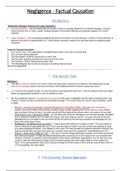
Negligence - Factual Causation
Introduction
Distinction between Factual and Legal Causation:
• Factual Causation = demonstrating that D’s breach of duty is causally related to C’s actional damage. It doesn’t
have to be the only, or main, cause. Factual causation is just about filtering out irrelevant causes to C’s harm
suffered.
• Legal Causation = this is assessing whether the factual connection is strong enough, in terms of moral fairness, to
warrant the burden of responsibility on D. Multi-factual causation needs to be narrowed down by applying legal
causation.
Tests for Factual Causation:
1. The ‘but for’ test = only applicable to straightforward cases, thus rare to use this test.
2. The common-sense approach
3. The Bonnington ‘material contribution to harm’ test
4. The Fairchild ‘material contribution to the risk of harm’ test
5. The Chester v Afshar ‘fairness and justice’ test
6. The Allied Maples test for the lost chance of avoiding financial harm
Not all are significant!
1. The ‘but for’ Test
Definition:
• This test is a test of necessity (C’s harm could only have been caused by D’s actions), and determined on the
balance of probability (there must be more than a 50% likelihood that D’s breach caused the harm).
• I.e. it must be D’s breach of duty, not just his actions, that caused the harm to C. The D’s actions must have fallen
below the appropriate standard of care for liability to arise.
• We must apply the relevant ‘counterfactual’ scenarios to the case to establish that if D hadn’t breached their duty
of care, C would not have sustained any actionable damage. This would mean the ‘but for’ test is satisfied, and D
is liable.
o Barnett v Chelsea & Kensington Hospital Management Committee [1969] 1 QB 428 (main precedent) =
arsenic case which failed at the factual causation stage as after applying the ‘but for’ test (i.e. even if there
was no breach of duty of care), the victim would still have died as the arsenic was in his system for too long.
o Performance Cars v Abrahams [1962] = car accident case where D damaged a car that was already damaged
from a previous accident (not C’s fault both times). This case failed at ‘but for’, as even if D had not hit and
damaged the car, the state of the car would still be the same as the previous accident had damaged the car
first in the same place D had.
o McWilliams v Sir William Arrol Co [1962] = C was injured after falling off a ladder at work. This case failed at
‘but for’ because D persuaded the court that C was the type of ‘manly’ man who would have refused to wear
any safety equipment/clothes. Thus based on this, even if D had provided the required protective clothing, the
outcome would still have been the same as C wouldn’t have worn the equipment. (Hypothetical act of C)
o Wilsher v Essex AHA [1988] AC 1047 = this case involved multiple alternative causes, all of which could have
been factual causation. A baby developed blindness after receiving too much oxygen from one hospital staff
member. However D showed 4 other possibilities of the baby’s blindness. Applying the ‘but for’ test, the court
couldn’t make the staff member liable as all 5 possible causes were also highly likely to have caused the
harm. Thus each possibility had a 20% chance of being the likely cause of harm and as none of them were of
a 51% possibility, the case failed.
2. The Common-Sense Approach
, Common-sense Approach: (doesn’t apply anymore)
Cases that have forced the courts to deviate from applying the ‘but for’ test are:
1. Concurrent Causes (simultaneous wrongs produce the harm, but each harm itself would have been enough to
cause the harm in the first place).
o Summers v Tice (1948) (US decision) and Cook v Lewis [1951] (Canadian decision) = case involves hunters
who shoot the victim, but are unable to determine whose bullet caused the harm. The ‘but for’ test cannot
apply as both D’s can argue the same harm would have occurred to C even if they didn’t shoot. Thus, the
courts reversed the burden of proof on the defendants to establish that they didn’t cause any harm.
o Fitzgerald v Lane [1987] = case involves pedestrian negligently crossing a road, who is hit by D1. They are
then run over by D2. Both D’s were negligently driving but it isn’t clear which D cause the most harm to C
(paralysis). The courts decided ‘but for’ wouldn’t apply and that all D’s would be held liable.
Key Concepts (for the following tests)
Key Concepts integral to the Remaining Tests:
a) Divisible harm = dose-related/progressive (the more you are expose, the worse the harm gets). Results in Several
Liability/Proportionate Liability.
b) Indivisible harm = not dose-related/non-progressive (as soon as the harm occurs, any other exposure to causal
agents will make no difference to the severity of the harm). Results in Joint and Several Liability.
How responsibility is allocated amongst multiple defendants: Civil Liability (Contribution) Act 1978
a) Joint and Several Liability (default) = where multiple D have caused divisible harm, each is liable for the entirety of
the harm. Thus, any one of the D’s involved can be picked by C to pay the whole compensation. Works in favour
of C.
b) Several liability/ Proportionate liability = the D picked out by C to pay, will only pay for their proportion of harm by
making the other D’s involved pay for their proportion of harms. Works in favour of D as each of their liability is
limited from the outset, so they never have to pay more than their own share.
3. The Bonnington (‘Material Contribution to Harm’) Test
The Bonnington ‘material contribution to harm’ test: (important)
Cases here must show that there are multiple cumulative causes and divisible injuries for test to be applied.
• Bonnington Castings Ltd v Wardlaw [1956] = case involved occupational negligence (harm occurred at work). C
suffered a lung disease injury that he claimed was caused by dust on the equipment supplied by his employer (D).
The dust was only found on 1 of 2 equipment pieces used by C. There were 2 exposures = innocent and
negligent.
o If the courts had applied the ‘but for’ test, C would have failed in his claim. The courts thought that would be
unjust as C had suffered actionable damage, thus created this test which means the C must only show that
D’s conduct resulted in ‘material contribution to the harm’ which would be enough to satisfy factual causation.
They said because cumulatively the ‘innocent’ and ‘guilty’ dust were more likely to cause harm, it was enough
to show D’s negligence made a material contribution. Thus, they ruled that Equipment 2 alone caused
material contribution to the harm C suffered.
o The HoL accounted Joint and Several Liability in the case (this case involves divisible injury) when it should
only have been Several/Proportionate Liability.
• Williams v The Bermuda Hospital Board (Bermuda) [2016] PC = case reinforced the Bonnington decision. C was
suffering from severe abdominal pain, at the hospital there was a 4-5 hour delay in getting his CT scan to
determine if he had appendicitis. During this time, C’s appendix ruptured, he developed sepsis and due to
reduced blood flow to his heart, he needed life support. The ‘but for’ test would not succeed and on appeal, the
court found the negligent diagnosis and subsequent treatment delay had materially contributed to the injury.
o Lord Toulson applied Bonnington and found ‘parallels with the present case …obvious’ (at [35]), that there
had been both ‘innocent’ (already begging to occur before the scan) and ‘guilty’ (attributed to the negligence)
sepsis. Thus, liability was found.
4. The Fairchild (‘Material Contribution to the Risk of Harm’) Test
The Fairchild ‘material contribution to the risk of harm’ test: (important)
Cases here must involve indeterminate defendants, indivisible injuries and single casual agents in order to apply this
test. It also must be scientifically impossible to show a causal connection through the ‘but for’ test.
Introduction
Distinction between Factual and Legal Causation:
• Factual Causation = demonstrating that D’s breach of duty is causally related to C’s actional damage. It doesn’t
have to be the only, or main, cause. Factual causation is just about filtering out irrelevant causes to C’s harm
suffered.
• Legal Causation = this is assessing whether the factual connection is strong enough, in terms of moral fairness, to
warrant the burden of responsibility on D. Multi-factual causation needs to be narrowed down by applying legal
causation.
Tests for Factual Causation:
1. The ‘but for’ test = only applicable to straightforward cases, thus rare to use this test.
2. The common-sense approach
3. The Bonnington ‘material contribution to harm’ test
4. The Fairchild ‘material contribution to the risk of harm’ test
5. The Chester v Afshar ‘fairness and justice’ test
6. The Allied Maples test for the lost chance of avoiding financial harm
Not all are significant!
1. The ‘but for’ Test
Definition:
• This test is a test of necessity (C’s harm could only have been caused by D’s actions), and determined on the
balance of probability (there must be more than a 50% likelihood that D’s breach caused the harm).
• I.e. it must be D’s breach of duty, not just his actions, that caused the harm to C. The D’s actions must have fallen
below the appropriate standard of care for liability to arise.
• We must apply the relevant ‘counterfactual’ scenarios to the case to establish that if D hadn’t breached their duty
of care, C would not have sustained any actionable damage. This would mean the ‘but for’ test is satisfied, and D
is liable.
o Barnett v Chelsea & Kensington Hospital Management Committee [1969] 1 QB 428 (main precedent) =
arsenic case which failed at the factual causation stage as after applying the ‘but for’ test (i.e. even if there
was no breach of duty of care), the victim would still have died as the arsenic was in his system for too long.
o Performance Cars v Abrahams [1962] = car accident case where D damaged a car that was already damaged
from a previous accident (not C’s fault both times). This case failed at ‘but for’, as even if D had not hit and
damaged the car, the state of the car would still be the same as the previous accident had damaged the car
first in the same place D had.
o McWilliams v Sir William Arrol Co [1962] = C was injured after falling off a ladder at work. This case failed at
‘but for’ because D persuaded the court that C was the type of ‘manly’ man who would have refused to wear
any safety equipment/clothes. Thus based on this, even if D had provided the required protective clothing, the
outcome would still have been the same as C wouldn’t have worn the equipment. (Hypothetical act of C)
o Wilsher v Essex AHA [1988] AC 1047 = this case involved multiple alternative causes, all of which could have
been factual causation. A baby developed blindness after receiving too much oxygen from one hospital staff
member. However D showed 4 other possibilities of the baby’s blindness. Applying the ‘but for’ test, the court
couldn’t make the staff member liable as all 5 possible causes were also highly likely to have caused the
harm. Thus each possibility had a 20% chance of being the likely cause of harm and as none of them were of
a 51% possibility, the case failed.
2. The Common-Sense Approach
, Common-sense Approach: (doesn’t apply anymore)
Cases that have forced the courts to deviate from applying the ‘but for’ test are:
1. Concurrent Causes (simultaneous wrongs produce the harm, but each harm itself would have been enough to
cause the harm in the first place).
o Summers v Tice (1948) (US decision) and Cook v Lewis [1951] (Canadian decision) = case involves hunters
who shoot the victim, but are unable to determine whose bullet caused the harm. The ‘but for’ test cannot
apply as both D’s can argue the same harm would have occurred to C even if they didn’t shoot. Thus, the
courts reversed the burden of proof on the defendants to establish that they didn’t cause any harm.
o Fitzgerald v Lane [1987] = case involves pedestrian negligently crossing a road, who is hit by D1. They are
then run over by D2. Both D’s were negligently driving but it isn’t clear which D cause the most harm to C
(paralysis). The courts decided ‘but for’ wouldn’t apply and that all D’s would be held liable.
Key Concepts (for the following tests)
Key Concepts integral to the Remaining Tests:
a) Divisible harm = dose-related/progressive (the more you are expose, the worse the harm gets). Results in Several
Liability/Proportionate Liability.
b) Indivisible harm = not dose-related/non-progressive (as soon as the harm occurs, any other exposure to causal
agents will make no difference to the severity of the harm). Results in Joint and Several Liability.
How responsibility is allocated amongst multiple defendants: Civil Liability (Contribution) Act 1978
a) Joint and Several Liability (default) = where multiple D have caused divisible harm, each is liable for the entirety of
the harm. Thus, any one of the D’s involved can be picked by C to pay the whole compensation. Works in favour
of C.
b) Several liability/ Proportionate liability = the D picked out by C to pay, will only pay for their proportion of harm by
making the other D’s involved pay for their proportion of harms. Works in favour of D as each of their liability is
limited from the outset, so they never have to pay more than their own share.
3. The Bonnington (‘Material Contribution to Harm’) Test
The Bonnington ‘material contribution to harm’ test: (important)
Cases here must show that there are multiple cumulative causes and divisible injuries for test to be applied.
• Bonnington Castings Ltd v Wardlaw [1956] = case involved occupational negligence (harm occurred at work). C
suffered a lung disease injury that he claimed was caused by dust on the equipment supplied by his employer (D).
The dust was only found on 1 of 2 equipment pieces used by C. There were 2 exposures = innocent and
negligent.
o If the courts had applied the ‘but for’ test, C would have failed in his claim. The courts thought that would be
unjust as C had suffered actionable damage, thus created this test which means the C must only show that
D’s conduct resulted in ‘material contribution to the harm’ which would be enough to satisfy factual causation.
They said because cumulatively the ‘innocent’ and ‘guilty’ dust were more likely to cause harm, it was enough
to show D’s negligence made a material contribution. Thus, they ruled that Equipment 2 alone caused
material contribution to the harm C suffered.
o The HoL accounted Joint and Several Liability in the case (this case involves divisible injury) when it should
only have been Several/Proportionate Liability.
• Williams v The Bermuda Hospital Board (Bermuda) [2016] PC = case reinforced the Bonnington decision. C was
suffering from severe abdominal pain, at the hospital there was a 4-5 hour delay in getting his CT scan to
determine if he had appendicitis. During this time, C’s appendix ruptured, he developed sepsis and due to
reduced blood flow to his heart, he needed life support. The ‘but for’ test would not succeed and on appeal, the
court found the negligent diagnosis and subsequent treatment delay had materially contributed to the injury.
o Lord Toulson applied Bonnington and found ‘parallels with the present case …obvious’ (at [35]), that there
had been both ‘innocent’ (already begging to occur before the scan) and ‘guilty’ (attributed to the negligence)
sepsis. Thus, liability was found.
4. The Fairchild (‘Material Contribution to the Risk of Harm’) Test
The Fairchild ‘material contribution to the risk of harm’ test: (important)
Cases here must involve indeterminate defendants, indivisible injuries and single casual agents in order to apply this
test. It also must be scientifically impossible to show a causal connection through the ‘but for’ test.