Study file serer.
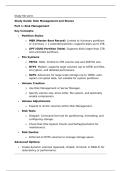
Study Guide: Disk Management and Shares
Part 1: Disk Management
Key Concepts:
Partition Styles:
o MBR (Master Boot Record): Limited to 4 primary partitions
or 3 primary + 1 extended partition, supports disks up to 2TB.
o GPT (GUID Partition Table): Supports disks larger than 2TB
and unlimited partitions.
File Systems:
o FAT32: Older, limited to 2TB volume size and 4GB file size.
o NTFS: Modern, supports large volumes (up to 16TB) and files,
encryption, and detailed permissions.
o ReFS: Advanced, for large-scale storage (up to 16EB), auto-
repairs corrupted data, not suitable for system partitions.
Volume Creation:
1. Use Disk Management or Server Manager.
2. Specify volume size, drive letter, file system, and optionally
enable compression.
Volume Adjustments:
o Expand or shrink volumes within Disk Management.
Disk Tools:
o Diskpart: Command-line tool for partitioning, formatting, and
configuring storage.
o Check Disk (File System Check) and Defragmentation for
maintenance.
Disk Quotas:
o Enforced on NTFS volumes to manage storage space.
Advanced Options:
Create dynamic volumes (spanned, striped, mirrored, or RAID-5) for
redundancy or performance.
, Part 2: Shares
Overview:
Purpose: Enable data sharing over a network.
Key Factors: Security, reliability, and redundancy.
Types of Shares:
Default Shares:
o ADMIN$, C$, IPC$, NETLOGON, SYSVOL.
o Hidden (e.g., shares with $ suffix) for system or administrative
use.
User Shares:
o Created for specific folders or volumes.
Configuring Shares:
1. Use the Server Manager or Computer Management (MMC).
2. Set share name and permissions (e.g., read-only or full access).
3. Use SMB (Windows) or NFS (Linux/Unix) protocols.
Share Mapping:
Use UNC paths (e.g., \\server\share\folder) to connect.
Automate mapping via scripts or Group Policy Objects (GPO).
Publishing Shares:
Shares can be published in Active Directory (AD) for easier discovery.
Volume Shadow Copy Service (VSS):
Creates shadow copies of shared files on NTFS volumes.
Minimum 300MB space required.
2.exam quiz
Pre-Exam Quiz
Multiple Choice Questions
1. Which file system supports encryption and detailed
permission settings?
Study Guide: Disk Management and Shares
Part 1: Disk Management
Key Concepts:
Partition Styles:
o MBR (Master Boot Record): Limited to 4 primary partitions
or 3 primary + 1 extended partition, supports disks up to 2TB.
o GPT (GUID Partition Table): Supports disks larger than 2TB
and unlimited partitions.
File Systems:
o FAT32: Older, limited to 2TB volume size and 4GB file size.
o NTFS: Modern, supports large volumes (up to 16TB) and files,
encryption, and detailed permissions.
o ReFS: Advanced, for large-scale storage (up to 16EB), auto-
repairs corrupted data, not suitable for system partitions.
Volume Creation:
1. Use Disk Management or Server Manager.
2. Specify volume size, drive letter, file system, and optionally
enable compression.
Volume Adjustments:
o Expand or shrink volumes within Disk Management.
Disk Tools:
o Diskpart: Command-line tool for partitioning, formatting, and
configuring storage.
o Check Disk (File System Check) and Defragmentation for
maintenance.
Disk Quotas:
o Enforced on NTFS volumes to manage storage space.
Advanced Options:
Create dynamic volumes (spanned, striped, mirrored, or RAID-5) for
redundancy or performance.
, Part 2: Shares
Overview:
Purpose: Enable data sharing over a network.
Key Factors: Security, reliability, and redundancy.
Types of Shares:
Default Shares:
o ADMIN$, C$, IPC$, NETLOGON, SYSVOL.
o Hidden (e.g., shares with $ suffix) for system or administrative
use.
User Shares:
o Created for specific folders or volumes.
Configuring Shares:
1. Use the Server Manager or Computer Management (MMC).
2. Set share name and permissions (e.g., read-only or full access).
3. Use SMB (Windows) or NFS (Linux/Unix) protocols.
Share Mapping:
Use UNC paths (e.g., \\server\share\folder) to connect.
Automate mapping via scripts or Group Policy Objects (GPO).
Publishing Shares:
Shares can be published in Active Directory (AD) for easier discovery.
Volume Shadow Copy Service (VSS):
Creates shadow copies of shared files on NTFS volumes.
Minimum 300MB space required.
2.exam quiz
Pre-Exam Quiz
Multiple Choice Questions
1. Which file system supports encryption and detailed
permission settings?