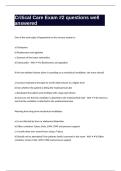
Critical Care Exam #2 questions well
answered
One of the early signs of hypoxemia on the nervous system is:
a) Tachypnea
b) Restlessness and agitation
c) Cyanosis of the lower extremities
d) Tachycardia - ANS ✔✔b) Restlessness and agitation
If the low-exhaled volume alarm is sounding on a mechanical ventilation, the nurse should:
a) Contact respiratory therapist to set the tidal volume at a higher level
b) See whether the patient is biting the endotracheal tube
c) Extubatne the patient and ventilate with a bag-valve device
d) Assess to see that the ventilator is attached to the endotracheal tube - ANS ✔✔d) Assess to
see that the ventilator is attached to the endotracheal tube
Weaning from long-term mechanical ventilation:
a) Is not affected by fever or abdominal distention
b) Often combines T-piece trials, SIMV, CPAP and pressure support
c) Is easily done over several hour using a T-piece
d) Should not be attempted if the patients family is present in the room - ANS ✔✔b) Often
combines T-piece trials, SIMV, CPAP and pressure support
, Assess the following arterial blood gases: pH 7.48, PaCO2 35mmHg, HCO3 28mEq/L, PaO2 85
mmHg.
a) Uncompensated metabolic alkalosis; normla oxygenation
b) Normal ventilation and oxygenation
c) Partly compensated respiratory acidosis with hypoxemia
d) Fully compensated metabolic acidosis; normal oxygenation - ANS ✔✔a) Uncompensated
metabolic alkalosis; normla oxygenation
True or False:
An end-tidal CO2 detector assists in verifying endotracheal tube placement. - ANS ✔✔True
True or False:
Cyanosis is an early sign of hypoxemia. - ANS ✔✔False
True or False:
Mechanical ventilation is commonly used in critical care setting and it has no complications. -
ANS ✔✔False
True or False:
Pulse oximetry is noninvasive method to measure arterial oxygen saturation. - ANS ✔✔True
answered
One of the early signs of hypoxemia on the nervous system is:
a) Tachypnea
b) Restlessness and agitation
c) Cyanosis of the lower extremities
d) Tachycardia - ANS ✔✔b) Restlessness and agitation
If the low-exhaled volume alarm is sounding on a mechanical ventilation, the nurse should:
a) Contact respiratory therapist to set the tidal volume at a higher level
b) See whether the patient is biting the endotracheal tube
c) Extubatne the patient and ventilate with a bag-valve device
d) Assess to see that the ventilator is attached to the endotracheal tube - ANS ✔✔d) Assess to
see that the ventilator is attached to the endotracheal tube
Weaning from long-term mechanical ventilation:
a) Is not affected by fever or abdominal distention
b) Often combines T-piece trials, SIMV, CPAP and pressure support
c) Is easily done over several hour using a T-piece
d) Should not be attempted if the patients family is present in the room - ANS ✔✔b) Often
combines T-piece trials, SIMV, CPAP and pressure support
, Assess the following arterial blood gases: pH 7.48, PaCO2 35mmHg, HCO3 28mEq/L, PaO2 85
mmHg.
a) Uncompensated metabolic alkalosis; normla oxygenation
b) Normal ventilation and oxygenation
c) Partly compensated respiratory acidosis with hypoxemia
d) Fully compensated metabolic acidosis; normal oxygenation - ANS ✔✔a) Uncompensated
metabolic alkalosis; normla oxygenation
True or False:
An end-tidal CO2 detector assists in verifying endotracheal tube placement. - ANS ✔✔True
True or False:
Cyanosis is an early sign of hypoxemia. - ANS ✔✔False
True or False:
Mechanical ventilation is commonly used in critical care setting and it has no complications. -
ANS ✔✔False
True or False:
Pulse oximetry is noninvasive method to measure arterial oxygen saturation. - ANS ✔✔True