Theories of strategy, disruption and
business transformation
Book: Strategic management – from confrontation to transformation
Authors: Henk W. Volberda, Rick M. A. Hollen, Joana R. Pereira, Jatinder S. Sidhu, Kevin Heij
Chapter 1 – Introduction to Strategic Management
What is strategy?
The term strategy originates from the Greek strategos (“military general”). In a business context,
it refers to the determination of long-term goals and objectives, the adoption of courses of
action, and the allocation of resources necessary for carrying out these goals (Chandler,
1962).
In this book, strategy is defined as an orchestrated, unified, integrated, and purposeful set of
choices, commitments, and activities directed at achieving and sustaining above-average
performance.
Strategy is about sustaining added value (above-average return)—that is, the ability to
continuously create value for stakeholders over time. In a for-profit setting, added value equals
competitive advantage: outperforming rivals and earning above-average return such as ROI,
ROE, or ROIC.
Strategy is about making choices about what to do and what not to do, which usually come with
(sometimes very difficult) trade-offs.
Levels of strategy
1. Functional-level strategy – specific to functions (for example: marketing, R&D).
2. Business-level (competitive) strategy – how to compete in a single market.
3. Corporate-level strategy – where to compete; portfolio of businesses.
4. Network-level (cooperative) strategy – how to collaborate with other firms.
All levels must be coherent and aligned toward the firm’s overarching purpose.
Key elements of strategy (Hambrick & Fredrickson, 2001)
A coherent strategy must answer five interrelated questions:
1. Arenas – Where do we maintain a (competitive) presence? (industries, markets,
geographic areas, platforms)
2. Differentiators – How do we differentiate ourselves from others? (activities, sources of
competitive advantage)
3. Vehicles – How will we get there? (alliances, acquisitions, restructuring, divestment)
4. Staging & Pacing – What will be the sequence and speed of our moves? (prioritizing)
5. Economic or value logic – How will we create and sustain value for stakeholders?
,What strategy is not
• Operational effectiveness is not strategy.
Performing similar activities better than rivals (through efficiency or process
improvements) may be necessary but is not sufficient for long-term advantage.
• A plan is not a strategy.
A plan lists actions; a strategy provides direction and choice—including trade-offs about
what to do and what not to do. A strategy specifies a desired outcome, in terms of
sustained above-average performance
A brief history of the strategy field
• 1950s–60s: Foundational works by Chandler, Penrose, and Ansoff; rise of corporate
diversification.
• 1970s: Emergence of business policy tools such as the SWOT framework and portfolio
matrices (BCG, McKinsey).
• 1980s: Michael Porter’s Five Forces and generic strategies centered the field
on competitive advantage.
• 1990s: Shift to resource-based view, core competencies, and dynamic capabilities.
• 2000s–present: Focus on business models, ecosystems, and digital platforms.
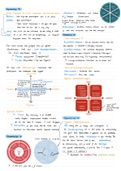
How to earn above-average returns: I/O model versus recourse-based model
,Research shows that both external (industry) and internal (resource) factors matter, so
strategists should combine the two perspectives.
Deliberate, emergent, and unrealized strategy
• Intended strategy (formulated): a clear strategy that a firm intends to implement
• Unrealized strategy: intended plans that were not implemented.
• Deliberate strategy: remaining parts of intended strategy that are put to action (formed
intentionally)
• Emergent strategy: develops incrementally through actions and learning. (formed
spontaneously)
• Realized strategy: what firms actually do (combination of deliberate and emergent)
• In practice, most organizations display a mix of these types.
Strategic management process
Strategic management encompasses both formulation and implementation of strategy.
Defined as such, just about everyone in an organization could somehow be involved in strategy.
The book is organized around the Confront–Sense–Choose–Transform (CSCT) process:
• Confront new realities and disruptive changes.
• Sense what matters through analysis of internal and external environments.
• Choose strategic options and make informed trade-offs.
• Transform structures, systems, and operations to execute and renew strategy.
This process is dynamic and iterative, not linear.
, Schools of strategy formation
Volberda et al. summarize Henry Mintzberg’s influential typology of ten schools of thought,
grouped into prescriptive and descriptive perspectives:
Prescriptive schools – how strategies should be formed (normative, design-oriented, top-
down, analytical and fully rational decision-making approach)
1. Design School – strategy as a fit between internal strengths and external opportunities
(SWOT). (implication: separation of thinking (by the central actor) and action (by staff)
can cause ‘not-invented-here syndrome and ensuing inertia of willingness to implement)
2. Planning School – strategy as a formal, systematic process with explicit steps and
forecasts. Detailed plan that is decomposed into steps, facilitated by checklists,
awaiting implementation. (implication: does not work in a unpredictive environment,
time-consuming, paralysis by analysis, the same as design school)
3. Positioning School – strategy as analytical positioning in the industry structure; based
on economics and Porter’s models. Most in line with I/O model of above-average
returns. Five forces framework. Critique: biased towards well-established firms and
therefore less adequate for new industry entrants.
→ These schools emphasize deliberate strategy and rational planning.
Descriptive schools – how strategies actually form in practice, emergent process
4. Entrepreneurial School – strategy shaped by the vision and intuition of a leader.
Creative destruction. The vision is based largely on intuition and some experimentation,
instead of leaning mostly on facts and figures, and on sensing opportunities where
others primarily see risks and obstacles.
5. Cognitive School – strategy as a mental process that involves information processing,
creative interpretation, knowledge structure mapping, and acquiring understanding
through experience, thought and the senses. Competitive strategy can be based on its
experiences with its other businesses.
6. Learning School – strategy as emergent through incremental learning (result of trial and
error), based on learning capacity and capability.
7. Power School – emphasizes self-interest and fragmentation. The power school
perceives strategy formation as a process of negotiation and influence that is rooted in
power. Persuasion, negotiation, firm’s efforts for strategy formation.
8. Cultural School – strategy rooted in organizational culture and shared values. Perceives
strategy formation as a collective process that is rooted in organizational culture.
Strategy takes the form of a perspective, and its supporting recourses and capabilities.
9. Environmental School – strategy shaped by external forces; organizations adapt or
perish.
10. Configuration School – organizations move through configurational stages; strategy is
about transformation from one stable state to another.
→ These schools highlight that strategy often emerges, evolves, and is influenced by context,
learning, and power.
Together, they show that strategy formation is multifaceted—involving analysis, intuition,
learning, politics, and environment. No single school explains everything; rather, strategists
should combine insights from several schools.
business transformation
Book: Strategic management – from confrontation to transformation
Authors: Henk W. Volberda, Rick M. A. Hollen, Joana R. Pereira, Jatinder S. Sidhu, Kevin Heij
Chapter 1 – Introduction to Strategic Management
What is strategy?
The term strategy originates from the Greek strategos (“military general”). In a business context,
it refers to the determination of long-term goals and objectives, the adoption of courses of
action, and the allocation of resources necessary for carrying out these goals (Chandler,
1962).
In this book, strategy is defined as an orchestrated, unified, integrated, and purposeful set of
choices, commitments, and activities directed at achieving and sustaining above-average
performance.
Strategy is about sustaining added value (above-average return)—that is, the ability to
continuously create value for stakeholders over time. In a for-profit setting, added value equals
competitive advantage: outperforming rivals and earning above-average return such as ROI,
ROE, or ROIC.
Strategy is about making choices about what to do and what not to do, which usually come with
(sometimes very difficult) trade-offs.
Levels of strategy
1. Functional-level strategy – specific to functions (for example: marketing, R&D).
2. Business-level (competitive) strategy – how to compete in a single market.
3. Corporate-level strategy – where to compete; portfolio of businesses.
4. Network-level (cooperative) strategy – how to collaborate with other firms.
All levels must be coherent and aligned toward the firm’s overarching purpose.
Key elements of strategy (Hambrick & Fredrickson, 2001)
A coherent strategy must answer five interrelated questions:
1. Arenas – Where do we maintain a (competitive) presence? (industries, markets,
geographic areas, platforms)
2. Differentiators – How do we differentiate ourselves from others? (activities, sources of
competitive advantage)
3. Vehicles – How will we get there? (alliances, acquisitions, restructuring, divestment)
4. Staging & Pacing – What will be the sequence and speed of our moves? (prioritizing)
5. Economic or value logic – How will we create and sustain value for stakeholders?
,What strategy is not
• Operational effectiveness is not strategy.
Performing similar activities better than rivals (through efficiency or process
improvements) may be necessary but is not sufficient for long-term advantage.
• A plan is not a strategy.
A plan lists actions; a strategy provides direction and choice—including trade-offs about
what to do and what not to do. A strategy specifies a desired outcome, in terms of
sustained above-average performance
A brief history of the strategy field
• 1950s–60s: Foundational works by Chandler, Penrose, and Ansoff; rise of corporate
diversification.
• 1970s: Emergence of business policy tools such as the SWOT framework and portfolio
matrices (BCG, McKinsey).
• 1980s: Michael Porter’s Five Forces and generic strategies centered the field
on competitive advantage.
• 1990s: Shift to resource-based view, core competencies, and dynamic capabilities.
• 2000s–present: Focus on business models, ecosystems, and digital platforms.
How to earn above-average returns: I/O model versus recourse-based model
,Research shows that both external (industry) and internal (resource) factors matter, so
strategists should combine the two perspectives.
Deliberate, emergent, and unrealized strategy
• Intended strategy (formulated): a clear strategy that a firm intends to implement
• Unrealized strategy: intended plans that were not implemented.
• Deliberate strategy: remaining parts of intended strategy that are put to action (formed
intentionally)
• Emergent strategy: develops incrementally through actions and learning. (formed
spontaneously)
• Realized strategy: what firms actually do (combination of deliberate and emergent)
• In practice, most organizations display a mix of these types.
Strategic management process
Strategic management encompasses both formulation and implementation of strategy.
Defined as such, just about everyone in an organization could somehow be involved in strategy.
The book is organized around the Confront–Sense–Choose–Transform (CSCT) process:
• Confront new realities and disruptive changes.
• Sense what matters through analysis of internal and external environments.
• Choose strategic options and make informed trade-offs.
• Transform structures, systems, and operations to execute and renew strategy.
This process is dynamic and iterative, not linear.
, Schools of strategy formation
Volberda et al. summarize Henry Mintzberg’s influential typology of ten schools of thought,
grouped into prescriptive and descriptive perspectives:
Prescriptive schools – how strategies should be formed (normative, design-oriented, top-
down, analytical and fully rational decision-making approach)
1. Design School – strategy as a fit between internal strengths and external opportunities
(SWOT). (implication: separation of thinking (by the central actor) and action (by staff)
can cause ‘not-invented-here syndrome and ensuing inertia of willingness to implement)
2. Planning School – strategy as a formal, systematic process with explicit steps and
forecasts. Detailed plan that is decomposed into steps, facilitated by checklists,
awaiting implementation. (implication: does not work in a unpredictive environment,
time-consuming, paralysis by analysis, the same as design school)
3. Positioning School – strategy as analytical positioning in the industry structure; based
on economics and Porter’s models. Most in line with I/O model of above-average
returns. Five forces framework. Critique: biased towards well-established firms and
therefore less adequate for new industry entrants.
→ These schools emphasize deliberate strategy and rational planning.
Descriptive schools – how strategies actually form in practice, emergent process
4. Entrepreneurial School – strategy shaped by the vision and intuition of a leader.
Creative destruction. The vision is based largely on intuition and some experimentation,
instead of leaning mostly on facts and figures, and on sensing opportunities where
others primarily see risks and obstacles.
5. Cognitive School – strategy as a mental process that involves information processing,
creative interpretation, knowledge structure mapping, and acquiring understanding
through experience, thought and the senses. Competitive strategy can be based on its
experiences with its other businesses.
6. Learning School – strategy as emergent through incremental learning (result of trial and
error), based on learning capacity and capability.
7. Power School – emphasizes self-interest and fragmentation. The power school
perceives strategy formation as a process of negotiation and influence that is rooted in
power. Persuasion, negotiation, firm’s efforts for strategy formation.
8. Cultural School – strategy rooted in organizational culture and shared values. Perceives
strategy formation as a collective process that is rooted in organizational culture.
Strategy takes the form of a perspective, and its supporting recourses and capabilities.
9. Environmental School – strategy shaped by external forces; organizations adapt or
perish.
10. Configuration School – organizations move through configurational stages; strategy is
about transformation from one stable state to another.
→ These schools highlight that strategy often emerges, evolves, and is influenced by context,
learning, and power.
Together, they show that strategy formation is multifaceted—involving analysis, intuition,
learning, politics, and environment. No single school explains everything; rather, strategists
should combine insights from several schools.