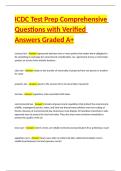
ICDC Test Prep Comprehensive
Questions with Verified
Answers Graded A+
contract law - Answer: Agreement between two or more parties that makes them obligated to
do something in exchange for some kind of consideration. (ex. agreement to buy or sell certain
product or service from anotehr business
sales law - Answer: relate to the transfer of ownership of property from one person to another
for value
property law - Answer: governs the various forms of ownership of property
tax laws - Answer: regulatory rules associated with taxes
environmental law - Answer: includes all government regulations that protect the environment,
wildlife, endangered species, water, and land and that prevent pollution and over-cutting of
forests. Because of environmental law, businesses must dispose of hazardous chemicals in safe,
approved ways to protect the land and water. They also must meet emissions standards to
protect the quality of the air.
trial court - Answer: where crimes are initially reviewed and examinated: first, preliminary court
appellate court - Answer: hears cases after an initial trial (also called intermediate courts--
middle level between trial and supreme courts)
,intermediate court - Answer: hears cases after an initial trial (also called appellate courts--
middle level between trial and supreme courts)
supreme court - Answer: the highest judicial court in a country or state, rulings have final
authority (can't be appealed further)
customs duty - Answer: tax/tariff on goods across international borders meant to protect
country's economy and residents by controlling flow of goods
comparison and contrast method of organization - Answer: organizing information according to
similarities and differences (chunk similar things together, put things next to eachother that are
directly different, etc)
geographical organization - Answer: organizing info according to the location its associated with
minutes format - Answer: recorded during meetings
report format - Answer: used to inform an audience about something
proposal format - Answer: used in persading (along with press releases and sales emails)
memo - Answer: breif, informative documents to bring attention to an important issue quickly
and effectively (internal, within an organization)
in person announcement - Answer: for casual messages (such as "free coffee")
,insulting customer - Answer: type of customer who take out their frustrations with a particular
product or company on an individual salesperson, even though the salesperson is not the
reason for the customer's problem.
leave-me-alone customers - Answer: type of customer who refuses to accept help, even when
they need it
domineering customers - Answer: type of customer who likes to be in control (give orders to
salespeople even when they don't know what they're talking about)
suspicious customer - Answer: type of customer who says things like
"Are you sure there's no bed bug in this hotel?"
"I want to be certain I won't be charged for extra towels."
word-of-mouth marketing - Answer: customers tell eachother how good (or bad) a product or
service is
brand touchpoint - Answer: any interation between business and customer or potential
customer. (Ex. ads, publicity, word-of-mouth marketing, engagement with sales people,
interaction with company website, the good itself)
(not a slogan---unless the customer comes into contact with the slogan)
choice/consent principle - Answer: business give customers options in how their info is used.
(Ex. opt in or out of receiving promo emails)
access/participation principle - Answer: customer should be able to view and verify their info
with ease
integrity/security principle - Answer: keep customer info safe and private
, capital goods/resources - Answer: manufactured or contructed items used to produce goods
and services (buildings, equipment, machinery, transportation systems)
big ticket items: you buy it once (expensive) and you have it for a long time (not-consumable)
land--if you pay for it
natural resources - Answer: found in nature and used to produce goods and services (trees, air,
land--unless your buying the land, then its a capital resource)
human resources - Answer: people (physical/mental work) used to produce goods and services
(entrepreneurs, construction workers, bus drivers, and police officers)
material resources - Answer: anything tangible (you can touch) can include equipment and
supplies
law of demand - Answer: consumers will buy more when its cheap and less when its expensive
strategic management - Answer: process of planning, controlling, and organizing an organization
or department (helps a business determine how it can succeed and reach goals over time
Business process management - Answer: business aligning its objectives and activities with
customer needs.
Human resources management - Answer: planning, staffing, leading, and organizing employees.
Questions with Verified
Answers Graded A+
contract law - Answer: Agreement between two or more parties that makes them obligated to
do something in exchange for some kind of consideration. (ex. agreement to buy or sell certain
product or service from anotehr business
sales law - Answer: relate to the transfer of ownership of property from one person to another
for value
property law - Answer: governs the various forms of ownership of property
tax laws - Answer: regulatory rules associated with taxes
environmental law - Answer: includes all government regulations that protect the environment,
wildlife, endangered species, water, and land and that prevent pollution and over-cutting of
forests. Because of environmental law, businesses must dispose of hazardous chemicals in safe,
approved ways to protect the land and water. They also must meet emissions standards to
protect the quality of the air.
trial court - Answer: where crimes are initially reviewed and examinated: first, preliminary court
appellate court - Answer: hears cases after an initial trial (also called intermediate courts--
middle level between trial and supreme courts)
,intermediate court - Answer: hears cases after an initial trial (also called appellate courts--
middle level between trial and supreme courts)
supreme court - Answer: the highest judicial court in a country or state, rulings have final
authority (can't be appealed further)
customs duty - Answer: tax/tariff on goods across international borders meant to protect
country's economy and residents by controlling flow of goods
comparison and contrast method of organization - Answer: organizing information according to
similarities and differences (chunk similar things together, put things next to eachother that are
directly different, etc)
geographical organization - Answer: organizing info according to the location its associated with
minutes format - Answer: recorded during meetings
report format - Answer: used to inform an audience about something
proposal format - Answer: used in persading (along with press releases and sales emails)
memo - Answer: breif, informative documents to bring attention to an important issue quickly
and effectively (internal, within an organization)
in person announcement - Answer: for casual messages (such as "free coffee")
,insulting customer - Answer: type of customer who take out their frustrations with a particular
product or company on an individual salesperson, even though the salesperson is not the
reason for the customer's problem.
leave-me-alone customers - Answer: type of customer who refuses to accept help, even when
they need it
domineering customers - Answer: type of customer who likes to be in control (give orders to
salespeople even when they don't know what they're talking about)
suspicious customer - Answer: type of customer who says things like
"Are you sure there's no bed bug in this hotel?"
"I want to be certain I won't be charged for extra towels."
word-of-mouth marketing - Answer: customers tell eachother how good (or bad) a product or
service is
brand touchpoint - Answer: any interation between business and customer or potential
customer. (Ex. ads, publicity, word-of-mouth marketing, engagement with sales people,
interaction with company website, the good itself)
(not a slogan---unless the customer comes into contact with the slogan)
choice/consent principle - Answer: business give customers options in how their info is used.
(Ex. opt in or out of receiving promo emails)
access/participation principle - Answer: customer should be able to view and verify their info
with ease
integrity/security principle - Answer: keep customer info safe and private
, capital goods/resources - Answer: manufactured or contructed items used to produce goods
and services (buildings, equipment, machinery, transportation systems)
big ticket items: you buy it once (expensive) and you have it for a long time (not-consumable)
land--if you pay for it
natural resources - Answer: found in nature and used to produce goods and services (trees, air,
land--unless your buying the land, then its a capital resource)
human resources - Answer: people (physical/mental work) used to produce goods and services
(entrepreneurs, construction workers, bus drivers, and police officers)
material resources - Answer: anything tangible (you can touch) can include equipment and
supplies
law of demand - Answer: consumers will buy more when its cheap and less when its expensive
strategic management - Answer: process of planning, controlling, and organizing an organization
or department (helps a business determine how it can succeed and reach goals over time
Business process management - Answer: business aligning its objectives and activities with
customer needs.
Human resources management - Answer: planning, staffing, leading, and organizing employees.