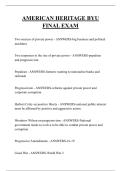
American Heritage Final BYU Test Questions and Answers Rated A
Progressive amendments are ______ - - 'The man who dies thus rich dies disgraced.'
16-21
The Golden Age of the Middle Class - -
Winthrop is compared to____________ - - Baby boom area so first time in a while that
Andrew Carnegie people had leisure time.
Talked about GI Bill: Paid for veterans to go to
college and get a degree.
Hoover had ___________________ and wanted
___________ compared to________. - -
Negative liberty, moderation, FDR Letter from Birmingham Jail by MLK Jr. - -
Remember 4 steps to non-violent campaign.
1. Collect facts to determine whether injustices
What are the Three Founding Moments exist.
(changed gov't) and who said it? - -1. 2. Negotiations
Philadelphia convention/constitution 3. Self-purification
2. Reconstruction/Civil War Amendments 4. Direct Action (non-violent)
3. New deal Also remember Just/Unjust Laws (We should not
obey unfair laws)
Bruce Ackerman *Must break law 1. openly, 2. lovely and 3. accept
consequences.*
What Social Classes Owe Each Other: By
Sumner - -The forgotten man, according to New Freedom - -Constitution is an evolving
Sumner's definition, is someone looking for a thing-needs to adapt to modern needs, "gov't is
chance to make it on his own -- and who the not a machine but a living thing." -Woodrow
government can help most by protecting Wilson
economic freedom, providing a stable currency,
and limiting the burden of taxation.
Plessy vs. Ferguson - -Took place in 1896
(Long time before civil rights movement)
Rugged Individualism: By Herbert Hoover - Set a precedent for civil rights movement
-More negative freedom than FDR, Plessy was 1/8 black, kicked off an all-white train,
liberties same otherwise become like a tyranny took it to Supreme Court and they ruled that
separate but equal was ok.
(However Justice Harlan thought this would
The Gospel of Wealth cause problems later on.)
By Andrew Carnegie - -1. Invest
2. Give it to children
3. Spend on behalf of the public good, while Los Angeles Club - -Two problems are
alive. (Best option) political machines and large corporations.
- He argued that the affluent had a unique
responsibility to be philanthropic. In other words,
the rich should devote themselves to distributing Sandel - -Chapter 9- Moral Individualism
their wealth responsibly to benefit society while Focusing on yourself
they are still alive. He famously ends saying, Kant and Rawls favored this (believed that the
, American Heritage Final BYU Test Questions and Answers Rated A
right is prior to the good) government should not interfere with human
Different from Aristotle who believed your rights:
religious and moral beliefs should affect your Freedom of Speech
actions Freedom of Religion
Freedom of the Press
Freedom of assembly
Moral Responsibility - -Natural duties- Freedom of Petition
universal, don't require consent, be respectful The government shouldn't get in the way of what
towards everybody else the people want
Voluntary obligations-particular, require consent,
anything you give your consent to helping people
Obligations of solidarity-particular but don't Progressivism - -Political (Initiative,
require consent (Sandel likes this, ex. like Referendum, Recall), a philosophy of political
helping the poor) reform based on the goodness and wisdom of the
individual citizen as opposed to special interests
and political institutions. (Scale of Private Power)
Chapter 10-The Inspired Constitution - -
Some parts of Constitution are divinely inspired
(new ideas) Dred Scott Case - -Sued for his freedom,
labeled slaves as property, subject to property
rights
Dealing with Factions - -1. Can't eliminate
causes
2. Control effects (extended republic-no faction Marbury vs. Madison - -The 1803 case in
can create a majority)(Like crabs in a bucket) which Chief Justice John Marshall and his
3. Separation of powers (each branch has a associates first asserted the right of the Supreme
specific job) Court to determine the meaning of the U.S.
4. Checks and balances Constitution. The decision established the Court's
power of judicial review over acts of Congress, in
this case the Judiciary Act of 1789.
Brown vs. Board of Education - -Separate
is NOT EQUAL (Took awhile for all schools to
enforce) Radical vs. Modern - -Radical: Be crazy,
doesn't matter if it's right or wrong.
Modern: Social norms, more constraint
1957 Little Rock Nine - -Governor Orval
was racist and wouldn't let blacks into school so
President Eisenhower called National Guard to Virtue, Freedom, and Welfare - -Virtue:
escort the kids in. Greeks mention based on achievements, virtue
also deals with civil liberty
Welfare: overall prosperity, public well-being,
Positive Liberty - -Freedom to Act (Gov't is what is the best for everybody
liberator, like the shepherd who freed the sheep)
Human Predicament Cycle - -Between
Negative Liberty - -Freedom from, The Tyranny and Anarchy, The cycle from tyranny to
Progressive amendments are ______ - - 'The man who dies thus rich dies disgraced.'
16-21
The Golden Age of the Middle Class - -
Winthrop is compared to____________ - - Baby boom area so first time in a while that
Andrew Carnegie people had leisure time.
Talked about GI Bill: Paid for veterans to go to
college and get a degree.
Hoover had ___________________ and wanted
___________ compared to________. - -
Negative liberty, moderation, FDR Letter from Birmingham Jail by MLK Jr. - -
Remember 4 steps to non-violent campaign.
1. Collect facts to determine whether injustices
What are the Three Founding Moments exist.
(changed gov't) and who said it? - -1. 2. Negotiations
Philadelphia convention/constitution 3. Self-purification
2. Reconstruction/Civil War Amendments 4. Direct Action (non-violent)
3. New deal Also remember Just/Unjust Laws (We should not
obey unfair laws)
Bruce Ackerman *Must break law 1. openly, 2. lovely and 3. accept
consequences.*
What Social Classes Owe Each Other: By
Sumner - -The forgotten man, according to New Freedom - -Constitution is an evolving
Sumner's definition, is someone looking for a thing-needs to adapt to modern needs, "gov't is
chance to make it on his own -- and who the not a machine but a living thing." -Woodrow
government can help most by protecting Wilson
economic freedom, providing a stable currency,
and limiting the burden of taxation.
Plessy vs. Ferguson - -Took place in 1896
(Long time before civil rights movement)
Rugged Individualism: By Herbert Hoover - Set a precedent for civil rights movement
-More negative freedom than FDR, Plessy was 1/8 black, kicked off an all-white train,
liberties same otherwise become like a tyranny took it to Supreme Court and they ruled that
separate but equal was ok.
(However Justice Harlan thought this would
The Gospel of Wealth cause problems later on.)
By Andrew Carnegie - -1. Invest
2. Give it to children
3. Spend on behalf of the public good, while Los Angeles Club - -Two problems are
alive. (Best option) political machines and large corporations.
- He argued that the affluent had a unique
responsibility to be philanthropic. In other words,
the rich should devote themselves to distributing Sandel - -Chapter 9- Moral Individualism
their wealth responsibly to benefit society while Focusing on yourself
they are still alive. He famously ends saying, Kant and Rawls favored this (believed that the
, American Heritage Final BYU Test Questions and Answers Rated A
right is prior to the good) government should not interfere with human
Different from Aristotle who believed your rights:
religious and moral beliefs should affect your Freedom of Speech
actions Freedom of Religion
Freedom of the Press
Freedom of assembly
Moral Responsibility - -Natural duties- Freedom of Petition
universal, don't require consent, be respectful The government shouldn't get in the way of what
towards everybody else the people want
Voluntary obligations-particular, require consent,
anything you give your consent to helping people
Obligations of solidarity-particular but don't Progressivism - -Political (Initiative,
require consent (Sandel likes this, ex. like Referendum, Recall), a philosophy of political
helping the poor) reform based on the goodness and wisdom of the
individual citizen as opposed to special interests
and political institutions. (Scale of Private Power)
Chapter 10-The Inspired Constitution - -
Some parts of Constitution are divinely inspired
(new ideas) Dred Scott Case - -Sued for his freedom,
labeled slaves as property, subject to property
rights
Dealing with Factions - -1. Can't eliminate
causes
2. Control effects (extended republic-no faction Marbury vs. Madison - -The 1803 case in
can create a majority)(Like crabs in a bucket) which Chief Justice John Marshall and his
3. Separation of powers (each branch has a associates first asserted the right of the Supreme
specific job) Court to determine the meaning of the U.S.
4. Checks and balances Constitution. The decision established the Court's
power of judicial review over acts of Congress, in
this case the Judiciary Act of 1789.
Brown vs. Board of Education - -Separate
is NOT EQUAL (Took awhile for all schools to
enforce) Radical vs. Modern - -Radical: Be crazy,
doesn't matter if it's right or wrong.
Modern: Social norms, more constraint
1957 Little Rock Nine - -Governor Orval
was racist and wouldn't let blacks into school so
President Eisenhower called National Guard to Virtue, Freedom, and Welfare - -Virtue:
escort the kids in. Greeks mention based on achievements, virtue
also deals with civil liberty
Welfare: overall prosperity, public well-being,
Positive Liberty - -Freedom to Act (Gov't is what is the best for everybody
liberator, like the shepherd who freed the sheep)
Human Predicament Cycle - -Between
Negative Liberty - -Freedom from, The Tyranny and Anarchy, The cycle from tyranny to