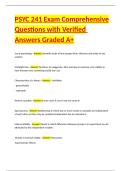
PSYC 241 Exam Comprehensive
Questions with Verified
Answers Graded A+
Social psychology - Answer: Scientific study of how people think, influence and relate to one
another
Hindsight bias - Answer: Tendency to exaggerate, after learning an outcome, one's ability to
have foreseen how something would turn out
Characteristics of a theory - Answer: - falsifiable
- generalizable
- replicable
Reverse causality - Answer: B may cause A, but A may not cause B
Spuriousness - Answer: Relationship in which two or more events or variables are independent
of each other yet they may be considered dependent due to coincidence
Internal Validity - Answer: Extent to which differences between groups in an experiment can be
attributed to the independent variable
Threats to internal validity - Answer: Maturation
Experimenter effects
,Participant effects
Regression to the mean
History - sometimes history takes its course so you cannot determine whether rhe end result of
an experiment is due to a variable or history
External validity - Answer: - results can be generalized
Self-concept - Answer: Who am I?
Self-esteem - Answer: My sense of worth
Social self - Answer: My roles as a student, family member, friend, etc
Self knowledge - Answer: How can I explain and predict myself?
Self schema - Answer: The elements of your self-concept, the specific benefits by which you
define yourself (ex. athletic, fat, etc.)
Schema - Answer: Mental templates by which we organize our own world
Social influences that might affect us - Answer: × Social identities we form
× Comparisons we make with others
× Our successes and failures
× How other people judge us
× Surrounding culture
, Social Comparison study - Answer: Exposed first and fourth years to an article about a star
fourth year and tried to determine their reaction (fourth years were upset by it and first years
found it to be aspirational)
Marsh, Kong & Hau 2000 - Answer: Students have a higher academic self-evaluation if they
attend school with mostly average students
Steele 1997 - Answer: If someone is told that they are incapable of doing something, they might
disidentify with it and find interest elsewhere (Ex. I am not good at math so I am not going to try
to be good at it)
Richard Nisbett (2003) - Answer: Collectivism also results in different ways of thinking
Heine et al 2001
Culture and Self-esteem - Answer: People in individualistic cultures, people are more likely to
persist when they are succeeding because success increases our self-esteem.
In places like Japan however, people are more likely to persist on tasks when they are failing so
that they do not disappoint others.
Impact bias - Answer: Overestimating the enduring impact of emotion-causing events
Planning fallacy - Answer: Tendency to underestimate how long it will take to complete a task
Immune neglect - Answer: Human tendency to underestimate speed and strength of the
psychological immune system, which enables emotional recovery and resilience after bad things
happen
Dual attitudes - Answer: Differing implicit and explicit attitudes toward the same object
Questions with Verified
Answers Graded A+
Social psychology - Answer: Scientific study of how people think, influence and relate to one
another
Hindsight bias - Answer: Tendency to exaggerate, after learning an outcome, one's ability to
have foreseen how something would turn out
Characteristics of a theory - Answer: - falsifiable
- generalizable
- replicable
Reverse causality - Answer: B may cause A, but A may not cause B
Spuriousness - Answer: Relationship in which two or more events or variables are independent
of each other yet they may be considered dependent due to coincidence
Internal Validity - Answer: Extent to which differences between groups in an experiment can be
attributed to the independent variable
Threats to internal validity - Answer: Maturation
Experimenter effects
,Participant effects
Regression to the mean
History - sometimes history takes its course so you cannot determine whether rhe end result of
an experiment is due to a variable or history
External validity - Answer: - results can be generalized
Self-concept - Answer: Who am I?
Self-esteem - Answer: My sense of worth
Social self - Answer: My roles as a student, family member, friend, etc
Self knowledge - Answer: How can I explain and predict myself?
Self schema - Answer: The elements of your self-concept, the specific benefits by which you
define yourself (ex. athletic, fat, etc.)
Schema - Answer: Mental templates by which we organize our own world
Social influences that might affect us - Answer: × Social identities we form
× Comparisons we make with others
× Our successes and failures
× How other people judge us
× Surrounding culture
, Social Comparison study - Answer: Exposed first and fourth years to an article about a star
fourth year and tried to determine their reaction (fourth years were upset by it and first years
found it to be aspirational)
Marsh, Kong & Hau 2000 - Answer: Students have a higher academic self-evaluation if they
attend school with mostly average students
Steele 1997 - Answer: If someone is told that they are incapable of doing something, they might
disidentify with it and find interest elsewhere (Ex. I am not good at math so I am not going to try
to be good at it)
Richard Nisbett (2003) - Answer: Collectivism also results in different ways of thinking
Heine et al 2001
Culture and Self-esteem - Answer: People in individualistic cultures, people are more likely to
persist when they are succeeding because success increases our self-esteem.
In places like Japan however, people are more likely to persist on tasks when they are failing so
that they do not disappoint others.
Impact bias - Answer: Overestimating the enduring impact of emotion-causing events
Planning fallacy - Answer: Tendency to underestimate how long it will take to complete a task
Immune neglect - Answer: Human tendency to underestimate speed and strength of the
psychological immune system, which enables emotional recovery and resilience after bad things
happen
Dual attitudes - Answer: Differing implicit and explicit attitudes toward the same object