Tuesday, October 29, 2019
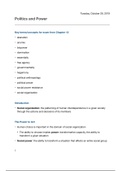
Politics and Power
Key terms/concepts for exam from Chapter 12
- alienation
- anomie
- biopower
- domination
- essentially
- free agency
- governmentality
- hegemony
- political anthropology
- political power
- social power resistance
- social organization
Introduction
- Social organization: the patterning of human interdependence in a given society
through the actions and decisions of its members
The Power to Act
- Human choice is important in the domain of social organization
• The ability to choose implies power: transformative capacity, the ability to
transform a given situation
- Social power: the ability to transform a situation that a ects an entire social group
1
ff
, Tuesday, October 29, 2019
- Political power: social power held by a group that is in a position to a ect the lives
of many people
- Vene Klasen and Miller identify three types of political power:
1) Visible (formal rules, institutions, authorities)
2) Hidden (groups with social power using discretion to in uence decisions)
3) Invisible (power embedded in cultural norms)
- Political anthropology: the study of social power in human society
- Involves interplay between ethnographic eldwork, political theory, and criticism of
political theory
The Role of the State
- The previous assumption was that without the state, there was anarchy and disorder
- Lewis Henry Morgan’s research showed the ways in which kinship institutions
organized social life in societies without states
- Later political anthropologists showed that societies without states can reach and
carry out decisions a ecting the entire social group by means of orderly traditional
processes
Coercion: With and Without Traditional State Institutions
- State and non-state societies:
• Both employ coercion as a means of maintaining control
• Free agency: the freedom of self-contained individuals to pursue their own
interests above everyone else and to challenge one another for dominance
Tribe
- Originally viewed as a culturally distinct, multiband population that imagined itself as
one people descended from a common ancestor; currently used to describe an
2
ff fi fl ff
Politics and Power
Key terms/concepts for exam from Chapter 12
- alienation
- anomie
- biopower
- domination
- essentially
- free agency
- governmentality
- hegemony
- political anthropology
- political power
- social power resistance
- social organization
Introduction
- Social organization: the patterning of human interdependence in a given society
through the actions and decisions of its members
The Power to Act
- Human choice is important in the domain of social organization
• The ability to choose implies power: transformative capacity, the ability to
transform a given situation
- Social power: the ability to transform a situation that a ects an entire social group
1
ff
, Tuesday, October 29, 2019
- Political power: social power held by a group that is in a position to a ect the lives
of many people
- Vene Klasen and Miller identify three types of political power:
1) Visible (formal rules, institutions, authorities)
2) Hidden (groups with social power using discretion to in uence decisions)
3) Invisible (power embedded in cultural norms)
- Political anthropology: the study of social power in human society
- Involves interplay between ethnographic eldwork, political theory, and criticism of
political theory
The Role of the State
- The previous assumption was that without the state, there was anarchy and disorder
- Lewis Henry Morgan’s research showed the ways in which kinship institutions
organized social life in societies without states
- Later political anthropologists showed that societies without states can reach and
carry out decisions a ecting the entire social group by means of orderly traditional
processes
Coercion: With and Without Traditional State Institutions
- State and non-state societies:
• Both employ coercion as a means of maintaining control
• Free agency: the freedom of self-contained individuals to pursue their own
interests above everyone else and to challenge one another for dominance
Tribe
- Originally viewed as a culturally distinct, multiband population that imagined itself as
one people descended from a common ancestor; currently used to describe an
2
ff fi fl ff