

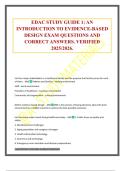
EDAC STUDY GUIDE 1: AN
INTRODUCTION TO EVIDENCE-BASED
DESIGN EXAM QUESTIONS AND
CORRECT ANSWERS. VERIFIED
2025/2026.
List four major stakeholders in a healthcare facility and the purpose that facility serves for each
of them. - ANS Patients and families - healing environment
Staff - work environment
Providers of healthcare - business environment
Community and organization - cultural environment
Define evidence-based design. - ANS EBD is the process of basing decisions about the built
environment on credible research to achieve the best possible outcomes.
List the seven major trends facing healthcare today. - ANS 1. Public focus on quality and
safety
2. Reimbursement challenges
3. Aging population and caregiver shortages
4. Health information technology
5. Genomics and technology
6. Emergency room saturation and disaster preparedness
1 @COPYRIGHT 2025/2026 ALLRIGHTS RESERVED.
, 7. Sustainable healthcare
EBD can positively influence the current trends and challenges healthcare faces by... - ANS -
reducing medical errors and therefore the cost of care
- improving satisfaction and efficiency of caregivers, thus helping employee recruitment and
retention
- designing a physical environment supportive of new IT and work processes
- providing innovative, adaptable designs maximizing disaster response
HAI is a ______(a)_______ and is now more generically referred to as ______(b)______. -
ANS a. Hospital-Acquired Infection
b. Healthcare-Associated Infection
An HAI is defined as... - ANS ...an infection that a patient acquires during the course of
receiving treatment for another condition within a healthcare setting.
List the two major factors that increased healthcare costs in the US ares associated with. -
ANS 1. Increased life expectancy
2. Cost of new medical technology
List the 8 key steps in the EBD process. - ANS 1. Define evidence-based goals and objectives
2. Find sources for relevant evidence
3. Critically interpret relevant evidence
4. Create and innovate evidence-based design concepts
5. Develop a hypothesis
6. Collect baseline performance measures
7. Monitor implementation of design and construction
8. Measure post-occupancy performance results
2 @COPYRIGHT 2025/2026 ALLRIGHTS RESERVED.
INTRODUCTION TO EVIDENCE-BASED
DESIGN EXAM QUESTIONS AND
CORRECT ANSWERS. VERIFIED
2025/2026.
List four major stakeholders in a healthcare facility and the purpose that facility serves for each
of them. - ANS Patients and families - healing environment
Staff - work environment
Providers of healthcare - business environment
Community and organization - cultural environment
Define evidence-based design. - ANS EBD is the process of basing decisions about the built
environment on credible research to achieve the best possible outcomes.
List the seven major trends facing healthcare today. - ANS 1. Public focus on quality and
safety
2. Reimbursement challenges
3. Aging population and caregiver shortages
4. Health information technology
5. Genomics and technology
6. Emergency room saturation and disaster preparedness
1 @COPYRIGHT 2025/2026 ALLRIGHTS RESERVED.
, 7. Sustainable healthcare
EBD can positively influence the current trends and challenges healthcare faces by... - ANS -
reducing medical errors and therefore the cost of care
- improving satisfaction and efficiency of caregivers, thus helping employee recruitment and
retention
- designing a physical environment supportive of new IT and work processes
- providing innovative, adaptable designs maximizing disaster response
HAI is a ______(a)_______ and is now more generically referred to as ______(b)______. -
ANS a. Hospital-Acquired Infection
b. Healthcare-Associated Infection
An HAI is defined as... - ANS ...an infection that a patient acquires during the course of
receiving treatment for another condition within a healthcare setting.
List the two major factors that increased healthcare costs in the US ares associated with. -
ANS 1. Increased life expectancy
2. Cost of new medical technology
List the 8 key steps in the EBD process. - ANS 1. Define evidence-based goals and objectives
2. Find sources for relevant evidence
3. Critically interpret relevant evidence
4. Create and innovate evidence-based design concepts
5. Develop a hypothesis
6. Collect baseline performance measures
7. Monitor implementation of design and construction
8. Measure post-occupancy performance results
2 @COPYRIGHT 2025/2026 ALLRIGHTS RESERVED.

