Governance Revision Notes
Q1
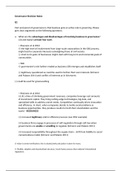
Part and parcel of governance is that business gets an active role in governing. Please
give clear arguments to the following questions:
a. What are the advantages and disadvantages of involving business in governance?
List and explain at least four each.
> Sheyvens et al 2016
(-) the high level of involvement from large‐scale corporations in the SDG process,
might lead to corporate interests outweighing those of civil society
(-) short-term gains of businesses might clash with long term environmental goals of
communities
> TBD
(-) government’s role further eroded as business CSR emerges and establishes itself
(-) legitimacy questioned as could be used to further their own interests (Schrerer
and Palazzo 2011) and conflict of interests as in Schveyens
(-) could be used for greenwashing
> Sheyvens et al 2016
(+) At a time of shrinking government revenues, companies leverage vast amounts
of investment capital. They bring cutting‐edge technologies, big data, and
specialized skills to address unmet needs. Competition continually drives innovation
and efficiency. In short, when companies decide to tackle social problems as
business opportunities, they produce results for both their shareholders and the
world – RESOURCES
(+) increased legitimacy and/or efficiency/success (see MSC example)
(+) business firms engage in processes of self-regulation through soft-law when
governments are unable or unwilling to regulate (Schrerer and Palazzo 2011)
(+) increased responsibility throughout the supply chain – shift from liability to social
connectedness model (Schrerer and Palazzo 2011)
(-) Value is central verification; info is valued jointly and justice is done for many.
(-) Flexible, adaptive and decentralized structure. (much faster process than national/ international
regulations
, (-) power imbalances
(-) difficult to reach consensus
Look at Steuer’s paper
b. What could be the motivation of business to get involved in governance? List and
explain at least four different motivations.
> Sheyvens et al 2016 - in one study of 40 large corporations the motivation to pursue
sustainable and inclusive business practices ‘ranged from “maintaining competitive
position” as the leading motivator, followed by “avoiding reputational damage,” “avoiding
future supply disruptions,” and “capturing revenues and building loyalty”’
c. One of the critiques of involving business is the argument of ‘greenwashing’. How do you
think that greenwashing (by business) can be prevented? List and explain at least three
options.
https://research.hanze.nl/ws/files/25737676/
Vollero_et_al_Avoiding_the_greenwashing_trap.pdf
https://lawdigitalcommons.bc.edu/cgi/viewcontent.cgi?referer=https://scholar.google.nl/
&httpsredir=1&article=2098&context=ealr
here the search: https://scholar.google.nl/scholar?
hl=it&as_sdt=0%2C5&q=greenwashing+AND+avoiding&btnG=
> short-term vs long-term involvement and goals
Q2
A group of international activists want to create their own voluntary standard with certifying
practices (similar to those existing in coffee, fisheries, palm oil, and other agricultural sectors). The
difference is that they want to introduce a voluntary standard and certifying practices to a sector
in which there are currently no private regulators. They believe that this is a great opportunity
and that they can make a big impact!
The group has heard that the Dutch government has allocated money into a special fund for
sustainability projects which may have a serious beneficial impact in the Global South, in
environmental, economic, and/or social terms. The Dutch minister of development aid is in the
committee deciding which projects should be granted funding and is considering whether it should
lend its support to the initiation of a transnational certification scheme in a sector that does not
have any other private sustainability regulation from the private sector.
The minister asks for your advice on the following issues:
Q1
Part and parcel of governance is that business gets an active role in governing. Please
give clear arguments to the following questions:
a. What are the advantages and disadvantages of involving business in governance?
List and explain at least four each.
> Sheyvens et al 2016
(-) the high level of involvement from large‐scale corporations in the SDG process,
might lead to corporate interests outweighing those of civil society
(-) short-term gains of businesses might clash with long term environmental goals of
communities
> TBD
(-) government’s role further eroded as business CSR emerges and establishes itself
(-) legitimacy questioned as could be used to further their own interests (Schrerer
and Palazzo 2011) and conflict of interests as in Schveyens
(-) could be used for greenwashing
> Sheyvens et al 2016
(+) At a time of shrinking government revenues, companies leverage vast amounts
of investment capital. They bring cutting‐edge technologies, big data, and
specialized skills to address unmet needs. Competition continually drives innovation
and efficiency. In short, when companies decide to tackle social problems as
business opportunities, they produce results for both their shareholders and the
world – RESOURCES
(+) increased legitimacy and/or efficiency/success (see MSC example)
(+) business firms engage in processes of self-regulation through soft-law when
governments are unable or unwilling to regulate (Schrerer and Palazzo 2011)
(+) increased responsibility throughout the supply chain – shift from liability to social
connectedness model (Schrerer and Palazzo 2011)
(-) Value is central verification; info is valued jointly and justice is done for many.
(-) Flexible, adaptive and decentralized structure. (much faster process than national/ international
regulations
, (-) power imbalances
(-) difficult to reach consensus
Look at Steuer’s paper
b. What could be the motivation of business to get involved in governance? List and
explain at least four different motivations.
> Sheyvens et al 2016 - in one study of 40 large corporations the motivation to pursue
sustainable and inclusive business practices ‘ranged from “maintaining competitive
position” as the leading motivator, followed by “avoiding reputational damage,” “avoiding
future supply disruptions,” and “capturing revenues and building loyalty”’
c. One of the critiques of involving business is the argument of ‘greenwashing’. How do you
think that greenwashing (by business) can be prevented? List and explain at least three
options.
https://research.hanze.nl/ws/files/25737676/
Vollero_et_al_Avoiding_the_greenwashing_trap.pdf
https://lawdigitalcommons.bc.edu/cgi/viewcontent.cgi?referer=https://scholar.google.nl/
&httpsredir=1&article=2098&context=ealr
here the search: https://scholar.google.nl/scholar?
hl=it&as_sdt=0%2C5&q=greenwashing+AND+avoiding&btnG=
> short-term vs long-term involvement and goals
Q2
A group of international activists want to create their own voluntary standard with certifying
practices (similar to those existing in coffee, fisheries, palm oil, and other agricultural sectors). The
difference is that they want to introduce a voluntary standard and certifying practices to a sector
in which there are currently no private regulators. They believe that this is a great opportunity
and that they can make a big impact!
The group has heard that the Dutch government has allocated money into a special fund for
sustainability projects which may have a serious beneficial impact in the Global South, in
environmental, economic, and/or social terms. The Dutch minister of development aid is in the
committee deciding which projects should be granted funding and is considering whether it should
lend its support to the initiation of a transnational certification scheme in a sector that does not
have any other private sustainability regulation from the private sector.
The minister asks for your advice on the following issues: