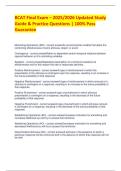
BCAT Final Exam – 2025/2026 Updated Study
Guide & Practice Questions | 100% Pass
Guarantee
Motivating Operations (MO) - correct answerAn environmental variable that alters the
reinforcing effectiveness of some stimulus, object, or event.
Contingency - correct answerRefers to dependent and/or temporal relations between
operant behavior an it's controlling variables.
Satiation - correct answerRepeated presentation of a reinforcer weakens its
effectiveness and for this reason the rate of responses declines.
Positive Reinforcement - correct answerA type of reinforcement in which the
presentation of the stimulus is contingent upon the response, resulting in an increase in
the future probability of that response
Negative Reinforcement - correct answerA type of reinforcement in which removal of a
stimulus is contingent on a response, resulting in an increase in the future probability of
that response.
Positive Punishment - correct answerA type of punishment in which stimulus
presentation is contingent on a response, resulting in the decrease of the future
probability of that response
Negative Punishment - correct answerA type of punishment in which stimulus removal
is contingent on a response, resulting in the decrease of the future probability of that
response.
Establishing Operations (EO) - correct answerIncreases motivation for something and
increases likelihood you will try to access that reinforcer
Abolishing Operations (AO) - correct answerDecreases motivation for something and
decreases likelihood you will try to access that reinforcer
Discriminative Stimulus (SD) - correct answerA stimulus in the presence of which a
particular response will be reinforced and in the absence of which that response will not
be reinf
,Stimulus Control (Discriminative Control) - correct answerThe tendency for the target
behavior to occur in the presence of the SD (b/c it was reinforced in the past)
Discrimination Training - correct answerTeach the child to respond to/tell the difference
between two (or more) SDs.
Discrete Trial Training (DTT) - correct answerA specific method of teaching in which a
task is isolated and taught across multiple trials. A specific opportunity (antecedent) is
presented and a specific response is expected. A consequence follows the response.
Fluency-Based Training - correct answerTaking an existing skill and increasing
accuracy and speed of skill performance in order to develop competence
Errorless Learning - correct answerInvolves early and immediate prompting of the target
response so that the learner's response is sure to be correct.
Most-to-Least Prompting - correct answerFading from one type of prompt to another
less intrusive prompt. Most assistance to least assistance.
Least-to-Most Prompting - correct answerStaring with a least intrusive prompt possible
and the client is not successful, therefore having to move to more intrusive prompts until
the client responds.
Chaining - correct answerA chain of sequence of SDs and responses where each
response in the sequence (expect for the last one) produces the SD for the next
response in the sequence; A complex bx that is comprised of many single responses
that occur in a specific sequence
Forward Chaining - correct answerBegin with the first SD-Response component in the
chain and then continue forward though the remaining SD-Response components
Backward Chaining - correct answerBegin with the final step, or the last SD-Response
component, then move backwards towards the remaining components
Total Task Presentation - correct answerAll of the SD-Response components of the
chain are taught during every learning trial. A reinforcer is delivered after each SD-
Response component.
Shaping - correct answerSystematically reinforcing successive approximations of a
target bx while extinguishing previous approximations.
Noncontingent Reinforcer - correct answerThe delivery of functional reinforcers on a
time based schedule, independent of the problem behavior
Replacement Behavior - correct answerOther behaviors or skills taught that are an
appropriate substitute for a problem behavior.
, Escape Extinction - correct answerPlanned ignoring of the problem behavior maintained
by social negative reinforcement (the ability to escape a situation/demand)
Attention Extinction - correct answerPlanned ignoring of the problem behavior
maintained by social positive reinforcement (receiving attention from another person)
Access to Tangible Extinction - correct answerPlanned ignoring of the problem behavior
maintained by social positive reinforcement (the ability to gain a desired item)
Extinction Burst - correct answerThe bx on extinction briefly increases in frequency,
duration, or intensity before it decreases and stops.
Differential Reinforcement of Alternative Behavior (DRA) - correct answerThe delivery of
reinforcers contingent on an alternative response, where a specific replacement bx is
identified and only that specific box is reinforced.
Differential Reinforcement of Incompatible Behavior (DRI) - correct answerThe delivery
of reinforcers contingent on a specific desirable bx that is physically incompatible with
the problem bx so that both responses could not occur at the same time.
Differential Reinforcement of Other Behavior (DRO) - correct answerThe delivery of
reinforcers on an internal schedule, contingent upon the absence of the problem bx.
With this, any appropriate bx other than the problem bx is reinforced
Deprivation - correct answerThe absence or reduction of a reinforcer for a period of
time. The deprivation is an establishing operation that inc. the effectiveness of
reinforcers
Extinction - correct answerA procedure by which a bx that was previously reinforced no
loner received reinforcement and the probability of the behavior decreases. Examples
include planned ignoring, escape extinction, and sensory extinction/response blocking.
Generalization - correct answerOccurs when a child uses a newly acquired skill in a
novel and appropriate situation or setting & engages in new forms of the newly acquired
skill w/o being taught to do so
Maintenance - correct answerThe continuation of a behavior change after all or part of
the intervention responsible for the behavior change has been faded or terminated. [The
extent to which the child continues to demonstrate: reduction of prob. behaviors and inc.
of appropriate bx]
Premack Principle - correct answerAKA: "If...then..." When a highly preferred activity
can be used to reinforce a low preferred activity.
Guide & Practice Questions | 100% Pass
Guarantee
Motivating Operations (MO) - correct answerAn environmental variable that alters the
reinforcing effectiveness of some stimulus, object, or event.
Contingency - correct answerRefers to dependent and/or temporal relations between
operant behavior an it's controlling variables.
Satiation - correct answerRepeated presentation of a reinforcer weakens its
effectiveness and for this reason the rate of responses declines.
Positive Reinforcement - correct answerA type of reinforcement in which the
presentation of the stimulus is contingent upon the response, resulting in an increase in
the future probability of that response
Negative Reinforcement - correct answerA type of reinforcement in which removal of a
stimulus is contingent on a response, resulting in an increase in the future probability of
that response.
Positive Punishment - correct answerA type of punishment in which stimulus
presentation is contingent on a response, resulting in the decrease of the future
probability of that response
Negative Punishment - correct answerA type of punishment in which stimulus removal
is contingent on a response, resulting in the decrease of the future probability of that
response.
Establishing Operations (EO) - correct answerIncreases motivation for something and
increases likelihood you will try to access that reinforcer
Abolishing Operations (AO) - correct answerDecreases motivation for something and
decreases likelihood you will try to access that reinforcer
Discriminative Stimulus (SD) - correct answerA stimulus in the presence of which a
particular response will be reinforced and in the absence of which that response will not
be reinf
,Stimulus Control (Discriminative Control) - correct answerThe tendency for the target
behavior to occur in the presence of the SD (b/c it was reinforced in the past)
Discrimination Training - correct answerTeach the child to respond to/tell the difference
between two (or more) SDs.
Discrete Trial Training (DTT) - correct answerA specific method of teaching in which a
task is isolated and taught across multiple trials. A specific opportunity (antecedent) is
presented and a specific response is expected. A consequence follows the response.
Fluency-Based Training - correct answerTaking an existing skill and increasing
accuracy and speed of skill performance in order to develop competence
Errorless Learning - correct answerInvolves early and immediate prompting of the target
response so that the learner's response is sure to be correct.
Most-to-Least Prompting - correct answerFading from one type of prompt to another
less intrusive prompt. Most assistance to least assistance.
Least-to-Most Prompting - correct answerStaring with a least intrusive prompt possible
and the client is not successful, therefore having to move to more intrusive prompts until
the client responds.
Chaining - correct answerA chain of sequence of SDs and responses where each
response in the sequence (expect for the last one) produces the SD for the next
response in the sequence; A complex bx that is comprised of many single responses
that occur in a specific sequence
Forward Chaining - correct answerBegin with the first SD-Response component in the
chain and then continue forward though the remaining SD-Response components
Backward Chaining - correct answerBegin with the final step, or the last SD-Response
component, then move backwards towards the remaining components
Total Task Presentation - correct answerAll of the SD-Response components of the
chain are taught during every learning trial. A reinforcer is delivered after each SD-
Response component.
Shaping - correct answerSystematically reinforcing successive approximations of a
target bx while extinguishing previous approximations.
Noncontingent Reinforcer - correct answerThe delivery of functional reinforcers on a
time based schedule, independent of the problem behavior
Replacement Behavior - correct answerOther behaviors or skills taught that are an
appropriate substitute for a problem behavior.
, Escape Extinction - correct answerPlanned ignoring of the problem behavior maintained
by social negative reinforcement (the ability to escape a situation/demand)
Attention Extinction - correct answerPlanned ignoring of the problem behavior
maintained by social positive reinforcement (receiving attention from another person)
Access to Tangible Extinction - correct answerPlanned ignoring of the problem behavior
maintained by social positive reinforcement (the ability to gain a desired item)
Extinction Burst - correct answerThe bx on extinction briefly increases in frequency,
duration, or intensity before it decreases and stops.
Differential Reinforcement of Alternative Behavior (DRA) - correct answerThe delivery of
reinforcers contingent on an alternative response, where a specific replacement bx is
identified and only that specific box is reinforced.
Differential Reinforcement of Incompatible Behavior (DRI) - correct answerThe delivery
of reinforcers contingent on a specific desirable bx that is physically incompatible with
the problem bx so that both responses could not occur at the same time.
Differential Reinforcement of Other Behavior (DRO) - correct answerThe delivery of
reinforcers on an internal schedule, contingent upon the absence of the problem bx.
With this, any appropriate bx other than the problem bx is reinforced
Deprivation - correct answerThe absence or reduction of a reinforcer for a period of
time. The deprivation is an establishing operation that inc. the effectiveness of
reinforcers
Extinction - correct answerA procedure by which a bx that was previously reinforced no
loner received reinforcement and the probability of the behavior decreases. Examples
include planned ignoring, escape extinction, and sensory extinction/response blocking.
Generalization - correct answerOccurs when a child uses a newly acquired skill in a
novel and appropriate situation or setting & engages in new forms of the newly acquired
skill w/o being taught to do so
Maintenance - correct answerThe continuation of a behavior change after all or part of
the intervention responsible for the behavior change has been faded or terminated. [The
extent to which the child continues to demonstrate: reduction of prob. behaviors and inc.
of appropriate bx]
Premack Principle - correct answerAKA: "If...then..." When a highly preferred activity
can be used to reinforce a low preferred activity.