EXAM 2 COMMUNITY PNR208
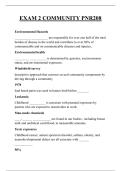
Environmental Hazards
__________ __________ are responsible for over one half of the total
burden of disease in the world and contribute to over 80% of
communicable and on communicable diseases and injuries,
Environmental health
_________ __________ is determined by genetics, socioeconomic
status, and environmental exposures.
Windshield survey
descriptive approach that assesses several community components by
driving through a community
1978
lead based paint was used in homes built before _______
Leukemia
Childhood __________ is associate with prenatal exposures by
parents who are exposed to insecticides at work.
Man-made chemicals
____-______ ___________ are found in our bodies , including breast
milk and umbilical cord blood, in measurable amounts.
Toxic exposures
Childhood cancer, autism spectrum disorder, asthma, obesity, and
neurodevelopmental delays are all associate with ______
___________
50%
, ______ of americans live in areas where the air quality does not meet
the national standards.
Motor vehicles
_______ _________ are the greatest single source of air pollution
followed by burning of fossil fuels
Air pollution
_______ ___________ is associate with asthma, respiratory diseas,
CV disease, cancer, immune system disruption, reproductive health
problems- including birth defects, infant deaths and neurologic
problems.
Indoor air quality
________ _______ ________ is affected by carbon monoxide, dust,
dust mites, molds, cockroaches, pests and pets, cleaning products and
personal care products, lead and tobacco smoke.
Salmonella, Campylobacter, E coli
Food contaminates include pathogens like _______ in chicken,
_________ is eggs, _______ in beef and greens.
Toxicology
study of poisonous substances and their effects upon body parts
Epidemiology
Branch of medical science concerned with the incidence, distribution,
and control of diseases that affect large numbers of people.
Affective domain
The most intangible domain of the learning process. It involves
affective behavior, which is conduct that expresses feelings, needs,
beliefs, values, and opinions; the feeling domain.
Cognitive domain
Environmental Hazards
__________ __________ are responsible for over one half of the total
burden of disease in the world and contribute to over 80% of
communicable and on communicable diseases and injuries,
Environmental health
_________ __________ is determined by genetics, socioeconomic
status, and environmental exposures.
Windshield survey
descriptive approach that assesses several community components by
driving through a community
1978
lead based paint was used in homes built before _______
Leukemia
Childhood __________ is associate with prenatal exposures by
parents who are exposed to insecticides at work.
Man-made chemicals
____-______ ___________ are found in our bodies , including breast
milk and umbilical cord blood, in measurable amounts.
Toxic exposures
Childhood cancer, autism spectrum disorder, asthma, obesity, and
neurodevelopmental delays are all associate with ______
___________
50%
, ______ of americans live in areas where the air quality does not meet
the national standards.
Motor vehicles
_______ _________ are the greatest single source of air pollution
followed by burning of fossil fuels
Air pollution
_______ ___________ is associate with asthma, respiratory diseas,
CV disease, cancer, immune system disruption, reproductive health
problems- including birth defects, infant deaths and neurologic
problems.
Indoor air quality
________ _______ ________ is affected by carbon monoxide, dust,
dust mites, molds, cockroaches, pests and pets, cleaning products and
personal care products, lead and tobacco smoke.
Salmonella, Campylobacter, E coli
Food contaminates include pathogens like _______ in chicken,
_________ is eggs, _______ in beef and greens.
Toxicology
study of poisonous substances and their effects upon body parts
Epidemiology
Branch of medical science concerned with the incidence, distribution,
and control of diseases that affect large numbers of people.
Affective domain
The most intangible domain of the learning process. It involves
affective behavior, which is conduct that expresses feelings, needs,
beliefs, values, and opinions; the feeling domain.
Cognitive domain