BIOLOGY
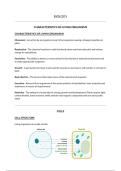
CHARACTERISTICS OF LIVING ORGANISMS
CHARACTERISTICS OF LIVING ORGANISMS
Movement - An action by an organism or part of an organism causing a change in position or
place
Respiration - The chemical reaction in cells that break down nutrient molecules and release
energy for metabolism
Sensitivity - The ability to detect or sense stimuli in the internal or external environment and
to make appropriate responses
Growth - A permanent increase in size and dry mass by an increase in cell number or cell size or
both
Reproduction - The process that makes more of the same kind of organism
Excretion - Removal from organisms of the waste products of metabolism, toxic materials and
substances in excess of requirements
Nutrition - The taking in of materials for energy, growth and development. Plants require light,
carbon dioxide, water and ions, while animals need organic compounds and ions and usually
water
CELLS
CELL STRUCTURE
Living organisms are made of cells.
, Structure Function
Nucleus Controls the activities of the cell
Cell Membrane Controls entry and exit of substances into the cell
Cytoplasm Where chemical reactions take place
Mitochondria Where respiration takes place and energy is release
Ribosomes Involved in the process of making protein (protein synthesis)
Cell Wall Made out of cellulose; provides support to the cell
Chloroplasts Converts light energy into chemical energy to carry out
photosynthesis; filled with green pigmentation (chlorophyll)
Vacuole Contains the waste products of the cells and is filled with cells sap
Ciliated Cell
- Lines the trachea (windpipe)
- Contains cilia which wafts bacteria-infested mucus out of the trachea to the mouth where it
can be swallowed and destroyed by the hydrochloric acid in the stomach
Root Hair Cell
- Primary role is to absorb water and mineral ions
- Root hair to increase surface area for absorption
- Thin walls also assist in increasing rate of absorption
- Absorption occurs by osmosis for water
- Palisade layer which is the palisade mesophyll
- Contains lots of chloroplasts which absorbs sunlight for photosynthesis to produce
,Palisade Mesophyll Cells
- Primary role is to help the plant photosynthesis
- Waxy cuticle is transparent to absorb sunlight
- Palisade Cells are at the top so chlorophyll can absorb sunlight and create more
photosynthesis
Red Blood Cell
- Transports oxygen around the body
- Contains the protein haemoglobin which binds to the oxygen to form oxyhaemoglobin;
haemoglobin contains iron
- Biconcave disc shape allows is to increase its surface area which allows it to transport more
oxygen
- No nucleus so it can carry more haemoglobin
- Flexible so it can travel through small spaces and along narrow capillaries
Sperm Cell
, - Made in the testes
- Fuses with the ovum in fertilisation to produce a zygote
- Vagina → Cervix → Uterus → Oviduct
- Has a flagellum (tail) to allow it to swim
- Middle section contains mitochondria which releases energy to power the sperm on its
journey
- Its head contains an acrosome which contains digestive enzymes which breaks down the
outer layers of the egg
- The nucleus is haploid so it contains one set of chromosomes
Egg Cell
- Jelly-like outer layer that changes once the sperm has penetrated through
- The nucleus is haploid so it contains one set of chromosomes
- Fuses with the sperm at fertilisation to create a zygote which is diploid
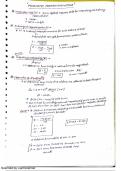
MAGNIFICATION
CHARACTERISTICS OF LIVING ORGANISMS
CHARACTERISTICS OF LIVING ORGANISMS
Movement - An action by an organism or part of an organism causing a change in position or
place
Respiration - The chemical reaction in cells that break down nutrient molecules and release
energy for metabolism
Sensitivity - The ability to detect or sense stimuli in the internal or external environment and
to make appropriate responses
Growth - A permanent increase in size and dry mass by an increase in cell number or cell size or
both
Reproduction - The process that makes more of the same kind of organism
Excretion - Removal from organisms of the waste products of metabolism, toxic materials and
substances in excess of requirements
Nutrition - The taking in of materials for energy, growth and development. Plants require light,
carbon dioxide, water and ions, while animals need organic compounds and ions and usually
water
CELLS
CELL STRUCTURE
Living organisms are made of cells.
, Structure Function
Nucleus Controls the activities of the cell
Cell Membrane Controls entry and exit of substances into the cell
Cytoplasm Where chemical reactions take place
Mitochondria Where respiration takes place and energy is release
Ribosomes Involved in the process of making protein (protein synthesis)
Cell Wall Made out of cellulose; provides support to the cell
Chloroplasts Converts light energy into chemical energy to carry out
photosynthesis; filled with green pigmentation (chlorophyll)
Vacuole Contains the waste products of the cells and is filled with cells sap
Ciliated Cell
- Lines the trachea (windpipe)
- Contains cilia which wafts bacteria-infested mucus out of the trachea to the mouth where it
can be swallowed and destroyed by the hydrochloric acid in the stomach
Root Hair Cell
- Primary role is to absorb water and mineral ions
- Root hair to increase surface area for absorption
- Thin walls also assist in increasing rate of absorption
- Absorption occurs by osmosis for water
- Palisade layer which is the palisade mesophyll
- Contains lots of chloroplasts which absorbs sunlight for photosynthesis to produce
,Palisade Mesophyll Cells
- Primary role is to help the plant photosynthesis
- Waxy cuticle is transparent to absorb sunlight
- Palisade Cells are at the top so chlorophyll can absorb sunlight and create more
photosynthesis
Red Blood Cell
- Transports oxygen around the body
- Contains the protein haemoglobin which binds to the oxygen to form oxyhaemoglobin;
haemoglobin contains iron
- Biconcave disc shape allows is to increase its surface area which allows it to transport more
oxygen
- No nucleus so it can carry more haemoglobin
- Flexible so it can travel through small spaces and along narrow capillaries
Sperm Cell
, - Made in the testes
- Fuses with the ovum in fertilisation to produce a zygote
- Vagina → Cervix → Uterus → Oviduct
- Has a flagellum (tail) to allow it to swim
- Middle section contains mitochondria which releases energy to power the sperm on its
journey
- Its head contains an acrosome which contains digestive enzymes which breaks down the
outer layers of the egg
- The nucleus is haploid so it contains one set of chromosomes
Egg Cell
- Jelly-like outer layer that changes once the sperm has penetrated through
- The nucleus is haploid so it contains one set of chromosomes
- Fuses with the sperm at fertilisation to create a zygote which is diploid
MAGNIFICATION