1|Page
Class 11 Maths Chapter 10. Straight Lines
Coordinate Geometry
The branch of Mathematics in which geometrical problem are solved through algebra by using
the coordinate system, is known as coordinate geometry.
Rectangular Axis
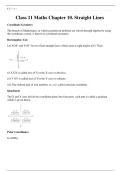
Let XOX’ and YOY’ be two fixed straight lines, which meet at right angles at O. Then,
(i) X’OX is called axis of X or the X-axis or abscissa.
(ii) Y’OY is called axis of Yor the Y-axis or ordinate.
(iii) The ordered pair of real numbers (x, y) is called cartesian coordinate .
Quadrants
The X and Y-axes divide the coordinate plane into four parts, each part is called a quadrant
which is given below.
Polar Coordinates
In ΔOPQ,
, 2|Page
cos θ = x / r and sin θ = y / r ⇒ x = r cos θ and y = r sin θ
where, r = √x2 + y2
The polar coordinate is represented by the symbol P(r,θ).
Distance Formula
(i) Distance between two points P (x1, y1) and Q (x2, y2), is
√(x2 – x1)2 + (y2 – y1)2.
(ii) If points are (r1 , θ1) arid (r2, θ2), then distance between them is
√r21 + r22 – 2r1r2cos(θ1 – θ2).
(iii) Distance of a point (x1, y1) from the origin is √x21 + y21.
Section Formula
(i) The coordinate of the point which divides the joint of (x 1, y1) and (x2, y2) in the ratio m1 :
m2 internally, is
(ii) X-axis divides the line segment joining (x1, y1) and (x2, y2) in the ratio – y1 : y2.
Similarly, Y-axis divides the same line segment in the ratio – x1 : x2.
(iii) Mid-point of the joint of (x1, y1) and (x2, y2) is (x1 + x , y1 + y)
Class 11 Maths Chapter 10. Straight Lines
Coordinate Geometry
The branch of Mathematics in which geometrical problem are solved through algebra by using
the coordinate system, is known as coordinate geometry.
Rectangular Axis
Let XOX’ and YOY’ be two fixed straight lines, which meet at right angles at O. Then,
(i) X’OX is called axis of X or the X-axis or abscissa.
(ii) Y’OY is called axis of Yor the Y-axis or ordinate.
(iii) The ordered pair of real numbers (x, y) is called cartesian coordinate .
Quadrants
The X and Y-axes divide the coordinate plane into four parts, each part is called a quadrant
which is given below.
Polar Coordinates
In ΔOPQ,
, 2|Page
cos θ = x / r and sin θ = y / r ⇒ x = r cos θ and y = r sin θ
where, r = √x2 + y2
The polar coordinate is represented by the symbol P(r,θ).
Distance Formula
(i) Distance between two points P (x1, y1) and Q (x2, y2), is
√(x2 – x1)2 + (y2 – y1)2.
(ii) If points are (r1 , θ1) arid (r2, θ2), then distance between them is
√r21 + r22 – 2r1r2cos(θ1 – θ2).
(iii) Distance of a point (x1, y1) from the origin is √x21 + y21.
Section Formula
(i) The coordinate of the point which divides the joint of (x 1, y1) and (x2, y2) in the ratio m1 :
m2 internally, is
(ii) X-axis divides the line segment joining (x1, y1) and (x2, y2) in the ratio – y1 : y2.
Similarly, Y-axis divides the same line segment in the ratio – x1 : x2.
(iii) Mid-point of the joint of (x1, y1) and (x2, y2) is (x1 + x , y1 + y)