State Court Interpreter Certification
Practice Exam
Overview of State Court Interpreter Certification Written Examination
Purpose of the Examination
Assess knowledge and experience of aspiring interpreters
Aid in preparation for the State Court Interpreter Written Certification Examination
Not the sole indicator of preparedness; other steps required for certification
"Passing Score: The passing score for the actual examination varies by state."
Examination Structure
Duration: 2 hours and 15 minutes
Divided into three essential areas: English Language, Court-Related Terms and Usage,
Ethics and Professional Conduct
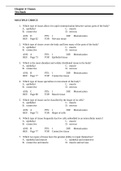
Consists of 135 multiple-choice questions with four answer options (A, B, C, D)
"Each question has four answer options, which are labeled A, B, C, and D."
Content Areas
English Language: Tests comprehension of synonyms, antonyms, and idioms
Court-Related Terms and Usage: Measures knowledge of legal terminology and
courtroom procedures
Ethics and Professional Conduct: Assesses adherence to professional standards
"Candidates are to select the most appropriate option and mark that answer on the screen."
Part I: General Language Proficiency
Section I: Sentence Completion
Candidates select the option that best completes the sentence
| Example Sentence: The accused had little chance of acquittal because he was a known
, ____________.
| Options: A. misogynist, B. misanthrope, C. evildoer, D. benefactor
"C is the best answer."
Section II: Synonyms in Context
Candidates choose the option closest in meaning to the underlined word or phrase
| Example Sentence: Recent legislation has tended to mitigate current economic
conditions.
| Options: A. extirpate, B. expurgate, C. excoriate, D. extenuate
"D is the best answer."
Section III: Synonyms
Candidates select the option closest in meaning to the word or phrase provided
Section IV: Antonyms
Candidates choose the option most opposite in meaning to the word or phrase provided
Section V: Idioms
Candidates select the option closest in meaning to the underlined idiom
Synonyms in Context
Words in Context
Lenient: Criticized for not being strict or harsh with his children.
Clandestine: Secretive or concealed operation.
Chronic: Condition that persists or becomes long-lasting.
Foremost: Leading or top expert in a particular field.
Enhance: Improve or enrich something.
Gravity: Seriousness or weight of a situation.
Lucrative: Profitable or financially rewarding.
Examples and Explanations
10. He was criticized for not being lenient with his children. - D. condemning 11. One factor that
juries consider in their verdicts is the character of the witness. - B. attribute 12. A clandestine
operation is typically surreptitious. - D. furtive 13. If you don’t recover quickly from your
Practice Exam
Overview of State Court Interpreter Certification Written Examination
Purpose of the Examination
Assess knowledge and experience of aspiring interpreters
Aid in preparation for the State Court Interpreter Written Certification Examination
Not the sole indicator of preparedness; other steps required for certification
"Passing Score: The passing score for the actual examination varies by state."
Examination Structure
Duration: 2 hours and 15 minutes
Divided into three essential areas: English Language, Court-Related Terms and Usage,
Ethics and Professional Conduct
Consists of 135 multiple-choice questions with four answer options (A, B, C, D)
"Each question has four answer options, which are labeled A, B, C, and D."
Content Areas
English Language: Tests comprehension of synonyms, antonyms, and idioms
Court-Related Terms and Usage: Measures knowledge of legal terminology and
courtroom procedures
Ethics and Professional Conduct: Assesses adherence to professional standards
"Candidates are to select the most appropriate option and mark that answer on the screen."
Part I: General Language Proficiency
Section I: Sentence Completion
Candidates select the option that best completes the sentence
| Example Sentence: The accused had little chance of acquittal because he was a known
, ____________.
| Options: A. misogynist, B. misanthrope, C. evildoer, D. benefactor
"C is the best answer."
Section II: Synonyms in Context
Candidates choose the option closest in meaning to the underlined word or phrase
| Example Sentence: Recent legislation has tended to mitigate current economic
conditions.
| Options: A. extirpate, B. expurgate, C. excoriate, D. extenuate
"D is the best answer."
Section III: Synonyms
Candidates select the option closest in meaning to the word or phrase provided
Section IV: Antonyms
Candidates choose the option most opposite in meaning to the word or phrase provided
Section V: Idioms
Candidates select the option closest in meaning to the underlined idiom
Synonyms in Context
Words in Context
Lenient: Criticized for not being strict or harsh with his children.
Clandestine: Secretive or concealed operation.
Chronic: Condition that persists or becomes long-lasting.
Foremost: Leading or top expert in a particular field.
Enhance: Improve or enrich something.
Gravity: Seriousness or weight of a situation.
Lucrative: Profitable or financially rewarding.
Examples and Explanations
10. He was criticized for not being lenient with his children. - D. condemning 11. One factor that
juries consider in their verdicts is the character of the witness. - B. attribute 12. A clandestine
operation is typically surreptitious. - D. furtive 13. If you don’t recover quickly from your