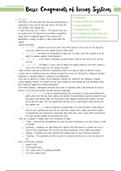
Basic Components of Living Systems
2.1 Microscopy
2.1 Microscopy
- Cell theory is the idea that both plant and animal tissue to 2.2 Magnification and calibration
composed of cells, cells are the basic unit of life and cells 2.3 More Microscopy
only develop from existing cells.
- A Light microscope has 2 lenses – the objective lens and 2.4 Eukaryotic Cell Structure
an eyepiece lens. The objective lens produces a magnified 2.5 The Ultrastructure of plant cells
image which is magnified again by the eyepiece lens.
2.6 Prokaryotic and eukaryotic cells
Illumination is usually provided by a light underneath the
sample.
- Sample preparation
o Dry mount – specimen cut into very thin slices then placed on the centre of the slide and a
cover slip is placed over the sample (e.g. hair, pollen, dust)
o Wet mount – specimens are suspended in a liquid such as water, cover slip is placed on at an
angle (e.g. aquatic samples, living organisms)
o Squash slides – a wet mount is prepared, and lens tissue is used to push down cover slip. (e.g.
root tip)
o Smear slides – the edge of a side is used to smear the sample creating a thin even coating a
cover slip is then placed over the sample. (e.g. blood)
- Stains increase contrasts as different components within a cell take up stains to different stains.
- Crystal violet or methylene blue are positively charged dyes which are attracted to negatively charged
materials in cytoplasm leading to staining of cell components.
- Dyes such as nigrosin or Congo red are negatively charged are repelled by the negatively charged
cytosol (aqueous interior). This means the dye stays outside the cells, leaving the cells unstained, which
then stand out against the stained background.
- Differential staining – distinguishes between two types of organisms that would otherwise be hard to
identify. It can also differentiate between different organelles.
o Gram stain technique is used to separate bacteria into two groups. Crystal violet applied, then
iodine which fixes the dye, then washed with alcohol. The gram-positive bacteria retain the stain
and appear blue/purple under the microscope. Gram-negative bacteria have thinner cell walls
and so lose the stain. They are stained with safranin dye (a counterstain). These bacteria will
then appear red.
o Acid-fast technique is used to separate mycobacterium from other bacteria. A lipid solvent is
used to carry carbolfuchsin dye into the cells, then washed with a dilute acid-alcohol solution.
Mycobacterium not affected by acid-alcohol and retain stain which is blue. Other bacteria lose
the stain and are exposed to methylene blue stain.
- There are a number of stages used in the production of slides
o Fixing – chemicals like formaldehyde are used to preserve specimens in as near natural a state
as possible.
o Sectioning – specimens are dehydrated with alcohols and then placed in a mould with wax or
resin to form a hard block. This can then be thinly sliced with a knife called a microtome.
o Staining – specimens are often treated with multiple stains to show different structure
o Mounting – the specimens are then secured to a microscope slide and a cover slip placed on
top.
- Rules of microscopic drawings
o Include a title
o State magnification
o Use a sharp pencil for drawings and labels
o Use white, unlined paper
, o Use as much of the paper as possible for the drawing
o Draw smooth, continuous lines
o Do not shade
o Draw clearly defined structures
o Ensure proportions are correct
o Label lines should not cross and should not have arrow heads
o Label lines should be parallel to the top of the page and drawn with a ruler.
2.1 Magnification and calibration
- Magnification is the number of times larger an image is compared with the real size of the object.
- Magnification of an object viewed with a light microscope can be calculated by multiplying the
magnification of the eye-piece lens by the magnification of the objective lens.
- Resolution is the ability of an optical instrument to see or produce an image that shows fine detail
clearly. It is defined by the distance between two points at which they are seen as 2 distinct points.
!"#$ &' "()*$
- 𝑚𝑎𝑔𝑛𝑖𝑓𝑖𝑐𝑎𝑡𝑖𝑜𝑛 = )+,-). !"#$ &' &/0$+,
- Calibrating objective lenses
1. Put the stage micrometer in place, and the eyepiece graticule in the eyepiece
2. Get the scale on the micrometer slide in clear focus
3. Align the micrometer scale with the scale in the eyepiece.
4. Divide the number of micrometer divisions by the number of graticule divisions. Use this number
to multiply by the measurement of an object.
5. Graticule divisions x magnification factor = measurement
2.3 More Microscopy
Light Microscope Electron Microscope
Maximum useful x1500 1x10⁶ (1 million)
magnification
Resolution 200nm 3nm (SEM) and 0.1nm (TEM)
Type of image -Colour -Black and white (computer coloured)
-Thicker Sections Possible -Thin specimens
-Live images possible -Specimens must be dead
-Flat sections for TEM
-Surface ‘3D’ detail for SEM
Microscope Description Advantages Limitations
Light -Light is focused using glass lenses -Low resolution due to
Microscope -Relies on light being able to pass wavelength of light (0.2𝜇m)
through the specimen. -Low magnification (max
-Regions that absorb more light appear 1250x)
darker in the image.
Scanning -Directs a beam of electrons at a -Much higher resolution -Expensive
Electron specimen than a light microscope -Extensive training required
Microscope -Creates an image based on the -Provides detailed images of -Samples must be dead
(SEM) electrons that are reflected. surface structures (vacuum, stains)
-Focused using electromagnets -High magnification
Transmission -Directs a beam of electrons at a -Much higher resolution -Expensive
Electron specimen than a light microscope -Extensive training required
2.1 Microscopy
2.1 Microscopy
- Cell theory is the idea that both plant and animal tissue to 2.2 Magnification and calibration
composed of cells, cells are the basic unit of life and cells 2.3 More Microscopy
only develop from existing cells.
- A Light microscope has 2 lenses – the objective lens and 2.4 Eukaryotic Cell Structure
an eyepiece lens. The objective lens produces a magnified 2.5 The Ultrastructure of plant cells
image which is magnified again by the eyepiece lens.
2.6 Prokaryotic and eukaryotic cells
Illumination is usually provided by a light underneath the
sample.
- Sample preparation
o Dry mount – specimen cut into very thin slices then placed on the centre of the slide and a
cover slip is placed over the sample (e.g. hair, pollen, dust)
o Wet mount – specimens are suspended in a liquid such as water, cover slip is placed on at an
angle (e.g. aquatic samples, living organisms)
o Squash slides – a wet mount is prepared, and lens tissue is used to push down cover slip. (e.g.
root tip)
o Smear slides – the edge of a side is used to smear the sample creating a thin even coating a
cover slip is then placed over the sample. (e.g. blood)
- Stains increase contrasts as different components within a cell take up stains to different stains.
- Crystal violet or methylene blue are positively charged dyes which are attracted to negatively charged
materials in cytoplasm leading to staining of cell components.
- Dyes such as nigrosin or Congo red are negatively charged are repelled by the negatively charged
cytosol (aqueous interior). This means the dye stays outside the cells, leaving the cells unstained, which
then stand out against the stained background.
- Differential staining – distinguishes between two types of organisms that would otherwise be hard to
identify. It can also differentiate between different organelles.
o Gram stain technique is used to separate bacteria into two groups. Crystal violet applied, then
iodine which fixes the dye, then washed with alcohol. The gram-positive bacteria retain the stain
and appear blue/purple under the microscope. Gram-negative bacteria have thinner cell walls
and so lose the stain. They are stained with safranin dye (a counterstain). These bacteria will
then appear red.
o Acid-fast technique is used to separate mycobacterium from other bacteria. A lipid solvent is
used to carry carbolfuchsin dye into the cells, then washed with a dilute acid-alcohol solution.
Mycobacterium not affected by acid-alcohol and retain stain which is blue. Other bacteria lose
the stain and are exposed to methylene blue stain.
- There are a number of stages used in the production of slides
o Fixing – chemicals like formaldehyde are used to preserve specimens in as near natural a state
as possible.
o Sectioning – specimens are dehydrated with alcohols and then placed in a mould with wax or
resin to form a hard block. This can then be thinly sliced with a knife called a microtome.
o Staining – specimens are often treated with multiple stains to show different structure
o Mounting – the specimens are then secured to a microscope slide and a cover slip placed on
top.
- Rules of microscopic drawings
o Include a title
o State magnification
o Use a sharp pencil for drawings and labels
o Use white, unlined paper
, o Use as much of the paper as possible for the drawing
o Draw smooth, continuous lines
o Do not shade
o Draw clearly defined structures
o Ensure proportions are correct
o Label lines should not cross and should not have arrow heads
o Label lines should be parallel to the top of the page and drawn with a ruler.
2.1 Magnification and calibration
- Magnification is the number of times larger an image is compared with the real size of the object.
- Magnification of an object viewed with a light microscope can be calculated by multiplying the
magnification of the eye-piece lens by the magnification of the objective lens.
- Resolution is the ability of an optical instrument to see or produce an image that shows fine detail
clearly. It is defined by the distance between two points at which they are seen as 2 distinct points.
!"#$ &' "()*$
- 𝑚𝑎𝑔𝑛𝑖𝑓𝑖𝑐𝑎𝑡𝑖𝑜𝑛 = )+,-). !"#$ &' &/0$+,
- Calibrating objective lenses
1. Put the stage micrometer in place, and the eyepiece graticule in the eyepiece
2. Get the scale on the micrometer slide in clear focus
3. Align the micrometer scale with the scale in the eyepiece.
4. Divide the number of micrometer divisions by the number of graticule divisions. Use this number
to multiply by the measurement of an object.
5. Graticule divisions x magnification factor = measurement
2.3 More Microscopy
Light Microscope Electron Microscope
Maximum useful x1500 1x10⁶ (1 million)
magnification
Resolution 200nm 3nm (SEM) and 0.1nm (TEM)
Type of image -Colour -Black and white (computer coloured)
-Thicker Sections Possible -Thin specimens
-Live images possible -Specimens must be dead
-Flat sections for TEM
-Surface ‘3D’ detail for SEM
Microscope Description Advantages Limitations
Light -Light is focused using glass lenses -Low resolution due to
Microscope -Relies on light being able to pass wavelength of light (0.2𝜇m)
through the specimen. -Low magnification (max
-Regions that absorb more light appear 1250x)
darker in the image.
Scanning -Directs a beam of electrons at a -Much higher resolution -Expensive
Electron specimen than a light microscope -Extensive training required
Microscope -Creates an image based on the -Provides detailed images of -Samples must be dead
(SEM) electrons that are reflected. surface structures (vacuum, stains)
-Focused using electromagnets -High magnification
Transmission -Directs a beam of electrons at a -Much higher resolution -Expensive
Electron specimen than a light microscope -Extensive training required