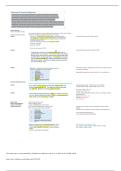
Income Statement
Revenue recognition Principle
The moment the product or service is delivered to the customer not when cash is received
Expense Recognition Principle Expenses are recognized when they are incurred by the company
Problem Revenue 100k - Expenses 60k = Netincome 40k
Problem Revenue 500k - Expenses 300k = Netincome 200k
Problem Depreciation Expense is needed to get the Net Income, but gets put back on
to calculate the Cashflow.
Depreciation is not paid out in cash, therefore it is not a cashflow item.
Statement of Retained earning
Formula : Beginning Retained Earnings + Net Income - Dividends = Ending Retained Earnings
Problem Ending Retained Earnings = 20,000 + Net Income - Dividends
Ending Retained Earnings = 20,000 +25,000 - 2,500 = 42,500
Net Income = 100k * 25% = 25k
Dividend = 10% * 25k = 2.5k
Problem Formula : Beginning Retained Earnings + Net Income - Dividends = Ending
Retained Earnings
400 = 300 + Net Income - 25
400-300+25 = Net Income
125 = Net Income
Balance Sheet Snap shot view of point in time
Basic Accounting Equation Assets = Liabilities + Equity
Statement of Cashflows Change in cash balance for a period of time
Cashflow Operations CFO = Net Income + Depreciation - Increase in NWC Examples of Current Assets : Accounts Receivable, Inventory, Prepaid
NWC = Current Assets minus Current Liabilities Expenses
Examples of Current Liabilities: Accounts Payable, Accrued Expenses, etc.
Current Assets aka Operating Assets
Current Liabilities aka Operating Liabilities
CFO = Net Income + Depreciation - NWC
CFO = 50,000 + 10,000 - ((Increase + 8,000) - (Decrease -3,000))
CFO = 60,000 - (11,000) = 49,000
This study source was downloaded by 1570889 from cliffsnotes.com on 11-11-2025 04:15:50 GMT -06:00
https://www.cliffsnotes.com//study-notes/15792470
, CFO = Net Income + Depreciation - NWC
CFO = 100,000 + 20,000 - (+ 10,000) - ( -4,000))
CFO = 120,000 - (14,000) = 106,000
CFO = Net Income + Depreciation - NWC
CFO = 100,000 + 20,000 - (+ 10,000 - 3,000) - ( -6000+2,000))
CFO = 120,000 - (7000 + 4000)
CFO = 120,000 - (11,0000) = 109,000
CFO = Net Income + Depreciation - NWC
CFO = Net Income + Depreciation - (5,000)
CFO will reduce 5000
Cashflow Investing Activities CFI CFI = ( Change in Gross PPE) x (-1)
Change in Gross PPE = (Change in Net PPE + Depreciation Expense)
Change in PPE = (PPE end of year - PPE at beginning of year)
CFI = (Change in Net PPE + Depreciation) x (-1)
CFI = ((4,500 - 5,000) + 300) x (-1)
CFI = (-500 + 300) x -1
CFI = 200
CFI = (Change in Net PPE + Depreciation) x (-1)
CFI = (20000 + 5000) x (-1)
CFI = (25000) x -1
CFI = -25,000
Cashflows from Financing CFF = Increase in Debt + Increase in Stock - Dividends Paid
CFF = Net change in Debt + Net Change in Stock - Dividends paid
CFF= (Increase in Debt - Decrease in Debt) + (Increase in Stock - Decrease in
Common Stock) - Dividend paid
Debt aka long term liabilities
stock aka equities
CFF = Increase in Debt + Increase in Stock - Dividends Paid
CFF = (15,000) + (35,000) - (5000) = 45,000
Simple Interest Problem Simple Interest
FV = Principal + ((Principal *Interest)*Years)
FV= 10,000 + ((10,000 * .08) * 3.75)
FV = 10,000 + (800 * 3.75) = 13,000
Sale is FV = 19
Bought is PV = -16
Divident is PMT= 1.15
Annual divident is yearly number = 1
CPT I/Y = 25.9375
Equity Valuation Models (3 ?s) Using the Gordon Growth Model
Price = Expected Dividend / (Required Return - Growth Rate)
Expected Dividend = Recent Dividend * (1 + Growth Rate) Price = Expected Dividend / (Required Return - Growth Rate)
Required Return = (Expected Dividend / Price) + Growth Rate Expected Dividend = Recent Dividend * (1 + Growth Rate)
Price = $5 / (10% - 4%)
Price = $5/ (.06) = 83.33
Expected Dividend = Recent Dividend * (1 + Growth Rate)
Expected Dividend =5 * (1 + .04) = 5.2
Price = Expected Dividend / (Required Return - Growth Rate)
Price = 5.2 * (10%-4%) = 88.67
This study source was downloaded by 1570889 from cliffsnotes.com on 11-11-2025 04:15:50 GMT -06:00
https://www.cliffsnotes.com//study-notes/15792470
Revenue recognition Principle
The moment the product or service is delivered to the customer not when cash is received
Expense Recognition Principle Expenses are recognized when they are incurred by the company
Problem Revenue 100k - Expenses 60k = Netincome 40k
Problem Revenue 500k - Expenses 300k = Netincome 200k
Problem Depreciation Expense is needed to get the Net Income, but gets put back on
to calculate the Cashflow.
Depreciation is not paid out in cash, therefore it is not a cashflow item.
Statement of Retained earning
Formula : Beginning Retained Earnings + Net Income - Dividends = Ending Retained Earnings
Problem Ending Retained Earnings = 20,000 + Net Income - Dividends
Ending Retained Earnings = 20,000 +25,000 - 2,500 = 42,500
Net Income = 100k * 25% = 25k
Dividend = 10% * 25k = 2.5k
Problem Formula : Beginning Retained Earnings + Net Income - Dividends = Ending
Retained Earnings
400 = 300 + Net Income - 25
400-300+25 = Net Income
125 = Net Income
Balance Sheet Snap shot view of point in time
Basic Accounting Equation Assets = Liabilities + Equity
Statement of Cashflows Change in cash balance for a period of time
Cashflow Operations CFO = Net Income + Depreciation - Increase in NWC Examples of Current Assets : Accounts Receivable, Inventory, Prepaid
NWC = Current Assets minus Current Liabilities Expenses
Examples of Current Liabilities: Accounts Payable, Accrued Expenses, etc.
Current Assets aka Operating Assets
Current Liabilities aka Operating Liabilities
CFO = Net Income + Depreciation - NWC
CFO = 50,000 + 10,000 - ((Increase + 8,000) - (Decrease -3,000))
CFO = 60,000 - (11,000) = 49,000
This study source was downloaded by 1570889 from cliffsnotes.com on 11-11-2025 04:15:50 GMT -06:00
https://www.cliffsnotes.com//study-notes/15792470
, CFO = Net Income + Depreciation - NWC
CFO = 100,000 + 20,000 - (+ 10,000) - ( -4,000))
CFO = 120,000 - (14,000) = 106,000
CFO = Net Income + Depreciation - NWC
CFO = 100,000 + 20,000 - (+ 10,000 - 3,000) - ( -6000+2,000))
CFO = 120,000 - (7000 + 4000)
CFO = 120,000 - (11,0000) = 109,000
CFO = Net Income + Depreciation - NWC
CFO = Net Income + Depreciation - (5,000)
CFO will reduce 5000
Cashflow Investing Activities CFI CFI = ( Change in Gross PPE) x (-1)
Change in Gross PPE = (Change in Net PPE + Depreciation Expense)
Change in PPE = (PPE end of year - PPE at beginning of year)
CFI = (Change in Net PPE + Depreciation) x (-1)
CFI = ((4,500 - 5,000) + 300) x (-1)
CFI = (-500 + 300) x -1
CFI = 200
CFI = (Change in Net PPE + Depreciation) x (-1)
CFI = (20000 + 5000) x (-1)
CFI = (25000) x -1
CFI = -25,000
Cashflows from Financing CFF = Increase in Debt + Increase in Stock - Dividends Paid
CFF = Net change in Debt + Net Change in Stock - Dividends paid
CFF= (Increase in Debt - Decrease in Debt) + (Increase in Stock - Decrease in
Common Stock) - Dividend paid
Debt aka long term liabilities
stock aka equities
CFF = Increase in Debt + Increase in Stock - Dividends Paid
CFF = (15,000) + (35,000) - (5000) = 45,000
Simple Interest Problem Simple Interest
FV = Principal + ((Principal *Interest)*Years)
FV= 10,000 + ((10,000 * .08) * 3.75)
FV = 10,000 + (800 * 3.75) = 13,000
Sale is FV = 19
Bought is PV = -16
Divident is PMT= 1.15
Annual divident is yearly number = 1
CPT I/Y = 25.9375
Equity Valuation Models (3 ?s) Using the Gordon Growth Model
Price = Expected Dividend / (Required Return - Growth Rate)
Expected Dividend = Recent Dividend * (1 + Growth Rate) Price = Expected Dividend / (Required Return - Growth Rate)
Required Return = (Expected Dividend / Price) + Growth Rate Expected Dividend = Recent Dividend * (1 + Growth Rate)
Price = $5 / (10% - 4%)
Price = $5/ (.06) = 83.33
Expected Dividend = Recent Dividend * (1 + Growth Rate)
Expected Dividend =5 * (1 + .04) = 5.2
Price = Expected Dividend / (Required Return - Growth Rate)
Price = 5.2 * (10%-4%) = 88.67
This study source was downloaded by 1570889 from cliffsnotes.com on 11-11-2025 04:15:50 GMT -06:00
https://www.cliffsnotes.com//study-notes/15792470