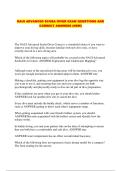
NAUI ADVANCED SCUBA DIVER EXAM QUESTIONS AND
CORRECT ANSWERS (NEW)
The NAUI Advanced Scuba Diver Course is a wonderful choice if you want to
improve your diving skills, become familiar with new dive sites, or have
recently moved to a new diving area.
Which of the following topics will probably be covered in the NAUI Advanced
Scuba Diver Course: ANSWER Exploration and Underwater Mapping?
Although some of the specialized diving areas will be introduced to you, you
won't get enough instruction to be deemed adept in them. ANSWER true
Making a checklist, putting your equipment in your dive bag the opposite way
you want to use it, and ensuring that you and your companion are both
psychologically and physically ready to dive are all part of dive preparation.
If the conditions are poor when you get to your dive site, you should either
ANSWER look for another dive site or cancel the dive.
Every dive must include the buddy check, which serves a number of functions,
such as ANSWER getting to know each other's equipment setup.
When getting acquainted with your friend's ballast system, you should:
ANSWER Become acquainted with the ballast system and identify how the
release works.
In buddy diving, you and your partner take on the duty of attempting to ensure
that you both have a comfortable and safe dive. ANSWER true
ANSWER water temperature has no effect on individual buoyancy.
Which of the following does not represent a basic design model for a compass?
The front reading for the answer
, Your bearing is read with a direct reading compass, and the answer is right
beneath the lubricant line.
The most popular method for estimating distance is to count kick cycles.
ANSWER schools of fish are an example of an environmental aid that is
inappropriate for natural navigation.
To follow a precise heading, you will typically utilize a compass as a steady
reference. - ANSWER false
Your compass indicates your bearing when swimming against a current, but
your actual path is known as your ANSWER heading.
The visible line you have created when you can align two permanent items from
your position is known as the ANSWER range.
Which of the following does not describe night diving's appeal? ANSWER: At
night, predators snooze.
The beam of your primary dive light should be broad.
In the event that your primary light fails, a smaller backup light can be helpful.
ANSWER true
Rechargeable batteries become more feasible the more frequently a diving light
is used. The answer is yes.
On a shore dive, lights used to indicate the entry/exit location shouldn't seem
like navigational aid lights.
The ANSWER tank valve typically has a personal safety light attached to it to
indicate your location.
For night diving, luminescent gauges are recommended. ANSWER true
Dives to depths greater than ANSWER 18 meters (60 feet) are often referred to
as deeper diving.
ANSWER false: Deeper diving should be done purely for its own sake.
Because of the higher density of the air you breathe, the pace at which you use
air increases with depth.
CORRECT ANSWERS (NEW)
The NAUI Advanced Scuba Diver Course is a wonderful choice if you want to
improve your diving skills, become familiar with new dive sites, or have
recently moved to a new diving area.
Which of the following topics will probably be covered in the NAUI Advanced
Scuba Diver Course: ANSWER Exploration and Underwater Mapping?
Although some of the specialized diving areas will be introduced to you, you
won't get enough instruction to be deemed adept in them. ANSWER true
Making a checklist, putting your equipment in your dive bag the opposite way
you want to use it, and ensuring that you and your companion are both
psychologically and physically ready to dive are all part of dive preparation.
If the conditions are poor when you get to your dive site, you should either
ANSWER look for another dive site or cancel the dive.
Every dive must include the buddy check, which serves a number of functions,
such as ANSWER getting to know each other's equipment setup.
When getting acquainted with your friend's ballast system, you should:
ANSWER Become acquainted with the ballast system and identify how the
release works.
In buddy diving, you and your partner take on the duty of attempting to ensure
that you both have a comfortable and safe dive. ANSWER true
ANSWER water temperature has no effect on individual buoyancy.
Which of the following does not represent a basic design model for a compass?
The front reading for the answer
, Your bearing is read with a direct reading compass, and the answer is right
beneath the lubricant line.
The most popular method for estimating distance is to count kick cycles.
ANSWER schools of fish are an example of an environmental aid that is
inappropriate for natural navigation.
To follow a precise heading, you will typically utilize a compass as a steady
reference. - ANSWER false
Your compass indicates your bearing when swimming against a current, but
your actual path is known as your ANSWER heading.
The visible line you have created when you can align two permanent items from
your position is known as the ANSWER range.
Which of the following does not describe night diving's appeal? ANSWER: At
night, predators snooze.
The beam of your primary dive light should be broad.
In the event that your primary light fails, a smaller backup light can be helpful.
ANSWER true
Rechargeable batteries become more feasible the more frequently a diving light
is used. The answer is yes.
On a shore dive, lights used to indicate the entry/exit location shouldn't seem
like navigational aid lights.
The ANSWER tank valve typically has a personal safety light attached to it to
indicate your location.
For night diving, luminescent gauges are recommended. ANSWER true
Dives to depths greater than ANSWER 18 meters (60 feet) are often referred to
as deeper diving.
ANSWER false: Deeper diving should be done purely for its own sake.
Because of the higher density of the air you breathe, the pace at which you use
air increases with depth.