surname names
Number Number
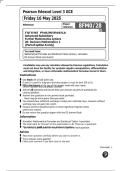
Afternoon
Mathematics
� �
Advanced
PAPER 31: Statistics
Candidates may use any calculator allowed by Pearson regulations.
Calculators must not have the facility for symbolic algebra manipulation,
differentiation and integration, or have retrievable mathematical formulae
stored in them.
Instructions
• If pencil is used for diagrams/sketches/graphs it must be dark (HB or B).
centre number and candidate number.
Answer all questions and ensure that your answers to parts of questions are
clearly labelled.
Answer the questions in the spaces provided
– there may be more space than you need.
You should show sufficient working to make your methods clear.
Answers without working may not gain full credit.
Values from statistical tables should be quoted in full. If a calculator is used instead of
tables the value should be given to an equivalent degree of accuracy.
Inexact answers should be given to three significant figures unless otherwise stated.
• The total mark for this part of the examination is 50. There are 6 questions.
– use this as a guide as to how much time to spend on each question.
• Read each question carefully before you start to answer it.
• Check your answers if you have time at the end.
,1. Bag A contains 5 red, 4 yellow and 3 green beads.
Bag B only contains red and yellow beads.
A bead is selected at random from bag A and a second bead is selected at random from
bag B
3
Given that the probability that both beads selected are yellow is
16
(a) (i) find the probability of selecting a yellow bead from bag B
(2)
(ii) Hence complete the tree diagram below by finding the probability on
each branch.
Bag A Bag B
.................... red
red
....................
.................... yellow
.................... red
....................
yellow
.................... yellow
.................... red
....................
green
.................... yellow
(2)
(b) Find the exact probability that at least one of the two beads selected is yellow.
(3)
The event X is that at least one of the beads selected is yellow.
The event W is that a green bead is selected.
(c) Find the exact value of P(W | X )
(2)
2
■■■■
,Question 1 continued
(Total for Question 1 is 9 marks)
3
■■■■ Turn over
, 2. Runners in an athletics club can train with either coach A or coach B for the 400 m race.
Coach A trains 120 runners for the 400 m and records the best time, x seconds, for
each runner.
The results are summarised by the following statistics
x 6612 x 2
364902
(a) Calculate the mean of the best times for the runners trained by coach A
(1)
(b) Calculate the standard deviation of the best times for the runners trained by coach A
(2)
The mean and standard deviation for the best times of the 100 runners trained for
the 400 m by coach B are 55.1 seconds and 3.6 seconds respectively.
A 400 m race consists of equal numbers of the fastest runners trained by coach A and by
coach B
(c) State, giving a reason, which coach is more likely to have trained the winner.
(2)
4
■■■■
Number Number
Afternoon
Mathematics
� �
Advanced
PAPER 31: Statistics
Candidates may use any calculator allowed by Pearson regulations.
Calculators must not have the facility for symbolic algebra manipulation,
differentiation and integration, or have retrievable mathematical formulae
stored in them.
Instructions
• If pencil is used for diagrams/sketches/graphs it must be dark (HB or B).
centre number and candidate number.
Answer all questions and ensure that your answers to parts of questions are
clearly labelled.
Answer the questions in the spaces provided
– there may be more space than you need.
You should show sufficient working to make your methods clear.
Answers without working may not gain full credit.
Values from statistical tables should be quoted in full. If a calculator is used instead of
tables the value should be given to an equivalent degree of accuracy.
Inexact answers should be given to three significant figures unless otherwise stated.
• The total mark for this part of the examination is 50. There are 6 questions.
– use this as a guide as to how much time to spend on each question.
• Read each question carefully before you start to answer it.
• Check your answers if you have time at the end.
,1. Bag A contains 5 red, 4 yellow and 3 green beads.
Bag B only contains red and yellow beads.
A bead is selected at random from bag A and a second bead is selected at random from
bag B
3
Given that the probability that both beads selected are yellow is
16
(a) (i) find the probability of selecting a yellow bead from bag B
(2)
(ii) Hence complete the tree diagram below by finding the probability on
each branch.
Bag A Bag B
.................... red
red
....................
.................... yellow
.................... red
....................
yellow
.................... yellow
.................... red
....................
green
.................... yellow
(2)
(b) Find the exact probability that at least one of the two beads selected is yellow.
(3)
The event X is that at least one of the beads selected is yellow.
The event W is that a green bead is selected.
(c) Find the exact value of P(W | X )
(2)
2
■■■■
,Question 1 continued
(Total for Question 1 is 9 marks)
3
■■■■ Turn over
, 2. Runners in an athletics club can train with either coach A or coach B for the 400 m race.
Coach A trains 120 runners for the 400 m and records the best time, x seconds, for
each runner.
The results are summarised by the following statistics
x 6612 x 2
364902
(a) Calculate the mean of the best times for the runners trained by coach A
(1)
(b) Calculate the standard deviation of the best times for the runners trained by coach A
(2)
The mean and standard deviation for the best times of the 100 runners trained for
the 400 m by coach B are 55.1 seconds and 3.6 seconds respectively.
A 400 m race consists of equal numbers of the fastest runners trained by coach A and by
coach B
(c) State, giving a reason, which coach is more likely to have trained the winner.
(2)
4
■■■■