Equity and Trusts
Definitions:
- Testamentary – valid upon death e.g. a will is testamentary
- Inter vivos – within lifetime
- Chattels – personal property
- Volunteer – if a trust is not fully constituted and is not part of a marital trust
Support Lecture 1 – week 2
Equity – whole body of law; born out of dissatisfaction with common law
- More flexible than common law
- Looks more at conscience and in an individual case-by-case manner
- Comprised of 3 things
o Equitable rights, remedies and maxims
Session 1 (a)– what is equity and how did it develop
- Equity is a way of ‘plugging the gaps’ of the common law
- 2 different court systems
o One for common law, one for equity
o Meant that common law and equity would sometimes conflict
Equity should prevail
- Supreme Court of Judicature Act 1873 s.25 (11)
o Brought the two courts together
- All about conscience
o Often deals with situations where the defendant may have done
something unconscionable but not illegal (contrary to common law)
o Initially religious (17th century) but now secular
o Determining conscience can be tricky since equity intervenes in both
commercial and familial instances
o Acts ‘in personam’ – on the conscience of the individual
- Comprises of:
o Equitable rights
o Equitable maxims
o Equitable remedies
Equitable rights
- Equitable vs legal property rights
o Legal – binding upon entire world
o Equitable – binds everyone except for the Bona Fide Purchaser For Value
Without Notice (BFPFVWN) – equity’s darling
Bona Fide – in good faith
Purchaser for value – paid (given consideration)
,
Without notice – actual notice, constructive notice, imputed
notice
Equitable maxims (no definitive list…)
- Equity seeks to prevent fraud
o Fraud as in an unconscionable act
- ‘Equity will not suffer a wrong without a remedy’
- ‘He who comes to equity must come with clean hands’
o You cannot seek an equitable remedy if you haven’t acted ethically
yourself
- ‘Equity follows the law (but not slavishly or always)’
o Will conflict in certain circumstances
- ‘Where there is equal equity the law shall prevail. Where equities are equal the
first in time shall prevail’
- ‘Equity looks to the intent rather than the form’
- ‘Equity looks on as done which ought to have been done’
- ‘Equity will not permit statute or common law to be used as an engine of fraud’
o Rochefoucauld v Boustead
Transferred legal title to the company without trust in writing
Used statute as an engine for fraud
Fraud as in acting unconscionably
- ‘Equity will not assist a volunteer’
- ‘Delay defeats equity’
- ‘Equity acts in personam’
- ‘Equity imputes an intention to fulfil an obligation’
Session 1(b) – An introduction to trusts
What are trusts and how did this concept develop
- The Trust concept
o Allows more than one persona to have an interest in a property at once
o Trustee – ownership in law – management
o Beneficiary – equitable interest in property - get benefit of trust property
- Types of Trust
- Express Trusts – sub categories and key features
- Implied trusts – sub categories and key features
Development of trusts
- Crusades
- Want to reclaim on return from war but give property temporarily
- Feudal system
- Henry VIII – enacted Statute of Uses (1536)
o Stop inheritance tax avoidance through system of passing on land
o Implications – that legal title was transferred to the beneficiary in the use;
thereby bringing the use to an end
,
Mainly concerning land
- By end of 17th century – ‘use’ -> ‘trust’
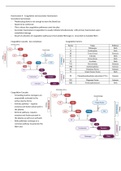
Express/implied
- Express
o Exhaustive
o Non exhaustive
o Fixed
o Discretionary
- Implied
o Resulting
o Constructive
- Ways of creating express trusts
o By declaring oneself as a trustee of one’s own property
Retain legal title but become trustee of property – beneficial
interest passes to beneficiary
o Transfer one’s property to trustees to hold
Passes property to a 3rd party (trustee), equitable interest passes
to beneficiary
Express trusts
- Characteristics of express trusts
o Can only exist if it refers to specific property
o Property must be held by trustees subject to MANDATORY obligations
o These mandatory obligations must be owed to people who can legally
assert their rights (the beneficiaries)
The beneficiary principle
The beneficiaries will police the trustee
o Beneficiaries are entitled to the benefit of the trust
Saunders v Vautier
Any adult beneficiaries who together are absolutely
entitled to the trust property who are all of sound mind
and agree can terminate the trust and demand the
property to be handed to them directly
o Importance given to beneficiary’s wishes
Beneficiaries have a proprietary right, which binds the world
except the BFPFVWN
o Can be Inter vivos or Testamentary
Inter vivos – trust created in a settlor’s life time
Testamentary trust – (property) trust left in a Will
Refer to creator of the Trust as the Testator
o The Trust Fund
Can only be created in relation to specific property
Westdeutsche Landesbank Girozentrale v Islington London
Borough Council [1996] AC 669
,
Property may be real (land), personal (chattels) or intellectual
property (copyrights, patents)
May also be tangible and intangible
Not future property
No unascertained property
Re Goldcorp Exchange Ltd [1995] 1 AC 74
Trusts will fail to exist if trust property is destroyed/dissipated
Re Diplock [1948] Ch 465
Bishopsgate Investment Management v Hoffman [1995] Ch
211
o Proprietary rights v personal rights
Proprietary right – a right in property
Beneficiaries have a proprietary right over trust fund
If trust property is misappropriated, they can trace the
property itself
Personal right – right against someone personally
e.g. if a trustee breaches their trustee duties, the
beneficiary can sue them personally for equitable
compensation
o Trusts are subject to the obligations of the trust
Trustees obligations are MANDATORY under the trust
Trustees liability for breach of trust personality to compensate for
breach of duty
Personal liability for breach of duty
Fiduciary obligations of trustees
In addition to the terms of trust, trustees are also
subjected to a fiduciary obligation
o Impose a strict duty to act solely in the interests of
the beneficiaries
- To create a valid express trust, you must have:
o 3 certainties + constitution = a valid express trust
Gifts v trusts
-When a gift is given, the donor (the giver of the gift) transfers the property
to the donee (recipient of the gift)
o The done is now the absolute owner of the gift
No splitting of legal title and equitable interest
Trust obligations v discretionary powers
-Trusts impose MANDATORY obligations on trustees
-Powers give the give the right holder a power to do something
o e.g. are not forced to do anything
Implied trusts