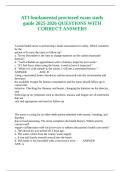
ATI Fundamentals Final Exam 2025/2026
QUESTIONS WITH ANSWERS
a nurse is admitting a client who will undergo a craniotomy. During the planning
phase of the nursing process, which of the following actions should the nurse take?
a) establish client outcomes
b) collect information about past health problems
c) determine whether the client has met specific goals
d) identify the client's specific health problem - ANSWER a)
establish client outcomes
The planning phase includes developing goals and outcomes that help the nurse
create the client's plan of care.
The nursing process:
step 1. assessment phase- collect information about past health problems (vitals,
age, height)
step 2. analysis phase- identify the client's specific health problem
step 3. planning phase- establish client goals and outcomes and selects
interventions that will help to achieve them. Also involves setting care priorities.
step 4. implementation- provides client care and uses interpersonal/technical skills
when implementing nursing interventions
step 5. evaluation phase- use critical thinking skills to determine whether the client
has met a specific goal. examines results, compares the data, identifies errors, and
considers pt's situation
a client who reports shortness of breath requests the nurse's help in changing
positions. After repositioning the client, which of the following actions should the
nurse take next?
a) encourage the client to take deep breaths
b) observe the client's rate, depth, and character of respirations
,c) prepare to administer oxygen
d) give the client a backrub to promote relaxation - ANSWER b)
observe the client's rate, depth, and character of respirations
a nurse is collecting health history data from a client who is deaf and uses
American sign language(ASL) to communicate. The nurse will be working with an
ASL interpreter. Which of the following actions should the nurse take when
working with the interpreter?
a) face away from the client to avoid distractions
b) pace speech to allow time for the interpreter to convey the words
c) make eye contact with the interpreter when explaining the procedure
d) stand in the background while the interpreter translates the message -
ANSWER b) pace speech to allow time for the interpreter to
convey the words
a nurse manager is providing teaching to a group of newly licensed nurses about
the ways that clients acquire healthcare-associated-infections (HAI's). Which of the
following routes of infection should the manager identify as an iatrogenic HAI?
a) infection required from improper hand hygiene
b) infection acquired by drug resistance
c) infection acquired by inappropriate waste disposal
d) infection acquired from diagnostic procedure - ANSWER d)
infection acquired from diagnostic procedure
Iatrogenic HAIs directly result from diagnostic or therapeutic procedures
a nurse is caring for a client who has Clostridium difficile infection and is in
contact isolation. Which of the following actions should the nurse take?
a) wear gloves when changing the clients gown
b) use alcohol-based sanitizers to cleanse the hands
c) wear a mask when assisting the client with his meal tray
,d) place the client on a complete bed rest - ANSWER a) wear
gloves when changing the clients gown
-alcohol-based sanitizers are ineffective against the spores of C.difficile
-nurse should wear a mask when working within 3 ft of a patient with droplet
precautions
-the nurse should not place the client on complete bed rest because this places him
at risk for the hazards of immobility, such as impaired skin integrity and retained
respiratory secretions. The nurse should instruct the patient to stay in his room but
to move, cough, and deep breathe at least every 2 hours
a nurse is reviewing the use of side rails with an A.P. Which of the following
statements by the A.P indicates that further teaching is required?
a) "I should not leave all 4 side rails up unless there is a prescription for restraints"
b) "an alert client will be the safest if I raise the 2 upper side rails at the head of the
bed"
c) "if the client seems confused, I'll raise all 4 side rails so that he doesn't hurt
himself"
d) "if a client is sedated, I should raise all 4 side rails to prevent a fall out of bed" -
ANSWER c) "if the client seems confused, I'll raise all 4 side rails
so that he doesn't hurt himself"
which diseases have airborne precautions? - ANSWER
Varicella, TB, and measles
which diseases have contact precautions? - ANSWER C.diff,
MRSA, scabies, vancomycin resistant enterococci
which diseases have droplet precautions? - ANSWER rubella,
influenza, meningoccal, pneumonia, streptococcal pharyngitis
, A nurse in a provider's office is measuring a client & notes a loss in height from
the previous year. The nurse should identify this finding as a manifestation of
which of the following musculoskeletal system disorders?
a) osteoporosis
b) scoliosis
c) kyphosis
d) lordosis - ANSWER a) osteoporosis
A loss of height is often an early indication of osteoporosis with occurs due to a
loss of calcium in the vertebrae which can cause them to fracture and collapse.
- scoliosis does not precipitate a decrease in the height of the client. It is an
abnormal lateral curve of the sign
- kyphosis does not precipitate a decrease in the height of a client. It is an
exaggerated posterior curvature of the thoracic spine hunchback
- lordosis does not precipitate a decrease in the height of a client. It is an
exaggerated lumbar curvature way back
Not on ATI:
The nurse is planning care for a pt with severe burns. Which of the following is
this pt at risk for developing?
1. intracellular fluid deficit
2. intracellular fluid overload
3. extracellular fluid deficit
4. interstitial fluid deficit - ANSWER 1. intracellular fluid
deficit
Because this pt was severely burned, the fluid within the cells is diminished,
leading to an intracellular fluid deficit.
Not on ATI:
QUESTIONS WITH ANSWERS
a nurse is admitting a client who will undergo a craniotomy. During the planning
phase of the nursing process, which of the following actions should the nurse take?
a) establish client outcomes
b) collect information about past health problems
c) determine whether the client has met specific goals
d) identify the client's specific health problem - ANSWER a)
establish client outcomes
The planning phase includes developing goals and outcomes that help the nurse
create the client's plan of care.
The nursing process:
step 1. assessment phase- collect information about past health problems (vitals,
age, height)
step 2. analysis phase- identify the client's specific health problem
step 3. planning phase- establish client goals and outcomes and selects
interventions that will help to achieve them. Also involves setting care priorities.
step 4. implementation- provides client care and uses interpersonal/technical skills
when implementing nursing interventions
step 5. evaluation phase- use critical thinking skills to determine whether the client
has met a specific goal. examines results, compares the data, identifies errors, and
considers pt's situation
a client who reports shortness of breath requests the nurse's help in changing
positions. After repositioning the client, which of the following actions should the
nurse take next?
a) encourage the client to take deep breaths
b) observe the client's rate, depth, and character of respirations
,c) prepare to administer oxygen
d) give the client a backrub to promote relaxation - ANSWER b)
observe the client's rate, depth, and character of respirations
a nurse is collecting health history data from a client who is deaf and uses
American sign language(ASL) to communicate. The nurse will be working with an
ASL interpreter. Which of the following actions should the nurse take when
working with the interpreter?
a) face away from the client to avoid distractions
b) pace speech to allow time for the interpreter to convey the words
c) make eye contact with the interpreter when explaining the procedure
d) stand in the background while the interpreter translates the message -
ANSWER b) pace speech to allow time for the interpreter to
convey the words
a nurse manager is providing teaching to a group of newly licensed nurses about
the ways that clients acquire healthcare-associated-infections (HAI's). Which of the
following routes of infection should the manager identify as an iatrogenic HAI?
a) infection required from improper hand hygiene
b) infection acquired by drug resistance
c) infection acquired by inappropriate waste disposal
d) infection acquired from diagnostic procedure - ANSWER d)
infection acquired from diagnostic procedure
Iatrogenic HAIs directly result from diagnostic or therapeutic procedures
a nurse is caring for a client who has Clostridium difficile infection and is in
contact isolation. Which of the following actions should the nurse take?
a) wear gloves when changing the clients gown
b) use alcohol-based sanitizers to cleanse the hands
c) wear a mask when assisting the client with his meal tray
,d) place the client on a complete bed rest - ANSWER a) wear
gloves when changing the clients gown
-alcohol-based sanitizers are ineffective against the spores of C.difficile
-nurse should wear a mask when working within 3 ft of a patient with droplet
precautions
-the nurse should not place the client on complete bed rest because this places him
at risk for the hazards of immobility, such as impaired skin integrity and retained
respiratory secretions. The nurse should instruct the patient to stay in his room but
to move, cough, and deep breathe at least every 2 hours
a nurse is reviewing the use of side rails with an A.P. Which of the following
statements by the A.P indicates that further teaching is required?
a) "I should not leave all 4 side rails up unless there is a prescription for restraints"
b) "an alert client will be the safest if I raise the 2 upper side rails at the head of the
bed"
c) "if the client seems confused, I'll raise all 4 side rails so that he doesn't hurt
himself"
d) "if a client is sedated, I should raise all 4 side rails to prevent a fall out of bed" -
ANSWER c) "if the client seems confused, I'll raise all 4 side rails
so that he doesn't hurt himself"
which diseases have airborne precautions? - ANSWER
Varicella, TB, and measles
which diseases have contact precautions? - ANSWER C.diff,
MRSA, scabies, vancomycin resistant enterococci
which diseases have droplet precautions? - ANSWER rubella,
influenza, meningoccal, pneumonia, streptococcal pharyngitis
, A nurse in a provider's office is measuring a client & notes a loss in height from
the previous year. The nurse should identify this finding as a manifestation of
which of the following musculoskeletal system disorders?
a) osteoporosis
b) scoliosis
c) kyphosis
d) lordosis - ANSWER a) osteoporosis
A loss of height is often an early indication of osteoporosis with occurs due to a
loss of calcium in the vertebrae which can cause them to fracture and collapse.
- scoliosis does not precipitate a decrease in the height of the client. It is an
abnormal lateral curve of the sign
- kyphosis does not precipitate a decrease in the height of a client. It is an
exaggerated posterior curvature of the thoracic spine hunchback
- lordosis does not precipitate a decrease in the height of a client. It is an
exaggerated lumbar curvature way back
Not on ATI:
The nurse is planning care for a pt with severe burns. Which of the following is
this pt at risk for developing?
1. intracellular fluid deficit
2. intracellular fluid overload
3. extracellular fluid deficit
4. interstitial fluid deficit - ANSWER 1. intracellular fluid
deficit
Because this pt was severely burned, the fluid within the cells is diminished,
leading to an intracellular fluid deficit.
Not on ATI: