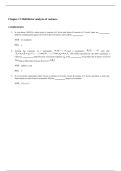
Chapter 11 Multifactor analysis of variance
COMPLETION
1. In two-factor ANOVA, when factor A consists of I levels and factor B consists of J levels, there are
different combinations (pairs) of levels of the two factors, each called a .
ANS: IJ, treatment
PTS: 1
2. Assume the existence of I parameters and J parameters such that
The model specified by the above equations is
called an model because each mean response is the of an effect due to factor A at level
and an effect due to factor B at level .
ANS: additive, sum
PTS: 1
3. In a two-factor experiment where factor A consists of I levels, factor B consists of J levels, and there is only one
observation on each of the IJ treatments, SSE has degrees of freedom.
ANS: (I-1) (J-1)
, PTS: 1
4. In a two-factor experiment where factor A consists of I levels, factor B consists of J levels, and there is only one
observation on each of the IJ treatments, SST has degrees of freedom.
ANS: IJ – 1
PTS: 1
5. In a two-factor experiment where factor A consists of 5 levels, factor B consists of 4 levels, and there is only one
observation on each of the 20 treatments, the critical value for testing the null hypothesis that the different levels of
factor B have no effect on true average response at significance level .05 is denoted by , and is equal to
.
ANS: =3.49
PTS: 1
6. In two-factor ANOVA, additivity means that the difference in true average responses for any two levels of one of the
factors is the same for each level of the other factor. When additivity does not hold, we say that there is
between the different levels of the factors.
ANS: interaction
PTS: 1
7. The parameters for the fixed effects model with interaction are and
Thus the model is The are called the for factor A, whereas the are the
for factor B. The are referred to as the parameters.
ANS: main effects, main effects, interaction
PTS: 1
8. In the fixed effects model with interaction, assume that there are I levels of factor A, J levels of factor B, and K
observations (replications) for each of the IJ combinations of levels of the two factors. Then SST (the total
sum of squares) has df = .
ANS: IJK – 1
PTS: 1
9. In the fixed effects model with interaction, assume that there are I levels of factor A, J levels of Factor J, and K
observations (replications) for each of the IJ combinations of levels of the two factors. Then SSE (the error sum of
squares) has df = .
ANS: IJ(K-1)
PTS: 1
,10. In the fixed effects model with interaction, assume that there are I levels of factor A, J levels of factor B, and K
observations (replications) for each of the IJ combinations of levels of the two factors. Then SSAB (the interaction
sum of squares) has df =_ .
ANS: (I-1) (J-1)
PTS: 1
11. The three-factor fixed effects model, with the same number of observations for each combination of levels, I, J, and
K of the three factors A, B, and C, respectively, is represented by
The parameters are called , and is called a , whereas
are the parameters.
ANS: two-factor interactions, three-factor interaction, main effects
PTS: 1
12. In the three-factor fixed effects model, assume that there are 5 levels of factor A, 4 levels of factor B, 3 levels of factor
C, and 2 observations for each combination of levels of the three factors. Then the error sum of squares (SSE) has df
= .
ANS: 60
PTS: 1
13. In the three-factor fixed effects model, assume that there are 4 levels for each of the three factors A, B, and C, and 3
observations for each combination of levels of the three factors. Then, the two-factor interaction sum of squares for
factors B and C (SSBC) has df = .
ANS: 9
PTS: 1
14. In the three-factor effects model, assume that there are 4 levels for factor A, 2 levels for factor B, 3 levels for factor C,
and 4 observations for each combination of levels of the three factors. Then, the three-factor interaction sum of squares
(SSABC) has df = .
ANS: 6
PTS: 1
15. When several factors are to be studied simultaneously, an experiment in which there is at least one observation for
every possible combination of levels is referred to as .
ANS: complete layout
PTS: 1
, 16. A three-factor experiment, with I levels of factor A, J levels of factor B, and C levels of factor C, in which fewer than
IJK observations are made is called an .
ANS: incomplete layout
PTS: 1
17. In a three-factor experiment, if the levels of factor A are identified with the rows of a two-way table and the levels of
B with the columns of the table, then the defining characteristic of a Latin square design is that every level of factor
C appears exactly in each row and exactly in each column.
ANS: once, once
PTS: 1
18. An experiment in which there are p factors, each at two levels, is referred to as a
ANS: factorial experiment.
PTS: 1
19. A experiment has factors, and each factor has levels.
ANS: three, two
PTS: 1
20. Consider a experiment with 2 blocks. The price paid for this blocking is that of the factor effects
cannot be estimated.
ANS: one
PTS: 1
21. Consider a experiment with four blocks. In this case, factor effects are confounded with the blocks.
ANS: three
PTS: 1
22. To select a quarter-replicate of a factorial experiment possible treatment conditions), the number
of defining effects that must be selected is .
ANS: two
PTS: 1
23. To select a half-replicate of a factorial experiment possible treatment conditions), the number of
defining effects that must be selected is .
COMPLETION
1. In two-factor ANOVA, when factor A consists of I levels and factor B consists of J levels, there are
different combinations (pairs) of levels of the two factors, each called a .
ANS: IJ, treatment
PTS: 1
2. Assume the existence of I parameters and J parameters such that
The model specified by the above equations is
called an model because each mean response is the of an effect due to factor A at level
and an effect due to factor B at level .
ANS: additive, sum
PTS: 1
3. In a two-factor experiment where factor A consists of I levels, factor B consists of J levels, and there is only one
observation on each of the IJ treatments, SSE has degrees of freedom.
ANS: (I-1) (J-1)
, PTS: 1
4. In a two-factor experiment where factor A consists of I levels, factor B consists of J levels, and there is only one
observation on each of the IJ treatments, SST has degrees of freedom.
ANS: IJ – 1
PTS: 1
5. In a two-factor experiment where factor A consists of 5 levels, factor B consists of 4 levels, and there is only one
observation on each of the 20 treatments, the critical value for testing the null hypothesis that the different levels of
factor B have no effect on true average response at significance level .05 is denoted by , and is equal to
.
ANS: =3.49
PTS: 1
6. In two-factor ANOVA, additivity means that the difference in true average responses for any two levels of one of the
factors is the same for each level of the other factor. When additivity does not hold, we say that there is
between the different levels of the factors.
ANS: interaction
PTS: 1
7. The parameters for the fixed effects model with interaction are and
Thus the model is The are called the for factor A, whereas the are the
for factor B. The are referred to as the parameters.
ANS: main effects, main effects, interaction
PTS: 1
8. In the fixed effects model with interaction, assume that there are I levels of factor A, J levels of factor B, and K
observations (replications) for each of the IJ combinations of levels of the two factors. Then SST (the total
sum of squares) has df = .
ANS: IJK – 1
PTS: 1
9. In the fixed effects model with interaction, assume that there are I levels of factor A, J levels of Factor J, and K
observations (replications) for each of the IJ combinations of levels of the two factors. Then SSE (the error sum of
squares) has df = .
ANS: IJ(K-1)
PTS: 1
,10. In the fixed effects model with interaction, assume that there are I levels of factor A, J levels of factor B, and K
observations (replications) for each of the IJ combinations of levels of the two factors. Then SSAB (the interaction
sum of squares) has df =_ .
ANS: (I-1) (J-1)
PTS: 1
11. The three-factor fixed effects model, with the same number of observations for each combination of levels, I, J, and
K of the three factors A, B, and C, respectively, is represented by
The parameters are called , and is called a , whereas
are the parameters.
ANS: two-factor interactions, three-factor interaction, main effects
PTS: 1
12. In the three-factor fixed effects model, assume that there are 5 levels of factor A, 4 levels of factor B, 3 levels of factor
C, and 2 observations for each combination of levels of the three factors. Then the error sum of squares (SSE) has df
= .
ANS: 60
PTS: 1
13. In the three-factor fixed effects model, assume that there are 4 levels for each of the three factors A, B, and C, and 3
observations for each combination of levels of the three factors. Then, the two-factor interaction sum of squares for
factors B and C (SSBC) has df = .
ANS: 9
PTS: 1
14. In the three-factor effects model, assume that there are 4 levels for factor A, 2 levels for factor B, 3 levels for factor C,
and 4 observations for each combination of levels of the three factors. Then, the three-factor interaction sum of squares
(SSABC) has df = .
ANS: 6
PTS: 1
15. When several factors are to be studied simultaneously, an experiment in which there is at least one observation for
every possible combination of levels is referred to as .
ANS: complete layout
PTS: 1
, 16. A three-factor experiment, with I levels of factor A, J levels of factor B, and C levels of factor C, in which fewer than
IJK observations are made is called an .
ANS: incomplete layout
PTS: 1
17. In a three-factor experiment, if the levels of factor A are identified with the rows of a two-way table and the levels of
B with the columns of the table, then the defining characteristic of a Latin square design is that every level of factor
C appears exactly in each row and exactly in each column.
ANS: once, once
PTS: 1
18. An experiment in which there are p factors, each at two levels, is referred to as a
ANS: factorial experiment.
PTS: 1
19. A experiment has factors, and each factor has levels.
ANS: three, two
PTS: 1
20. Consider a experiment with 2 blocks. The price paid for this blocking is that of the factor effects
cannot be estimated.
ANS: one
PTS: 1
21. Consider a experiment with four blocks. In this case, factor effects are confounded with the blocks.
ANS: three
PTS: 1
22. To select a quarter-replicate of a factorial experiment possible treatment conditions), the number
of defining effects that must be selected is .
ANS: two
PTS: 1
23. To select a half-replicate of a factorial experiment possible treatment conditions), the number of
defining effects that must be selected is .