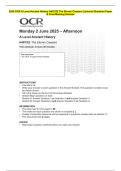
2025 OCR A Level Ancient History H407/22 The Eleven Caesars Combined Question Paper
& Final Marking Scheme
Oxford Cambridge and RSA
Monday 2 June 2025 – Afternoon
A Level Ancient History
H407/22 The Eleven Caesars
Time allowed: 2 hours 30 minutes
You must have:
• the OCR 12-page Answer Booklet
INSTRUCTIONS
• Use black ink.
• Write your answer to each question in the Answer Booklet. The question numbers must
be clearly shown.
• Fill in the boxes on the front of the Answer Booklet.
• Answer four questions in total:
Section A: Answer Question 1 or Question 2 and answer Question 3.
Section B: Answer Question 4 and answer Question 5 or Question 6.
INFORMATION
• The total mark for this paper is 98.
• The marks for each question are shown in brackets [ ].
• Quality of extended response will be assessed in questions marked with an asterisk (*).
• This document has 4 pages.
ADVICE
• Read each question carefully before you start your answer.
, © OCR 2025 [603/0805/9] OCR is an exempt Charity
DC (WW) 353008/2 Turn over
*1845778427*
, 2
Section A: The Julio‑Claudian Emperors, 31 BC–AD 68
Answer Question 1 or Question 2 and answer Question 3.
Answer either Question 1 or Question 2.
1* To what extent did the reign of Tiberius set a pattern for the future direction of the principate?
You must use and analyse the ancient sources you have studied as well as your own knowledge
to support your answer. [30]
2* ‘The imperial women had very little influence during this period.’
How far do the sources support this view?
You must use and analyse the ancient sources you have studied as well as your own knowledge
to support your answer. [30]
Answer Question 3.
3 Read the interpretation below.
The people most bitter about imperial rule were the aristocrats, who had lost the political
power that had always belonged to their ancestors. The average Roman had never
held more than a token share of this power and could not, therefore, grieve too deeply
when the monarchy of the emperor replaced the aristocracy of the Senate. In fact, many
Romans welcomed this new system of government because it brought peace, stability, 5
and therefore prosperity. In the republican period, the fate of the common man was
frequently dependent on magistrates who changed every year and who were willing to
sacrifice the welfare of other people to achieve their own political and financial ambitions.
In the imperial period, affairs of state were conducted by bureaucrats, not politicians; by
men who had served in one office for a long time and who had no illusions of securing 10
for themselves supreme control over the Roman world.
J-A Shelton, As the Romans Did (adapted)
How convincing do you find Shelton’s interpretation that the majority benefitted from the
Julio-Claudian system of government because it brought ‘peace, stability, and therefore
prosperity’?
You must use your knowledge of the historical period and the ancient sources you have studied
to analyse and evaluate Shelton’s interpretation. [20]
© OCR 2025 H407/22 Jun25
, 3
Section B: The Flavians, AD 68–96
Answer Question 4 and answer Question 5 or Question 6.
Answer Question 4.
4 Read the passages below.
Though the general public greeted the news of Domitian’s fate with indifference, it deeply
affected the troops, who at once began to speak of him as Divus – they would have
avenged him had anyone given them a lead – and insisted that his assassins should
be brought to justice. The senators, on the other hand, were delighted, and thronged to
denounce Domitian in the Senate House with bitter and insulting cries. Then, sending 5
for ladders, they had his images and votive shields engraved with his likeness brought
smashing down, and ended by decreeing that all inscriptions referring to him must be
effaced and all records of his reign obliterated.
Suetonius, Domitian 23
He established two new factions of charioteers, called Gold and Purple. He gave many
gifts to spectators …, and once he gave them a feast while they stayed in their seats,
and supplied them with wine, which flowed in abundance all night everywhere. All this of
course won him great popularity with the mob, but for the upper classes it spelt ruination.
For he had no reserves of cash from which to fund his generosity, and so he murdered 5
many of them.
Dio Cassius 67.4.4– 4.5
How useful are these passages for our understanding of relations between Domitian and the
different classes of Roman citizens? [12]
Answer either Question 5 or Question 6.
5* To what extent and for what reasons did the Flavian emperors change the nature of the
principate?
You must use and analyse the ancient sources you have studied as well as your own knowledge
to support your answer. [36]
6* How far do the sources help us to understand the attitudes of the Flavians towards religion?
You must use and analyse the ancient sources you have studied as well as your own knowledge
to support your answer. [36]
END OF QUESTION PAPER
© OCR 2025 H407/22 Jun25
& Final Marking Scheme
Oxford Cambridge and RSA
Monday 2 June 2025 – Afternoon
A Level Ancient History
H407/22 The Eleven Caesars
Time allowed: 2 hours 30 minutes
You must have:
• the OCR 12-page Answer Booklet
INSTRUCTIONS
• Use black ink.
• Write your answer to each question in the Answer Booklet. The question numbers must
be clearly shown.
• Fill in the boxes on the front of the Answer Booklet.
• Answer four questions in total:
Section A: Answer Question 1 or Question 2 and answer Question 3.
Section B: Answer Question 4 and answer Question 5 or Question 6.
INFORMATION
• The total mark for this paper is 98.
• The marks for each question are shown in brackets [ ].
• Quality of extended response will be assessed in questions marked with an asterisk (*).
• This document has 4 pages.
ADVICE
• Read each question carefully before you start your answer.
, © OCR 2025 [603/0805/9] OCR is an exempt Charity
DC (WW) 353008/2 Turn over
*1845778427*
, 2
Section A: The Julio‑Claudian Emperors, 31 BC–AD 68
Answer Question 1 or Question 2 and answer Question 3.
Answer either Question 1 or Question 2.
1* To what extent did the reign of Tiberius set a pattern for the future direction of the principate?
You must use and analyse the ancient sources you have studied as well as your own knowledge
to support your answer. [30]
2* ‘The imperial women had very little influence during this period.’
How far do the sources support this view?
You must use and analyse the ancient sources you have studied as well as your own knowledge
to support your answer. [30]
Answer Question 3.
3 Read the interpretation below.
The people most bitter about imperial rule were the aristocrats, who had lost the political
power that had always belonged to their ancestors. The average Roman had never
held more than a token share of this power and could not, therefore, grieve too deeply
when the monarchy of the emperor replaced the aristocracy of the Senate. In fact, many
Romans welcomed this new system of government because it brought peace, stability, 5
and therefore prosperity. In the republican period, the fate of the common man was
frequently dependent on magistrates who changed every year and who were willing to
sacrifice the welfare of other people to achieve their own political and financial ambitions.
In the imperial period, affairs of state were conducted by bureaucrats, not politicians; by
men who had served in one office for a long time and who had no illusions of securing 10
for themselves supreme control over the Roman world.
J-A Shelton, As the Romans Did (adapted)
How convincing do you find Shelton’s interpretation that the majority benefitted from the
Julio-Claudian system of government because it brought ‘peace, stability, and therefore
prosperity’?
You must use your knowledge of the historical period and the ancient sources you have studied
to analyse and evaluate Shelton’s interpretation. [20]
© OCR 2025 H407/22 Jun25
, 3
Section B: The Flavians, AD 68–96
Answer Question 4 and answer Question 5 or Question 6.
Answer Question 4.
4 Read the passages below.
Though the general public greeted the news of Domitian’s fate with indifference, it deeply
affected the troops, who at once began to speak of him as Divus – they would have
avenged him had anyone given them a lead – and insisted that his assassins should
be brought to justice. The senators, on the other hand, were delighted, and thronged to
denounce Domitian in the Senate House with bitter and insulting cries. Then, sending 5
for ladders, they had his images and votive shields engraved with his likeness brought
smashing down, and ended by decreeing that all inscriptions referring to him must be
effaced and all records of his reign obliterated.
Suetonius, Domitian 23
He established two new factions of charioteers, called Gold and Purple. He gave many
gifts to spectators …, and once he gave them a feast while they stayed in their seats,
and supplied them with wine, which flowed in abundance all night everywhere. All this of
course won him great popularity with the mob, but for the upper classes it spelt ruination.
For he had no reserves of cash from which to fund his generosity, and so he murdered 5
many of them.
Dio Cassius 67.4.4– 4.5
How useful are these passages for our understanding of relations between Domitian and the
different classes of Roman citizens? [12]
Answer either Question 5 or Question 6.
5* To what extent and for what reasons did the Flavian emperors change the nature of the
principate?
You must use and analyse the ancient sources you have studied as well as your own knowledge
to support your answer. [36]
6* How far do the sources help us to understand the attitudes of the Flavians towards religion?
You must use and analyse the ancient sources you have studied as well as your own knowledge
to support your answer. [36]
END OF QUESTION PAPER
© OCR 2025 H407/22 Jun25