

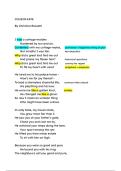
COUSIN KATE
By Christina Rossetti
I was a cottage-maiden
Hardened by sun and air,
Contented with my cottage-mates, past tense = happiness thing of past
Not mindful I was fair. fair=beautiful
Why did a great lord find me out
And praise my flaxen hair? rhetorical questions
Why did a great lord find me out convey her regret
To fill my heart with care? anaphora = emphasis
He lured me to his palace-home –
Woe’s me for joy thereof –
To lead a shameless shameful life, contrast infers deceit
His plaything and his love.
He wore me like a golden knot, similes
He changed me like a glove:
So now I moan an unclean thing
Who might have been a dove.
O Lady Kate, my Cousin Kate,
You grow more fair than I:
He saw you at your father’s gate,
Chose you and cast me by.
He watched your steps along the lane,
Your sport among the rye:
He lifted you from mean estate
To sit with him on high.
Because you were so good and pure
He bound you with his ring:
The neighbours call you good and pure,
, Call me an outcast thing.
Even so I sit and howl in dust
You sit in gold and sing:
Now which of us has tenderer heart?
You had the stronger wing.
O Cousin Kate, my love was true,
Your love was writ in sand:
If he had fooled not me but you,
If you stood where I stand,
He had not won me with his love
Nor bought me with his land:
I would have spit into his face
And not have taken his hand.
Yet I’ve a gift you have not got scornful tone
And seem not like to get:
For all your clothes and wedding-ring
I’ve little doubt you fret.
My fair-haired son, my shame, my pride, continuation of the contrast
Cling closer, closer yet:
Your sire would give broad lands for one
To wear his coronet. small crown worn by non royals
The poem is a dramatic monologue, directly addressed to the
eponymous Cousin Kate, who is called “you” throughout, although she
is clearly not present. As in all good dramatic monologues, the reader
can track the gamut of emotions, contradictions and inconsistencies in
this unreliable narrator’s story. The emotional story is complex, and one
can read into it possible comments about gender imbalance, class
inequality and family discord.
The diction used by the speaker to describe the ‘great lord’ has
connotations of deceit and beguilement. The speaker is “lured” by him
which implies an element of manipulation and deception. The words
“find me out” in the first stanza has overtones of this “lord” having a
By Christina Rossetti
I was a cottage-maiden
Hardened by sun and air,
Contented with my cottage-mates, past tense = happiness thing of past
Not mindful I was fair. fair=beautiful
Why did a great lord find me out
And praise my flaxen hair? rhetorical questions
Why did a great lord find me out convey her regret
To fill my heart with care? anaphora = emphasis
He lured me to his palace-home –
Woe’s me for joy thereof –
To lead a shameless shameful life, contrast infers deceit
His plaything and his love.
He wore me like a golden knot, similes
He changed me like a glove:
So now I moan an unclean thing
Who might have been a dove.
O Lady Kate, my Cousin Kate,
You grow more fair than I:
He saw you at your father’s gate,
Chose you and cast me by.
He watched your steps along the lane,
Your sport among the rye:
He lifted you from mean estate
To sit with him on high.
Because you were so good and pure
He bound you with his ring:
The neighbours call you good and pure,
, Call me an outcast thing.
Even so I sit and howl in dust
You sit in gold and sing:
Now which of us has tenderer heart?
You had the stronger wing.
O Cousin Kate, my love was true,
Your love was writ in sand:
If he had fooled not me but you,
If you stood where I stand,
He had not won me with his love
Nor bought me with his land:
I would have spit into his face
And not have taken his hand.
Yet I’ve a gift you have not got scornful tone
And seem not like to get:
For all your clothes and wedding-ring
I’ve little doubt you fret.
My fair-haired son, my shame, my pride, continuation of the contrast
Cling closer, closer yet:
Your sire would give broad lands for one
To wear his coronet. small crown worn by non royals
The poem is a dramatic monologue, directly addressed to the
eponymous Cousin Kate, who is called “you” throughout, although she
is clearly not present. As in all good dramatic monologues, the reader
can track the gamut of emotions, contradictions and inconsistencies in
this unreliable narrator’s story. The emotional story is complex, and one
can read into it possible comments about gender imbalance, class
inequality and family discord.
The diction used by the speaker to describe the ‘great lord’ has
connotations of deceit and beguilement. The speaker is “lured” by him
which implies an element of manipulation and deception. The words
“find me out” in the first stanza has overtones of this “lord” having a

