1
For Expert help and assignment solutions, +254707240657
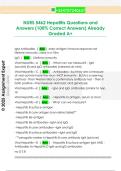
Nurs 5462 Headache Questions and
Answers (100% Correct Answers) Already
Graded A+
• Primary headache [ Ans: ] common and is not a symptom of
another medical condition • Migraine • Tension-type • Cluster
Secondary Headache [ Ans: ] specific etiologies-and sx depend
on these pathologies
© 2025 Assignment Expert
Gender differences [ Ans: ] migraine/tension/Giant Cell Arteritis-
more common in women. Cluster more common in men
Onset over 50 [ Ans: ] or worsening headache check for
Guru01 - Stuvia
underlying neurological disease, 17% of older adults report
frequent headche
Headache Needing Investigation [ Ans: ] • Sudden onset of
new, severe headache • Progressively getting worse • After
exertion, straining, coughing, or sex-suggests inc ICP-needs CT •
With associated symptoms - "worst headache I have ever had" •
First headache occurring after the age of 50 years
Cortical Spreading Depression [ Ans: ] • Basis of the migraine
aura • Cortical neuronal activity followed by a postictal
depression of neuronal firing • CSD can trigger meningeal pain
mechanisms via neurogenic inflammation, vasodilation and
plasma extravasation • Blood barrier is activated—which may
explain some of the pain • Glutamatergic synapses in the cortex
are activated
Brain Stem Generator [ Ans: ] • Meningeal pain mechanisms are
activated through the trigeminovascular pathways • This causes
release of inflammatory cytokines, neuroinflammatory peptides
and calcitonin gene-related peptide—this hormone causes the
vasodilation • Peripheral nociceptors are activated—this
, 2
For Expert help and assignment solutions, +254707240657
mechanism is referred to as peripheral sensitization • When the
trigeminal nucleus caudalis and rostral brain structures are
activated—it is known as central sensitization
Clinical Presentation: Migraine [ Ans: ] • Migraine without aura •
Common migraine • Most common headache • One sided
headache • Pounding/throbbing • Moderate to severe intensity •
Lasts 4-24 hours, May be associated with nausea, vomiting,
sensitivity to light or sound
Clinical Presentation: Migraine (aura) [ Ans: ] • Aura usually
occurs before onset of headache • Auras usually last seconds, but
can last up to 20", patient then gets headache • "Fortification
spectrum" occurs in 10% [Jagged lines similar to stone fortifications
© 2025 Assignment Expert
around a fort], • Visual auras can be spots, shimmering bright
lights or visual loss [scotomas] • Sensory auras include tingling,
numbness of fingers, motor disturbances such as hemiparesis or
Guru01 - Stuvia
monoparesis and cognitive disorders
"prodrome" to a migraine [ Ans: ] • Increased irritability,
decreased energy, food cravings • A signal that a headache is
coming and may allow patient to use methods to abort the
headache
IHS Criteria for Migraine without Aura [ Ans: ] A At least 5 attacks
fulfilling criteria B through D B Headache lasting 4-72 hrs. [treated
or untreated] C Headache has at least 2 of the following:
Unilateral location Pulsating quality Moderate to severe intensity
Worse with walking stairs or physical activity D During headache,
at least one of the following: Nausea, vomiting [or both]
Photophobia and/or phonophobia E No evidence of related
organic disease
IHS Criteria for Migraine with Aura [ Ans: ] A At least 2 attacks
fulfilling criterion B: B At least 3 of the following characteristics: One
or more fully reversible aura symptoms At least 1 aura symptom
develops gradually over >4" or 2 or more symptoms occur in
succession No single aura symptoms lasts >60" Headache follows
aura with a free interval of <60" C No evidence of a secondary
cause
For Expert help and assignment solutions, +254707240657
Nurs 5462 Headache Questions and
Answers (100% Correct Answers) Already
Graded A+
• Primary headache [ Ans: ] common and is not a symptom of
another medical condition • Migraine • Tension-type • Cluster
Secondary Headache [ Ans: ] specific etiologies-and sx depend
on these pathologies
© 2025 Assignment Expert
Gender differences [ Ans: ] migraine/tension/Giant Cell Arteritis-
more common in women. Cluster more common in men
Onset over 50 [ Ans: ] or worsening headache check for
Guru01 - Stuvia
underlying neurological disease, 17% of older adults report
frequent headche
Headache Needing Investigation [ Ans: ] • Sudden onset of
new, severe headache • Progressively getting worse • After
exertion, straining, coughing, or sex-suggests inc ICP-needs CT •
With associated symptoms - "worst headache I have ever had" •
First headache occurring after the age of 50 years
Cortical Spreading Depression [ Ans: ] • Basis of the migraine
aura • Cortical neuronal activity followed by a postictal
depression of neuronal firing • CSD can trigger meningeal pain
mechanisms via neurogenic inflammation, vasodilation and
plasma extravasation • Blood barrier is activated—which may
explain some of the pain • Glutamatergic synapses in the cortex
are activated
Brain Stem Generator [ Ans: ] • Meningeal pain mechanisms are
activated through the trigeminovascular pathways • This causes
release of inflammatory cytokines, neuroinflammatory peptides
and calcitonin gene-related peptide—this hormone causes the
vasodilation • Peripheral nociceptors are activated—this
, 2
For Expert help and assignment solutions, +254707240657
mechanism is referred to as peripheral sensitization • When the
trigeminal nucleus caudalis and rostral brain structures are
activated—it is known as central sensitization
Clinical Presentation: Migraine [ Ans: ] • Migraine without aura •
Common migraine • Most common headache • One sided
headache • Pounding/throbbing • Moderate to severe intensity •
Lasts 4-24 hours, May be associated with nausea, vomiting,
sensitivity to light or sound
Clinical Presentation: Migraine (aura) [ Ans: ] • Aura usually
occurs before onset of headache • Auras usually last seconds, but
can last up to 20", patient then gets headache • "Fortification
spectrum" occurs in 10% [Jagged lines similar to stone fortifications
© 2025 Assignment Expert
around a fort], • Visual auras can be spots, shimmering bright
lights or visual loss [scotomas] • Sensory auras include tingling,
numbness of fingers, motor disturbances such as hemiparesis or
Guru01 - Stuvia
monoparesis and cognitive disorders
"prodrome" to a migraine [ Ans: ] • Increased irritability,
decreased energy, food cravings • A signal that a headache is
coming and may allow patient to use methods to abort the
headache
IHS Criteria for Migraine without Aura [ Ans: ] A At least 5 attacks
fulfilling criteria B through D B Headache lasting 4-72 hrs. [treated
or untreated] C Headache has at least 2 of the following:
Unilateral location Pulsating quality Moderate to severe intensity
Worse with walking stairs or physical activity D During headache,
at least one of the following: Nausea, vomiting [or both]
Photophobia and/or phonophobia E No evidence of related
organic disease
IHS Criteria for Migraine with Aura [ Ans: ] A At least 2 attacks
fulfilling criterion B: B At least 3 of the following characteristics: One
or more fully reversible aura symptoms At least 1 aura symptom
develops gradually over >4" or 2 or more symptoms occur in
succession No single aura symptoms lasts >60" Headache follows
aura with a free interval of <60" C No evidence of a secondary
cause