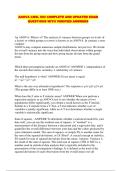
ANOVA CNSL 503 COMPLETE AND UPDATED EXAM
QUESTIONS WITH VERIFIED ANSWERS
An ANOVA: What is it? The analysis of variance between groups (or levels of
a factor) or within groups (or error) is known as an ANOVA. In contrast, t-tests
compare
ANOVA may compare numerous sample distributions, not just two. We divide
the overall variance into the ways that individual observations within groups
deviate from the group mean and how group means deviate from the grand
mean.
Which three presumptions underlie an ANOVA? ANSWER 1. independence of
the second observation. normalcy 3. uniformity of variance
The null hypothesis is what? ANSWER: Every mean is equal.
μ1 = μ2 = μ3 = μ4
What is the one-way alternative hypothesis? The response is μ1≠ μ2≠ μ3≠ μ4.
(The groups differ in at least ONE way.)
What does the F ratio or F statistic mean? ANSWER When you perform a
regression analysis or an ANOVA test to see whether the means of two
populations differ significantly, you obtain a result known as the F statistic.
Similar to a T statistic from a T-Test, a F test indicates whether a set of
variables is jointly significant, while an A-T test determines whether a single
variable is statistically significant.
Sum of squares - ANSWER To determine whether a statistical model fits your
data well, you can use the residual sum of squares. A "residual" is a
measurement of the distance between a data point and a regression line, and it
quantifies the overall difference between your data and the values projected by
your estimation model. The sum of squares, or simply SS, is another name for
the sum of the squared deviations, or (X-Xbar)². A crucial concept in statistics,
SS stands for sum of squared deviations from the mean. variance. Variance is
the result of the sum of squares. The total sum of squares (TSS or SST) is a
number used in statistical data analysis that is typically included in the
presentation of the investigation's findings. It is defined as the total of the
squared deviations of each observation from the overall mean over all
, observations. Able to compute TOTAL, WITHIN, and BETWEEN sums of
squares
What is the formula for mean squares? Mean Square for the answer is
Divide the sum of squares by the number of degrees of freedom.
To ascertain if factors (treatments) are significant, ANOVA employs mean
squares.
shows how the sample means differ from one another.
What is a post-hoc test used for? ANSWER Goal: Determine which score pairs
differ considerably.
-Maintains Type I error protection for families.
When are post-hoc tests examined? Only respond if the total F value is
significant.
A two-way ANOVA: what is it? The second independent variable is
How many levels are there?
For example:
You're interested in how gender and age affect gait speed.
Describe the levels, IV, and DV. The number of groups that each independent
variable contains
DV: Speed of gait
IV: Gender and Age
Three age-based levels (groups)
Two tiers (groups) according to gender
The three age groups that were previously employed should be tested for sex
differences in gait velocity.
The "main effect" is what? The mean impact of every independent variable.
primary sex effect (combing all ages)
"What is the effect of sex on gait speed? Is there a difference in gait speed if
you're male versus female? Do men and women have different gaits speeds?"
age-related main effect (combining both genders)?
"Does gait speed depend on age?"
QUESTIONS WITH VERIFIED ANSWERS
An ANOVA: What is it? The analysis of variance between groups (or levels of
a factor) or within groups (or error) is known as an ANOVA. In contrast, t-tests
compare
ANOVA may compare numerous sample distributions, not just two. We divide
the overall variance into the ways that individual observations within groups
deviate from the group mean and how group means deviate from the grand
mean.
Which three presumptions underlie an ANOVA? ANSWER 1. independence of
the second observation. normalcy 3. uniformity of variance
The null hypothesis is what? ANSWER: Every mean is equal.
μ1 = μ2 = μ3 = μ4
What is the one-way alternative hypothesis? The response is μ1≠ μ2≠ μ3≠ μ4.
(The groups differ in at least ONE way.)
What does the F ratio or F statistic mean? ANSWER When you perform a
regression analysis or an ANOVA test to see whether the means of two
populations differ significantly, you obtain a result known as the F statistic.
Similar to a T statistic from a T-Test, a F test indicates whether a set of
variables is jointly significant, while an A-T test determines whether a single
variable is statistically significant.
Sum of squares - ANSWER To determine whether a statistical model fits your
data well, you can use the residual sum of squares. A "residual" is a
measurement of the distance between a data point and a regression line, and it
quantifies the overall difference between your data and the values projected by
your estimation model. The sum of squares, or simply SS, is another name for
the sum of the squared deviations, or (X-Xbar)². A crucial concept in statistics,
SS stands for sum of squared deviations from the mean. variance. Variance is
the result of the sum of squares. The total sum of squares (TSS or SST) is a
number used in statistical data analysis that is typically included in the
presentation of the investigation's findings. It is defined as the total of the
squared deviations of each observation from the overall mean over all
, observations. Able to compute TOTAL, WITHIN, and BETWEEN sums of
squares
What is the formula for mean squares? Mean Square for the answer is
Divide the sum of squares by the number of degrees of freedom.
To ascertain if factors (treatments) are significant, ANOVA employs mean
squares.
shows how the sample means differ from one another.
What is a post-hoc test used for? ANSWER Goal: Determine which score pairs
differ considerably.
-Maintains Type I error protection for families.
When are post-hoc tests examined? Only respond if the total F value is
significant.
A two-way ANOVA: what is it? The second independent variable is
How many levels are there?
For example:
You're interested in how gender and age affect gait speed.
Describe the levels, IV, and DV. The number of groups that each independent
variable contains
DV: Speed of gait
IV: Gender and Age
Three age-based levels (groups)
Two tiers (groups) according to gender
The three age groups that were previously employed should be tested for sex
differences in gait velocity.
The "main effect" is what? The mean impact of every independent variable.
primary sex effect (combing all ages)
"What is the effect of sex on gait speed? Is there a difference in gait speed if
you're male versus female? Do men and women have different gaits speeds?"
age-related main effect (combining both genders)?
"Does gait speed depend on age?"