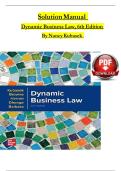
Solution Manual
Dynamic Business Law, 6th Edition
By Nancy Kubasek
,Chapter |1|- |An |Introduction |to |Dynamic |Business |Law
CHAPTER | OVERVIEW
Chapter | One | lays | the | foundation | for | the | textbook. | Make | sure | you | look | on | the
| publisher‘s | web | site | for | information |about |how | business |law |intersects | with |the | six | functional
| areas | of | business. | The | |authors | encourage |students |to |―connect | to |the |core,‖ |and |remember
|the |ways |in |which |law |intersects |with |other |areas | of | study, | including | corporate
| management, | production | and | transportation, | marketing, | research | and | development,
|accounting |and |finance, |and |human |resource |management.
This | manual | supports | the | ―connecting | to | the | core‖ | theme | by | giving | ideas | for
| assignments | that | encourage | students |to | integrate | their | business | law | knowledge | with
| knowledge | they | are | acquiring | from | their | other | business | classes. | The | manual | also
| encourages | professors | to | improve | their | teaching | skills. | Finally, | the | manual | suggests |teaching
|ideas |for |both |beginning |and |experienced |teachers.
LEARNING | OBJECTIVES
After |reading |this |chapter, |students |will |be |able |to:
1-1 Define |business |law.
1-2 Relate |the |functional |areas |of |business |to |the |relevant |areas |of
business |law1- | 3 |Recall | the |purposes |of |law.
|
1-4 Distinguish |among |types |of |law.
1-5 Differentiate |between |sources |of |the |law.
1-6 Identify |the |various |schools |of |jurisprudence.
LECTURE | NOTES | WITH | DEFINITIONS
In the news… Teaching tip: For each chapter, consider asking students to relate current news
items to material from the chapter.
In addition to ideas students come up with on their own, consider weaving in
news stories provided by the McGraw Hill.
For Chapter One, McGraw Hill offers the following stories:
―Smoking Ban: Tobacco Tyrants: Gone Too Far? Many States Are Putting
Stronger Restrictions on Where You Can Smoke‖
Have states gone too far in banning smoking?
, Whose | interests | are | state | legislatures | looking | out | for
| in | banning | smoking?
―College |Officer |Dealings |With |Lenders |Scrutinized.‖
Should |regulators |take |a |more |careful |look |at |college |officers?
Why |created |changes |in |the |ways |college |officers |interact |with
1-1 | Define Business |lenders?
| law | consists | of | the | enforceable | rules | of | conduct
| business | law. | that | govern | commercial |relationships.
1-2 |Relate |the Business |law |applies |to |the |six |functional |areas |of |business:
| functional
Corporate |management
| areas | of
Production |and |transportation
| business |to |the
| relevant |areas
Marketing
|of | business Research |and |development
|law. Accounting |and |finance
Human |resource |management
1-3 |Recall |the Providing |order
| purposes |of Serving |as |an |alternative |to |fighting
|law.
Facilitating |a |sense |that |change |is |possible
Encouraging |social |justice
Guaranteeing |personal |freedoms
Serving |as |a |moral |guide
1-4 |Distinguish One |way |to |classify |law:
| among |types |of Private |law |involves |disputes |between |private |individuals |or |groups.
|law.
Public | law | involves | disputes | between | private | individuals | or
| groups | and | their | government.
A |second |way |to |classify |law:
Civil | law |involves |the |rights | and |responsibilities |involved |in
|relationshipsbetween | persons |and |between |persons | and |their
|government.
Criminal | law | involves |incidents |in |which |someone |commits | an |act
|against | the | public |as |a |unit.
Teaching | tip: | Ask | students | to | give | an | example | of | a | fact | situation
1-5 |Differentiate that | led
Sources
| | to
| of | both |criminal
|business |and |civil | lawsuits, |e.g., |the |O.J. |Simpson
|law |are:
| between |trials.
1. Constitutions
|sources |of | the
Constitutional | law | refers | to | the | general | limits | and | powers | of
|law.
| governments | as | stated |in |their |written |constitutions.
2. Statutes |or |legislative |actions
3. Cases
Case | law | (or | common | law) | is | the | collection | of | legal
| interpretations | made | by | judges.
Stare |decisis |means |courts |are |relying |on |precedent.
Teaching | tip: | The | first | time | your | students | encounter | an | appellate
| case | in | the
, readings, |show |them |what |stare |decisis |looks |like |in |the |context |of |a |real
|case.
4. Administrative |law
Administrative | law | is | the | collection | of | rules | and
| decisions | made | by | administrative |agencies.
5. Treaties
A | treaty | is | a | |binding | agreement | between | two | states | or
| international | organizations.
6. | | Executive |orders
An |executive | order |is |a |directive |that |comes |from |the | president |or
1-6 |Identify |the | stategovernor.
Schools | of |jurisprudence |are |common |guides |to |legal |interpretation.
| various |schools
Natural | law—certain | ethical | laws | and | principles | are | morally
|of
| right | and
| jurisprudence.
―above‖ |the |laws |devised |by |humans.
Legal | Positivism—assumes | the | legitimate | political | authority
| deserves | our |obedience |when |it |issues |a |rule.
Identification |with |the |Vulnerable—emphasis | on |fairness | and
|looking | out |for |those |with |the |least |power.
Historical |School/Tradition—emphasis |on |the |use |of |stare |decisis.
Legal |Realism—judges |consider |social |and |economic |conditions.
Cost-benefit | Analysis—make | calculations | to |maximize |the
| ratio | of | benefits | to |costs.
Teaching | tip: | Consider | using | ―The | Case | of | the | Speluncean
Global |and At | this | point
| Explorers | (link ||in | the ||to
below) textbook,
|make |the| |students
schools |of| should | merely
|jurisprudence | have | an
|come
| Comparative awareness
|alive.
| | that | globalization | has | affected | the | scope | of | business
|Law | law. | Consequently, | we | highlight | the |definitions |to |the |following |key
|terms | that |will | |come |up |later |in |the |book:
Trade, | i.e. | the | exchange | of | goods | or | services, | on | a | global
| scale | has | ledto | the | creation | of | trade | agreements | that | serve
| as | de | facto | rules | governing|the | global | business | environment.
Comparative |law—the | field |of |law |that |studies | and |compares
| laws |in | different |countries.
Appendix |on Critical | thinking | includes | the | application | of | evaluative | standards
|Critical | Thinking | to | assess | the | quality | or | the | reasoning | being | offered | to | support | the
|and | Business | conclusion. | Critical | thinkers | will |follow |this |pattern |of |careful | thinking
|when |they |read | |an |argument:
1. Find |the |facts.
2. Look |for |the |issue.
3. Identify |the |judge‘s |reasons |and |conclusion.
4. Locate |in |the |decision |the |rules |of |law |that |govern |the |judge‘s
|reasoning.
5. Apply |critical |thinking |to |the |reasoning. |Evaluate |the |reasoning.
Look |for |potential |ambiguity.
Consider |the |strength |of |analogies.
Dynamic Business Law, 6th Edition
By Nancy Kubasek
,Chapter |1|- |An |Introduction |to |Dynamic |Business |Law
CHAPTER | OVERVIEW
Chapter | One | lays | the | foundation | for | the | textbook. | Make | sure | you | look | on | the
| publisher‘s | web | site | for | information |about |how | business |law |intersects | with |the | six | functional
| areas | of | business. | The | |authors | encourage |students |to |―connect | to |the |core,‖ |and |remember
|the |ways |in |which |law |intersects |with |other |areas | of | study, | including | corporate
| management, | production | and | transportation, | marketing, | research | and | development,
|accounting |and |finance, |and |human |resource |management.
This | manual | supports | the | ―connecting | to | the | core‖ | theme | by | giving | ideas | for
| assignments | that | encourage | students |to | integrate | their | business | law | knowledge | with
| knowledge | they | are | acquiring | from | their | other | business | classes. | The | manual | also
| encourages | professors | to | improve | their | teaching | skills. | Finally, | the | manual | suggests |teaching
|ideas |for |both |beginning |and |experienced |teachers.
LEARNING | OBJECTIVES
After |reading |this |chapter, |students |will |be |able |to:
1-1 Define |business |law.
1-2 Relate |the |functional |areas |of |business |to |the |relevant |areas |of
business |law1- | 3 |Recall | the |purposes |of |law.
|
1-4 Distinguish |among |types |of |law.
1-5 Differentiate |between |sources |of |the |law.
1-6 Identify |the |various |schools |of |jurisprudence.
LECTURE | NOTES | WITH | DEFINITIONS
In the news… Teaching tip: For each chapter, consider asking students to relate current news
items to material from the chapter.
In addition to ideas students come up with on their own, consider weaving in
news stories provided by the McGraw Hill.
For Chapter One, McGraw Hill offers the following stories:
―Smoking Ban: Tobacco Tyrants: Gone Too Far? Many States Are Putting
Stronger Restrictions on Where You Can Smoke‖
Have states gone too far in banning smoking?
, Whose | interests | are | state | legislatures | looking | out | for
| in | banning | smoking?
―College |Officer |Dealings |With |Lenders |Scrutinized.‖
Should |regulators |take |a |more |careful |look |at |college |officers?
Why |created |changes |in |the |ways |college |officers |interact |with
1-1 | Define Business |lenders?
| law | consists | of | the | enforceable | rules | of | conduct
| business | law. | that | govern | commercial |relationships.
1-2 |Relate |the Business |law |applies |to |the |six |functional |areas |of |business:
| functional
Corporate |management
| areas | of
Production |and |transportation
| business |to |the
| relevant |areas
Marketing
|of | business Research |and |development
|law. Accounting |and |finance
Human |resource |management
1-3 |Recall |the Providing |order
| purposes |of Serving |as |an |alternative |to |fighting
|law.
Facilitating |a |sense |that |change |is |possible
Encouraging |social |justice
Guaranteeing |personal |freedoms
Serving |as |a |moral |guide
1-4 |Distinguish One |way |to |classify |law:
| among |types |of Private |law |involves |disputes |between |private |individuals |or |groups.
|law.
Public | law | involves | disputes | between | private | individuals | or
| groups | and | their | government.
A |second |way |to |classify |law:
Civil | law |involves |the |rights | and |responsibilities |involved |in
|relationshipsbetween | persons |and |between |persons | and |their
|government.
Criminal | law | involves |incidents |in |which |someone |commits | an |act
|against | the | public |as |a |unit.
Teaching | tip: | Ask | students | to | give | an | example | of | a | fact | situation
1-5 |Differentiate that | led
Sources
| | to
| of | both |criminal
|business |and |civil | lawsuits, |e.g., |the |O.J. |Simpson
|law |are:
| between |trials.
1. Constitutions
|sources |of | the
Constitutional | law | refers | to | the | general | limits | and | powers | of
|law.
| governments | as | stated |in |their |written |constitutions.
2. Statutes |or |legislative |actions
3. Cases
Case | law | (or | common | law) | is | the | collection | of | legal
| interpretations | made | by | judges.
Stare |decisis |means |courts |are |relying |on |precedent.
Teaching | tip: | The | first | time | your | students | encounter | an | appellate
| case | in | the
, readings, |show |them |what |stare |decisis |looks |like |in |the |context |of |a |real
|case.
4. Administrative |law
Administrative | law | is | the | collection | of | rules | and
| decisions | made | by | administrative |agencies.
5. Treaties
A | treaty | is | a | |binding | agreement | between | two | states | or
| international | organizations.
6. | | Executive |orders
An |executive | order |is |a |directive |that |comes |from |the | president |or
1-6 |Identify |the | stategovernor.
Schools | of |jurisprudence |are |common |guides |to |legal |interpretation.
| various |schools
Natural | law—certain | ethical | laws | and | principles | are | morally
|of
| right | and
| jurisprudence.
―above‖ |the |laws |devised |by |humans.
Legal | Positivism—assumes | the | legitimate | political | authority
| deserves | our |obedience |when |it |issues |a |rule.
Identification |with |the |Vulnerable—emphasis | on |fairness | and
|looking | out |for |those |with |the |least |power.
Historical |School/Tradition—emphasis |on |the |use |of |stare |decisis.
Legal |Realism—judges |consider |social |and |economic |conditions.
Cost-benefit | Analysis—make | calculations | to |maximize |the
| ratio | of | benefits | to |costs.
Teaching | tip: | Consider | using | ―The | Case | of | the | Speluncean
Global |and At | this | point
| Explorers | (link ||in | the ||to
below) textbook,
|make |the| |students
schools |of| should | merely
|jurisprudence | have | an
|come
| Comparative awareness
|alive.
| | that | globalization | has | affected | the | scope | of | business
|Law | law. | Consequently, | we | highlight | the |definitions |to |the |following |key
|terms | that |will | |come |up |later |in |the |book:
Trade, | i.e. | the | exchange | of | goods | or | services, | on | a | global
| scale | has | ledto | the | creation | of | trade | agreements | that | serve
| as | de | facto | rules | governing|the | global | business | environment.
Comparative |law—the | field |of |law |that |studies | and |compares
| laws |in | different |countries.
Appendix |on Critical | thinking | includes | the | application | of | evaluative | standards
|Critical | Thinking | to | assess | the | quality | or | the | reasoning | being | offered | to | support | the
|and | Business | conclusion. | Critical | thinkers | will |follow |this |pattern |of |careful | thinking
|when |they |read | |an |argument:
1. Find |the |facts.
2. Look |for |the |issue.
3. Identify |the |judge‘s |reasons |and |conclusion.
4. Locate |in |the |decision |the |rules |of |law |that |govern |the |judge‘s
|reasoning.
5. Apply |critical |thinking |to |the |reasoning. |Evaluate |the |reasoning.
Look |for |potential |ambiguity.
Consider |the |strength |of |analogies.