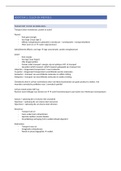
MSN 612 FINAL EXAM
LEVELS OF ADVOCACY
1. Individual & Family Advocacy
2. System-level Advocacy (involves changing policies)
Patient-Advocacy Skills
1. Empathetic listening
2. Self-confidence
3. Assertiveness
4. Negotiation
5. Collaboration
6. Communication
7. Physical Assessment
8. Mental Status Assessment
9. Teaching
Evidence base Practice (EBP)
approach in which practitioners make practice decisions based on the
integration of the research evidence with clinical expertise and the
patient's unique values and circumstances.
Key skill of ANPs
translating evidence into practice
PICOT Format
P - Population or problem of Interest
I - Intervention of practice interest
C - Comparison Intervention or practice, usually SOC or no
comparison
O - Outcome of the intervention or practice
T - Timeframe in which outcome is expected
, Removing Barrier to APN Research Activities
APN involvement in clinical research is critical to the profession. At
the this end, it is necessary to remove all the barriers to APN Research
Activities
It is important to consider having Professional Liability
insurance.
whether:
- working as an employee
- independent contractor
- a sole proprietor
- acting outside any type of work setting
What are the two primary APRN certifications boards?
1. ANCC (American Nurses Credentialing Center)
2. AANPCB (American Academy Nurse Practitioners Certification
Board)
Fein v. Permanente
NP standard of practice, not MD for tort case
Sermchief v. Gonzales
APRN and MDs did not violate scope of practice laws because nurses'
scope of practice had expanded as an APRNs
Berdyck v. HR Magruder Hospital
All professions owe the same duty of care, within their respective
professional practice boundaries, e.g. APRN and MD both have a duty
of care defined by their professional roles
Ali v. Community Health
The trial court stated that the standard was what a reasonable nurse
midwife would have done in the situation. HMO prevailed, plaintiffs
appealed stating that the standard of care was too low. The appellate
LEVELS OF ADVOCACY
1. Individual & Family Advocacy
2. System-level Advocacy (involves changing policies)
Patient-Advocacy Skills
1. Empathetic listening
2. Self-confidence
3. Assertiveness
4. Negotiation
5. Collaboration
6. Communication
7. Physical Assessment
8. Mental Status Assessment
9. Teaching
Evidence base Practice (EBP)
approach in which practitioners make practice decisions based on the
integration of the research evidence with clinical expertise and the
patient's unique values and circumstances.
Key skill of ANPs
translating evidence into practice
PICOT Format
P - Population or problem of Interest
I - Intervention of practice interest
C - Comparison Intervention or practice, usually SOC or no
comparison
O - Outcome of the intervention or practice
T - Timeframe in which outcome is expected
, Removing Barrier to APN Research Activities
APN involvement in clinical research is critical to the profession. At
the this end, it is necessary to remove all the barriers to APN Research
Activities
It is important to consider having Professional Liability
insurance.
whether:
- working as an employee
- independent contractor
- a sole proprietor
- acting outside any type of work setting
What are the two primary APRN certifications boards?
1. ANCC (American Nurses Credentialing Center)
2. AANPCB (American Academy Nurse Practitioners Certification
Board)
Fein v. Permanente
NP standard of practice, not MD for tort case
Sermchief v. Gonzales
APRN and MDs did not violate scope of practice laws because nurses'
scope of practice had expanded as an APRNs
Berdyck v. HR Magruder Hospital
All professions owe the same duty of care, within their respective
professional practice boundaries, e.g. APRN and MD both have a duty
of care defined by their professional roles
Ali v. Community Health
The trial court stated that the standard was what a reasonable nurse
midwife would have done in the situation. HMO prevailed, plaintiffs
appealed stating that the standard of care was too low. The appellate