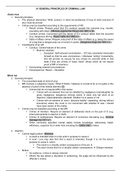
01 GENERAL PRINCIPLES OF CRIMINAL LAW
Actus reus
1. General principles
The physical element(s): What conduct, in what circumstances (if any) & what outcome (if
any) must be proved
Crimes may be classified according to the requirements of AR:
Result crimes: Require proof that D’s conduct caused the outcome (e.g. murder,
wounding with intent (Offences Against the Person Act 1861 s 18))
Conduct crimes: Concerned with the nature of D’s conduct rather than the outcome
(e.g. dangerous driving (Road Traffic Act 1988 s 2))
State of affairs crimes: Require only proof of the state of affairs (e.g. being the owner
of a dog that is dangerously out of control in public (Dangerous Dogs Act 1991 s 3))
Constituents of an AR
Conduct: Central feature of the crime
Must be voluntary
o Exception: Self-induced involuntarism – If D has voluntarily intoxicated
himself so that he was unconscious / otherwise “acting” involuntarily,
that will provide no excuse for any crimes he commits while in that
state if they are crimes of “basic intent” (those which do not require
proof of MR of intention)
Surrounding material circumstances
Consequences: Result – Causation
Mens rea
2. General principles
The proscribed state of mind (if any)
MR involves a subjective inquiry: What D thinks / believes is crucial & he is not guilty in the
absence of proof of the mental element (G)
Crimes that do not require MR in this sense:
Crimes with an element that can be satisfied by negligence (manslaughter by
gross negligence, dangerous driving) where D need only fall short of an
objective, reasonableness standard, whether he is aware or not
Crimes with an element of ‘strict / absolute liability” (speeding, driving without
insurance) where the court is not concerned with whether D was / should
have been aware of the matter
Crimes may be classified according to the MR:
Crimes of intention: Require an element of deliberate intent on the part of D (e.g.
intent permanently to deprive in theft)
Crimes of recklessness: Require an element of conscious risk-taking (e.g. Criminal
Damage Act 1971 s 1)
Other commonly specified mental states include knowledge, dishonesty, belief,
wilfulness, suspicion & (in older Acts including the OAPA 1861) malice
3. Intention
Current legal position (Moloney)
A result is intended when it is the actor’s purpose to cause it
A court / jury may also find that a result is intended, though it is not the actor’s
purpose to cause it, when–
The result is a virtually certain consequence of his act; &
The actor knows that it is a virtually certain consequence Oblique intention
Motive
As evidence, motive is always relevant
Where the law allows a discretion in sentencing, the judge will be influenced by the
offender’s motive
, 4. Recklessness
Current legal position (G)
Facts: 2 boys set fire to newspapers & left them to burn out near a rubbish bin, which
was situated next to a supermarket The newspapers did not burn out, but set fire
to the bin & spread to the supermarket, causing £1 million in damage
Decision: They were not guilty of recklessly causing criminal damage
Reasoning:
The court rejected Caldwell’s objective recklessness test
Test: Subjective recklessness
o Whether D foresaw a risk of the proscribed result / circumstance in the
AR of the crime
o Whether it was reasonable for D to take the risk in the circumstances
known to him
Subjective awareness of a risk (Cunningham)
Only necessary for D to foresee a risk of the proscribed harm
Whether it is justifiable to take a risk depends on the social value of the activity involved
relative to the probability & the gravity of the harm which might be caused; Whether the risk
was one which a reasonable & prudent person might have taken
D’s indifference to the risk of a relevant result, is an aggravating factor, but not an element in
the definition of the required fault
Presumption of fault
5. General principles
There is a presumption of MR which is strongest in relation to “truly criminal” statutory
offences It can be displaced only by necessary inference where the offence deals with an
issue of social concern e.g. public safety, provided that the imposition of strict liability will be
effective to promote the objectives of the prohibition (Gammon v A-G Hong Kong)
Strict liability
6. Strict liability in statutory offences
AR without corresponding MR An exception to the correspondence principle
In statutory offences if Parliament’s intent is clearly to impose liability without a subjectively
guilty mind / MR the courts must respect this, even where the offence is serious (G)
Crimes of strict liability do not violate the presumption of innocence (ECHR Art 6(2)) which is
concerned with procedure not substance (G)
Liability is not strict as to conduct, only as to circumstance (e.g. G: D “takes the risk” that V
may be younger than he thinks)
7. Benefits of strict liability
Liability without fault sends a clear message about the prohibition (e.g. driving without
insurance)
Clear evidence of fault (subjective / objective) might be hard to find even if present (e.g.
speeding) so the guilty might go free In strict liability offences the prosecution does not
have to supply this proof
Prosecution is a matter of discretion so the truly innocent need not be prosecuted
Minor / Regulatory offences do not attract the same stigma as “real” crime so they should not
attract the same criteria as to fault
8. Downsides of strict liability
What is the point in holding someone to a standard of care that they cannot be expected to
reach? (Pharmaceutical Society of GB v Storkwain)
What social purpose does such an offence serve?
9. Strict liability & regulatory offences
, Often promulgated via secondary legislation (so little debate / regulation)
Aimed at avoiding rather than punishing actual harm (e.g. health & safety legislation) But
may still attract “real” penalties including imprisonment
Often imposes strict liability
Burden of proof
10. General principles
Standard of proof
Where the legal burden is on the prosecution, proof beyond reasonable doubt is
required (Woolmington v DPP)
Where (exceptionally) the legal burden is on D, proof on a balance of probabilities
(the civil standard) is enough (Carr-Briant)
Presumption of innocence: “Everyone charged with a criminal offence shall be presumed
innocent until proved guilty according to law” (ECHR Art 6(2))
Legal & evidential burdens
D may be required to produce / identify some evidence on a particular matter
(typically a defence) to make it a live issue – the “evidential burden”, to distinguish it
from the burden of proof (the “legal burden”)
Causation
11. General principles
Principle of voluntariness
D should not be judged responsible for his conduct / to have brought about a state of
affairs, if it was not a matter within his conscious control (Mitchell; Hill v Baxter)
The rules of causation determine whether D’s conduct is a sufficiently substantial & legally
operative cause of V’s death There must be a “chain” of causation
The meaning of causation is heavily context-specific (Hughes)
Causing death: The acceleration rule
What the law calls “causing” the death of an individual might more accurately be
described as “accelerating” his death (Dyson)
“Mercy-killing” / Assisted suicide is unlawful (Nicklinson)
Contributory negligence of V himself is no defence
Innocent agent
Where D knowingly employs an innocent agent to commit an offence, D, in law,
causes the result though the immediate causer in the innocent agent
12. Tests for causation
Factual causation
Established if it can be stated that “but for” D’s conduct the result would not have
occurred (White)
Legal causation
Satisfied if D’s conduct is the “operative” (Malcherek & Steel), ‘substantial” (Smith),
“beyond the de minimus range” / “more than minimal” (Cato) cause of the prohibited
consequence; “Contribute significantly” to the result (Pagett); “Blameworthy”
(Hughes)
D’s conduct need not be the only / principal cause (Hughes)
Causation: Supervening causes which may break the chain of causation
13. General principles
Naturally occurring events (“Acts of God”)
Gowans
Facts: D attacks V & leaves her in a coma V dies of subsequent infection
Decision: D caused V’s death
Reasoning: Natural events only break the chain of causation if they are
unforeseen by D & unforeseeable to the reasonable person
Refusal of medical treatment by V
Actus reus
1. General principles
The physical element(s): What conduct, in what circumstances (if any) & what outcome (if
any) must be proved
Crimes may be classified according to the requirements of AR:
Result crimes: Require proof that D’s conduct caused the outcome (e.g. murder,
wounding with intent (Offences Against the Person Act 1861 s 18))
Conduct crimes: Concerned with the nature of D’s conduct rather than the outcome
(e.g. dangerous driving (Road Traffic Act 1988 s 2))
State of affairs crimes: Require only proof of the state of affairs (e.g. being the owner
of a dog that is dangerously out of control in public (Dangerous Dogs Act 1991 s 3))
Constituents of an AR
Conduct: Central feature of the crime
Must be voluntary
o Exception: Self-induced involuntarism – If D has voluntarily intoxicated
himself so that he was unconscious / otherwise “acting” involuntarily,
that will provide no excuse for any crimes he commits while in that
state if they are crimes of “basic intent” (those which do not require
proof of MR of intention)
Surrounding material circumstances
Consequences: Result – Causation
Mens rea
2. General principles
The proscribed state of mind (if any)
MR involves a subjective inquiry: What D thinks / believes is crucial & he is not guilty in the
absence of proof of the mental element (G)
Crimes that do not require MR in this sense:
Crimes with an element that can be satisfied by negligence (manslaughter by
gross negligence, dangerous driving) where D need only fall short of an
objective, reasonableness standard, whether he is aware or not
Crimes with an element of ‘strict / absolute liability” (speeding, driving without
insurance) where the court is not concerned with whether D was / should
have been aware of the matter
Crimes may be classified according to the MR:
Crimes of intention: Require an element of deliberate intent on the part of D (e.g.
intent permanently to deprive in theft)
Crimes of recklessness: Require an element of conscious risk-taking (e.g. Criminal
Damage Act 1971 s 1)
Other commonly specified mental states include knowledge, dishonesty, belief,
wilfulness, suspicion & (in older Acts including the OAPA 1861) malice
3. Intention
Current legal position (Moloney)
A result is intended when it is the actor’s purpose to cause it
A court / jury may also find that a result is intended, though it is not the actor’s
purpose to cause it, when–
The result is a virtually certain consequence of his act; &
The actor knows that it is a virtually certain consequence Oblique intention
Motive
As evidence, motive is always relevant
Where the law allows a discretion in sentencing, the judge will be influenced by the
offender’s motive
, 4. Recklessness
Current legal position (G)
Facts: 2 boys set fire to newspapers & left them to burn out near a rubbish bin, which
was situated next to a supermarket The newspapers did not burn out, but set fire
to the bin & spread to the supermarket, causing £1 million in damage
Decision: They were not guilty of recklessly causing criminal damage
Reasoning:
The court rejected Caldwell’s objective recklessness test
Test: Subjective recklessness
o Whether D foresaw a risk of the proscribed result / circumstance in the
AR of the crime
o Whether it was reasonable for D to take the risk in the circumstances
known to him
Subjective awareness of a risk (Cunningham)
Only necessary for D to foresee a risk of the proscribed harm
Whether it is justifiable to take a risk depends on the social value of the activity involved
relative to the probability & the gravity of the harm which might be caused; Whether the risk
was one which a reasonable & prudent person might have taken
D’s indifference to the risk of a relevant result, is an aggravating factor, but not an element in
the definition of the required fault
Presumption of fault
5. General principles
There is a presumption of MR which is strongest in relation to “truly criminal” statutory
offences It can be displaced only by necessary inference where the offence deals with an
issue of social concern e.g. public safety, provided that the imposition of strict liability will be
effective to promote the objectives of the prohibition (Gammon v A-G Hong Kong)
Strict liability
6. Strict liability in statutory offences
AR without corresponding MR An exception to the correspondence principle
In statutory offences if Parliament’s intent is clearly to impose liability without a subjectively
guilty mind / MR the courts must respect this, even where the offence is serious (G)
Crimes of strict liability do not violate the presumption of innocence (ECHR Art 6(2)) which is
concerned with procedure not substance (G)
Liability is not strict as to conduct, only as to circumstance (e.g. G: D “takes the risk” that V
may be younger than he thinks)
7. Benefits of strict liability
Liability without fault sends a clear message about the prohibition (e.g. driving without
insurance)
Clear evidence of fault (subjective / objective) might be hard to find even if present (e.g.
speeding) so the guilty might go free In strict liability offences the prosecution does not
have to supply this proof
Prosecution is a matter of discretion so the truly innocent need not be prosecuted
Minor / Regulatory offences do not attract the same stigma as “real” crime so they should not
attract the same criteria as to fault
8. Downsides of strict liability
What is the point in holding someone to a standard of care that they cannot be expected to
reach? (Pharmaceutical Society of GB v Storkwain)
What social purpose does such an offence serve?
9. Strict liability & regulatory offences
, Often promulgated via secondary legislation (so little debate / regulation)
Aimed at avoiding rather than punishing actual harm (e.g. health & safety legislation) But
may still attract “real” penalties including imprisonment
Often imposes strict liability
Burden of proof
10. General principles
Standard of proof
Where the legal burden is on the prosecution, proof beyond reasonable doubt is
required (Woolmington v DPP)
Where (exceptionally) the legal burden is on D, proof on a balance of probabilities
(the civil standard) is enough (Carr-Briant)
Presumption of innocence: “Everyone charged with a criminal offence shall be presumed
innocent until proved guilty according to law” (ECHR Art 6(2))
Legal & evidential burdens
D may be required to produce / identify some evidence on a particular matter
(typically a defence) to make it a live issue – the “evidential burden”, to distinguish it
from the burden of proof (the “legal burden”)
Causation
11. General principles
Principle of voluntariness
D should not be judged responsible for his conduct / to have brought about a state of
affairs, if it was not a matter within his conscious control (Mitchell; Hill v Baxter)
The rules of causation determine whether D’s conduct is a sufficiently substantial & legally
operative cause of V’s death There must be a “chain” of causation
The meaning of causation is heavily context-specific (Hughes)
Causing death: The acceleration rule
What the law calls “causing” the death of an individual might more accurately be
described as “accelerating” his death (Dyson)
“Mercy-killing” / Assisted suicide is unlawful (Nicklinson)
Contributory negligence of V himself is no defence
Innocent agent
Where D knowingly employs an innocent agent to commit an offence, D, in law,
causes the result though the immediate causer in the innocent agent
12. Tests for causation
Factual causation
Established if it can be stated that “but for” D’s conduct the result would not have
occurred (White)
Legal causation
Satisfied if D’s conduct is the “operative” (Malcherek & Steel), ‘substantial” (Smith),
“beyond the de minimus range” / “more than minimal” (Cato) cause of the prohibited
consequence; “Contribute significantly” to the result (Pagett); “Blameworthy”
(Hughes)
D’s conduct need not be the only / principal cause (Hughes)
Causation: Supervening causes which may break the chain of causation
13. General principles
Naturally occurring events (“Acts of God”)
Gowans
Facts: D attacks V & leaves her in a coma V dies of subsequent infection
Decision: D caused V’s death
Reasoning: Natural events only break the chain of causation if they are
unforeseen by D & unforeseeable to the reasonable person
Refusal of medical treatment by V