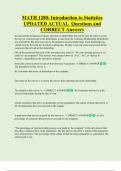
MATH 1280: Introduction to Statistics
UPDATED ACTUAL Questions and
CORRECT Answers
An automobile producing company operates car dealerships that sell its cars. In order to assess
the service customers get at the dealerships, a team from the Customer Relationship Department
was assembled. The team was sent to 20 randomly selected dealerships. Each dealership was
visited once by the team for an entire working day. During a visit, the team interviewed all the
customers that arrived at that dealership.
One of the questions that each of the customers was asked is: "Do you currently possess a car
made by our company?" The answers were marked down as "Yes", "No", or "Refuse to
Answer", depending on the customer's response.
Select the correct answer in each of the following 4 questions: - CORRECT ANSWER -
The population in this survey is:
B) Customers that arrive at dealerships of the company.
The target of the survey is to assess the service that customers get at the dealerships.
The sample in this survey is: - CORRECT ANSWER - B) Customers that arrive at the
selected dealerships during the day of visit.
All the customers that arrive at dealerships are the population. The subset of those that arrive at
the 20 dealerships that were selected is the sample.
A parameter that may be targeted by this survey is: - CORRECT ANSWER - A) The
percentage of customers that possess a car made by the company.
"The percentage of customers that possess a car made by the company" is the only answer that
describes a characteristic of the population. The last answer describes a subset of the population,
not a characteristic: The percentage of the subset within the entire population is a parameter, the
subset itself is not.
, A statistic that may be used to summarize the outcome of the survey is: - CORRECT
ANSWER - B) The percentage, among costumers that were interviewed, of those that do
not possess a car made by the company.
"The percentage, among costumers that were interviewed, of those that do not possess a car
made by the company" is the only answer that describes a characteristic of the sample. The third
answer describes the sample, not a characteristic of it: The percentage of the subset within the
sample is a statistic, the sample itself is not.
The Customers Service Center of a large bank receive calls from customers. The number of
incoming calls between 8:00 AM and 8:10 AM in consecutive days were recorded. The number
of incoming calls during the working days of the month of September were:
8, 10, 6, 7, 12, 7, 8, 7, 8, 6, 9, 4, 6, 14, 10, 10, 10, 10, 6, 10, 12, 7
The number of incoming calls during the working days of the month of February were:
9, 11, 14, 6, 4, 6, 7, 3, 3, 2, 5, 6, 6, 5, 6, 7, 5, 4, 3, 5.
Create two R objects, one by the name "Sep", and the other by the name "Feb". The first object
should contain the first data and the second object should contain the second data. Produce a
frequency table (with the function "table") for each of the objects and a bar plot (with the
combination of the function "plot" and the function "table"). For comparison, bar plots like the
one you should obtain are presented in Figure 1.6. and Figure 1.7.
In light of - CORRECT ANSWER - The data used to produce the tables and plots is:
C) A sample.
The meaning of deciding that the given information is a population is that one's target in the
investigation of number of arriving calls is only with respect to the specific dates and times that
are described in the question. It is more likely that one has a broader interest, say the overall
workload of the department. In such a case the data represents number of incoming calls at other
dates and times. Hence, it is a sample. A hint in favor of the option that the data is a subset of a
larger population of phone-tracking information is the sentence: "The number of incoming calls
between 8:00 AM and 8:10 AM in consecutive days were recorded."
The average number of calls that arrived between 8:00 AM and 8:10 AM during the working
days of any month is: - CORRECT ANSWER - C) A parameter.
UPDATED ACTUAL Questions and
CORRECT Answers
An automobile producing company operates car dealerships that sell its cars. In order to assess
the service customers get at the dealerships, a team from the Customer Relationship Department
was assembled. The team was sent to 20 randomly selected dealerships. Each dealership was
visited once by the team for an entire working day. During a visit, the team interviewed all the
customers that arrived at that dealership.
One of the questions that each of the customers was asked is: "Do you currently possess a car
made by our company?" The answers were marked down as "Yes", "No", or "Refuse to
Answer", depending on the customer's response.
Select the correct answer in each of the following 4 questions: - CORRECT ANSWER -
The population in this survey is:
B) Customers that arrive at dealerships of the company.
The target of the survey is to assess the service that customers get at the dealerships.
The sample in this survey is: - CORRECT ANSWER - B) Customers that arrive at the
selected dealerships during the day of visit.
All the customers that arrive at dealerships are the population. The subset of those that arrive at
the 20 dealerships that were selected is the sample.
A parameter that may be targeted by this survey is: - CORRECT ANSWER - A) The
percentage of customers that possess a car made by the company.
"The percentage of customers that possess a car made by the company" is the only answer that
describes a characteristic of the population. The last answer describes a subset of the population,
not a characteristic: The percentage of the subset within the entire population is a parameter, the
subset itself is not.
, A statistic that may be used to summarize the outcome of the survey is: - CORRECT
ANSWER - B) The percentage, among costumers that were interviewed, of those that do
not possess a car made by the company.
"The percentage, among costumers that were interviewed, of those that do not possess a car
made by the company" is the only answer that describes a characteristic of the sample. The third
answer describes the sample, not a characteristic of it: The percentage of the subset within the
sample is a statistic, the sample itself is not.
The Customers Service Center of a large bank receive calls from customers. The number of
incoming calls between 8:00 AM and 8:10 AM in consecutive days were recorded. The number
of incoming calls during the working days of the month of September were:
8, 10, 6, 7, 12, 7, 8, 7, 8, 6, 9, 4, 6, 14, 10, 10, 10, 10, 6, 10, 12, 7
The number of incoming calls during the working days of the month of February were:
9, 11, 14, 6, 4, 6, 7, 3, 3, 2, 5, 6, 6, 5, 6, 7, 5, 4, 3, 5.
Create two R objects, one by the name "Sep", and the other by the name "Feb". The first object
should contain the first data and the second object should contain the second data. Produce a
frequency table (with the function "table") for each of the objects and a bar plot (with the
combination of the function "plot" and the function "table"). For comparison, bar plots like the
one you should obtain are presented in Figure 1.6. and Figure 1.7.
In light of - CORRECT ANSWER - The data used to produce the tables and plots is:
C) A sample.
The meaning of deciding that the given information is a population is that one's target in the
investigation of number of arriving calls is only with respect to the specific dates and times that
are described in the question. It is more likely that one has a broader interest, say the overall
workload of the department. In such a case the data represents number of incoming calls at other
dates and times. Hence, it is a sample. A hint in favor of the option that the data is a subset of a
larger population of phone-tracking information is the sentence: "The number of incoming calls
between 8:00 AM and 8:10 AM in consecutive days were recorded."
The average number of calls that arrived between 8:00 AM and 8:10 AM during the working
days of any month is: - CORRECT ANSWER - C) A parameter.