100% de satisfacción garantizada Inmediatamente disponible después del pago Tanto en línea como en PDF No estas atado a nada 4,6 TrustPilot
logo-home
Examen

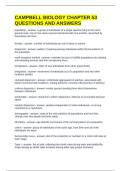
CAMPBELL BIOLOGY CHAPTER 53 QUESTIONS AND ANSWERS

Puntuación
-
Vendido
-
Páginas
3
Grado
A+
Subido en
02-11-2025
Escrito en
2025/2026

CAMPBELL BIOLOGY CHAPTER 53 QUESTIONS AND ANSWERS population - answer- a group of individuals of a single species living in the same general area, rely on the same sources and breed with one another, described by boundaries and size density - answer- number of individuals per unit of area or volume dispersion - answer- pattern of spacing among individuals within the boundaries of the population mark-recapture method - answer- estimate the size of wildlife populations by marking and releasing animals and then recapturing them immigration - answer- influx of new individuals from other areas (birth) emigration - answer- movement of individuals out of a population and into other locations (death) clumped dispersion - answer- individuals aggregated in patches, associated with better environmental conditions, mating behavior, increase effectiveness of defense uniform dispersion - answer- evenly spaced resulting from direct interactions between individuals territoriality - answer- result from uniform dispersion, defense of a bounded physical space random dispersion - answer- position independent of other individuals, no strong connections or repulsions demography - answer- study of the vital statistics of populations and how they change over time (death and birth rates) life tables - answer- age-specific summaries of the survival pattern of a population cohort - answer- group of individuals of the same age, from birth until all of the individuals are dead Survivorship curve - answer- plot of the proportion or numbers in a cohort still alive at each stage Type I - answer- flat at start, reflecting low death rates during early and middle life, drops steeply as death rates increase among older age groups (humans) Type III - answer- drops sharply at the beginning, but flattens out as death rates decline (fish) Type II - answer- constant death rate (squirrel) reproductive rate - answer- how reproductive output varies with the ages of females reproductive table - answer- age specific summary of the reproductive rates in a population, measures the reproductive output of a cohort from birth to death reproductive output - answer- product of the proportion of female offspring of those breeding females Exponential population model - answer- population growth in an ideal unlimited environment, J-shaped curve per capita birth rate - answer- number of offspring produced per unit of time by an average member of the population B=bn per capita death rate - answer- expected number of deaths per unit of time D=mn zero population growth - answer- balance of birth and death rates r=0 carrying capacity - answer- (K), maximum population size that a particular environment can sustain Logistic population model - answer- per capita rate of increase approaches zero as the carrying capacity is reached, S-shaped curve, limited resources allele effect - answer- individuals may have a more difficult time reproducing if the population size is too small life history - answer- traits that affect an organism's schedule of reproduction and survival, 3 variables: when reproduction begins, how often the organism reproduces, how many of offspring are produced per reproductive cycle semelparity - answer- big-bang reproduction, produces offspring in ideal conditions and then die, favored in environments that are variable and unpredictable iteroparity - answer- repeated reproduction, generally produce few but large organisms and take care of them better, favored in environments that are dependable k-selection - answer- selection for traits are are sensitive to population density, favored at high densities, density dependent, populations near K r-selection - answer- selection for traits that maximize reproductive success in uncrowded environments, maximize per capita rate of increase density independe

Mostrar más Leer menos
Institución
CAMPBELL BIOLOGY CHAPTER 53
Grado
CAMPBELL BIOLOGY CHAPTER 53


Ups! No podemos cargar tu documento ahora. Inténtalo de nuevo o contacta con soporte.

Escuela, estudio y materia

Institución
CAMPBELL BIOLOGY CHAPTER 53
Grado
CAMPBELL BIOLOGY CHAPTER 53

Información del documento

Subido en
2 de noviembre de 2025
Número de páginas
3
Escrito en
2025/2026
Tipo
Examen
Contiene
Preguntas y respuestas

Temas

Vista previa del contenido

CAMPBELL BIOLOGY CHAPTER 53
QUESTIONS AND ANSWERS
population - answer- a group of individuals of a single species living in the same
general area, rely on the same sources and breed with one another, described by
boundaries and size


density - answer- number of individuals per unit of area or volume

dispersion - answer- pattern of spacing among individuals within the boundaries of
the population

mark-recapture method - answer- estimate the size of wildlife populations by marking
and releasing animals and then recapturing them

immigration - answer- influx of new individuals from other areas (birth)

emigration - answer- movement of individuals out of a population and into other
locations (death)

clumped dispersion - answer- individuals aggregated in patches, associated with
better environmental conditions, mating behavior, increase effectiveness of defense

uniform dispersion - answer- evenly spaced resulting from direct interactions
between individuals

territoriality - answer- result from uniform dispersion, defense of a bounded physical
space

random dispersion - answer- position independent of other individuals, no strong
connections or repulsions

demography - answer- study of the vital statistics of populations and how they
change over time (death and birth rates)

life tables - answer- age-specific summaries of the survival pattern of a population

cohort - answer- group of individuals of the same age, from birth until all of the
individuals are dead

Survivorship curve - answer- plot of the proportion or numbers in a cohort still alive at
each stage

Type I - answer- flat at start, reflecting low death rates during early and middle life,
drops steeply as death rates increase among older age groups (humans)
$20.99
Accede al documento completo:

100% de satisfacción garantizada
Inmediatamente disponible después del pago
Tanto en línea como en PDF
No estas atado a nada


Documento también disponible en un lote

Conoce al vendedor

Seller avatar
Los indicadores de reputación están sujetos a la cantidad de artículos vendidos por una tarifa y las reseñas que ha recibido por esos documentos. Hay tres niveles: Bronce, Plata y Oro. Cuanto mayor reputación, más podrás confiar en la calidad del trabajo del vendedor.
Freshy Oxford University
Seguir Necesitas iniciar sesión para seguir a otros usuarios o asignaturas
Vendido
53
Miembro desde
1 año
Número de seguidores
4
Documentos
6784
Última venta
3 semanas hace

3.6

10 reseñas

5
3
4
4
3
1
2
0
1
2

Recientemente visto por ti

Por qué los estudiantes eligen Stuvia

Creado por compañeros estudiantes, verificado por reseñas

Calidad en la que puedes confiar: escrito por estudiantes que aprobaron y evaluado por otros que han usado estos resúmenes.

¿No estás satisfecho? Elige otro documento

¡No te preocupes! Puedes elegir directamente otro documento que se ajuste mejor a lo que buscas.

Paga como quieras, empieza a estudiar al instante

Sin suscripción, sin compromisos. Paga como estés acostumbrado con tarjeta de crédito y descarga tu documento PDF inmediatamente.

Student with book image

“Comprado, descargado y aprobado. Así de fácil puede ser.”

Alisha Student

Preguntas frecuentes