100% de satisfacción garantizada Inmediatamente disponible después del pago Tanto en línea como en PDF No estas atado a nada 4,6 TrustPilot
logo-home
Examen

CAMPBELL BIOLOGY CHAPTER 11 EXAM QUESTIONS AND ANSWERS

Puntuación
-
Vendido
-
Páginas
3
Grado
A+
Subido en
02-11-2025
Escrito en
2025/2026

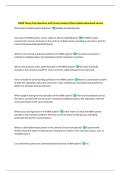
CAMPBELL BIOLOGY CHAPTER 11 EXAM QUESTIONS AND ANSWERS signal transduction pathway - answer- the process by which a signal on a cell's surface is converted into a specific cellular response biofilm - answer- A microbial community that usually forms as a slimy layer on a surface local regulators - answer- Messenger molecules secreted by the signaling cell which only travel short distance and influence cells in the local vicinity growth factor - answer- one of a group of external regulatory proteins that stimulate the growth and division of cells paracrine signaling - answer- a type of local signaling where the target cell is close to the signal-releasing cell synaptic signaling - answer- a type of local signaling specific to neurotransmitters in nerve cells hormones - answer- chemical messengers, mostly those manufactured by the endocrine glands, that are produced in one tissue and affect another long-distance signaling - answer- cell is secreting a hormone and the hormone must travel through the blood stream to reach its target place. 3 stages of cell signaling - answer- 1. reception 2. transduction 3. response Earl Sutherland - answer- 1971 Nobel Prize (In Med): discovered cAMP as a second messenger while studying effects of epinephrine on phosphorylase. reception - answer- the target cell's detection of a signal molecule coming from outside the cell transduction - answer- in cellular communication, the conversion of a signal from outside the cell to a form that can bring about a specific cellular response signal transduction pathway - answer- A series of steps linking a mechanical or chemical stimulus to a specific cellular response. relay molecule - answer- molecule in a signal transduction pathway response - answer- In cellular communication, the change in a specific cellular activity brought about by a transduced signal from outside the cell. ligand - answer- A molecule that binds specifically to a receptor site of another molecule. G-protein coupled receptor - answer- A signal receptor protein in the plasma membrane that responds to the binding of a signaling molecule by activating a G protein. G-protein - answer- A GTP-binding protein that relays signals from a plasma membrane signal receptor, known as a G protein-coupled receptor, to other signal transduction proteins inside the cell.. receptor tyrosine kinases - answer- belong to a major class of plasma membrane receptors characterized by having enzymatic activity - attach phosphates to tyrosine's dimer - answer- a compound whose molecules are composed of two identical monomers ligand-gated ion channel - answer- a type of membrane receptor containing a region that can act as a "gate" when the receptor changes shape intracellular receptor - answer- describes a receptor that binds to its signal inside the cell, must be nonpolar (testosterone acts as transcription factor) protein kinase - answer- An enzyme that transfers phosphate groups from ATP to a protein, thus phosphorylating the protein. protein phosphatase - answer- An enzyme that removes phosphate groups from (dephosphorylates) proteins, often functioning to reverse the effect of a protein kinase. second messenger - answer- A small, nonprotein, water-soluble molecule or ion, such as calcium ion or cyclic AMP, that relays a signal to a cell's interior in response to a signal received by a signal receptor protein. cAMP - answer- is a second messenger important in many biological processes. is derived from adenosine triphosphate (ATP) and used for intracellular signal transduction in many different organisms, conveying the cAMP-dependent pathway. adenylyl cyclase - answer- An enzyme that converts ATP to cyclic AMP in response to a chemical signal. protein kinase A - answer- a serine/threonine kinase which is activated by cAMP (immediate effect) IP3 - answer- inositol triphosphate; binds to ligand-gated channels in the endoplasmic reticulum, opening them and releasing calcium into the cytosol DAG - answer

Mostrar más Leer menos
Institución
CAMPBELL BIOLOGY CHAPTER 11
Grado
CAMPBELL BIOLOGY CHAPTER 11


Ups! No podemos cargar tu documento ahora. Inténtalo de nuevo o contacta con soporte.

Escuela, estudio y materia

Institución
CAMPBELL BIOLOGY CHAPTER 11
Grado
CAMPBELL BIOLOGY CHAPTER 11

Información del documento

Subido en
2 de noviembre de 2025
Número de páginas
3
Escrito en
2025/2026
Tipo
Examen
Contiene
Preguntas y respuestas

Temas

Vista previa del contenido

CAMPBELL BIOLOGY CHAPTER 11
EXAM QUESTIONS AND ANSWERS
signal transduction pathway - answer- the process by which a signal on a cell's
surface is converted into a specific cellular response

biofilm - answer- A microbial community that usually forms as a slimy layer on a
surface

local regulators - answer- Messenger molecules secreted by the signaling cell which
only travel short distance and influence cells in the local vicinity

growth factor - answer- one of a group of external regulatory proteins that stimulate
the growth and division of cells

paracrine signaling - answer- a type of local signaling where the target cell is close to
the signal-releasing cell

synaptic signaling - answer- a type of local signaling specific to neurotransmitters in
nerve cells

hormones - answer- chemical messengers, mostly those manufactured by the
endocrine glands, that are produced in one tissue and affect another

long-distance signaling - answer- cell is secreting a hormone and the hormone must
travel through the blood stream to reach its target place.

3 stages of cell signaling - answer- 1. reception
2. transduction
3. response

Earl Sutherland - answer- 1971 Nobel Prize (In Med): discovered cAMP as a second
messenger while studying effects of epinephrine on phosphorylase.

reception - answer- the target cell's detection of a signal molecule coming from
outside the cell

transduction - answer- in cellular communication, the conversion of a signal from
outside the cell to a form that can bring about a specific cellular response

signal transduction pathway - answer- A series of steps linking a mechanical or
chemical stimulus to a specific cellular response.

relay molecule - answer- molecule in a signal transduction pathway

response - answer- In cellular communication, the change in a specific cellular
activity brought about by a transduced signal from outside the cell.
$17.49
Accede al documento completo:

100% de satisfacción garantizada
Inmediatamente disponible después del pago
Tanto en línea como en PDF
No estas atado a nada


Documento también disponible en un lote

Conoce al vendedor

Seller avatar
Los indicadores de reputación están sujetos a la cantidad de artículos vendidos por una tarifa y las reseñas que ha recibido por esos documentos. Hay tres niveles: Bronce, Plata y Oro. Cuanto mayor reputación, más podrás confiar en la calidad del trabajo del vendedor.
Freshy Oxford University
Seguir Necesitas iniciar sesión para seguir a otros usuarios o asignaturas
Vendido
53
Miembro desde
1 año
Número de seguidores
4
Documentos
6784
Última venta
3 semanas hace

3.6

10 reseñas

5
3
4
4
3
1
2
0
1
2

Recientemente visto por ti

Por qué los estudiantes eligen Stuvia

Creado por compañeros estudiantes, verificado por reseñas

Calidad en la que puedes confiar: escrito por estudiantes que aprobaron y evaluado por otros que han usado estos resúmenes.

¿No estás satisfecho? Elige otro documento

¡No te preocupes! Puedes elegir directamente otro documento que se ajuste mejor a lo que buscas.

Paga como quieras, empieza a estudiar al instante

Sin suscripción, sin compromisos. Paga como estés acostumbrado con tarjeta de crédito y descarga tu documento PDF inmediatamente.

Student with book image

“Comprado, descargado y aprobado. Así de fácil puede ser.”

Alisha Student

Preguntas frecuentes