

Escrito por estudiantes que aprobaron Inmediatamente disponible después del pago Leer en línea o como PDF ¿Documento equivocado? Cámbialo gratis 4,6 TrustPilot
logo-home
Document preview thumbnail
Vista previa 2 fuera de 8 páginas
Examen

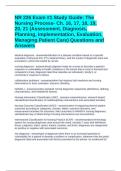
NR 226 Exam #1 Study Guide: The Nursing Process- Ch. 16, 17, 18, 19, 20, 21 (Assessment, Diagnosis, Planning, Implementation, Evaluation, Managing Patient Care) Questions and Answers

Document preview thumbnail
Vista previa 2 fuera de 8 páginas

NR 226 Exam #1 Study Guide: The Nursing Process- Ch. 16, 17, 18, 19, 20, 21 (Assessment, Diagnosis, Planning, Implementation, Evaluation, Managing Patient Care) Questions and Answers medical diagnosis identification of a disease condition based on a specific evaluation of physical S/S, PT's medical history, and the results of diagnostic tests and procedures, cannot be treated by nurses nursing diagnosis clinical judgment made by a nurse to describe a patient's response or vulnerability to health conditions or life events that a nurse is licensed and competent to treat, diagnostic label that classifies an individual's, family's, or community's response to illness collaborative problems problem that requires both medicine and nursing interventions to treat, examples: seizures, bleeding NANDA-I provides standard, formal diagnostic statements (definitions, defining characteristics, and related/risk factors) Nursing Intervention Classification (NIC) a comprehensive, research-based, standardized classification of multidisciplinary interventions and associated activities Nursing Outcome Classification (NOC) system of organizing desired patient outcomes according to categories, classes, labels, outcome indicators, and measurement activities for outcomes. links outcomes to NANDA-I nursing diagnoses, standardized way of determining if nursing interventions are successfulnur International Classification for Nursing Practice (ICNP) standard terminology system for nursing diagnoses used around the world, includes 7 axes with definitions (focus, judgment, client, action, means, location, and time). diagnoses are categorized as positive or negative with associated outcomes risk diagnosis type of diagnosis when there is an increased potential or vulnerability for a patient to develop a problem or complication. statement has two parts: diagnostic label and associated risk factors preceded by the phrase "as evidenced by" problem-focused diagnosis type of diagnosis when there is an identified undesirable human response to existing problems or concerns of a patient. statement has three parts: diagnostic label, related factors, and major defining characteristics health promotion diagnosis type of diagnosis where there is an identified desire or motivation to improve health status through a positive behavioral change. statements have two parts: diagnostic label and defining characteristics/assessment findings data clusters group of data elements, the signs or symptoms gathered during assessment data elements objective or subjective signs, symptoms, or risk factors that leads you into making a diagnostic conclusion, offer cues to a type of health problem diagnostic label component of a nursing diagnosis that names the nursing diagnosis (approved by NANDA-I, ICNP, or another system) related factors components of a nursing diagnosis that identify the patient's response to a health problem as related to a set of conditions that caused/influenced the response (etiologies, circumstances, facts, etc.), can be pathophysiological, treatment-related, situational, or maturational planning process of identifying a problem and making or carrying out a plan of action that is goal oriented, involves setting priorities and identifying PT-centered goals and expected outcomes, as well as prescribing nursing interventions appropriate for each nursing diagnosis high priority nursing diagnoses that result in harm to a patient or others if left untreated, consider patients' immediate needs based on ABC, Maslow's hierarchy of needs intermediate priority nursing diagnoses that are non-emergent and non-life threatening low priority nursing diagnoses that are not always directly related to a specific illness or prognosis but affect a patient's future well-being, focus on long-term health care needs cognitive shifts shift in attention from one patient to another during the conduct of the nursing process, occurs in response to changing PT needs, new procedures being ordered, or environmental processes expected outcomes time limited, measurable ways of determining whether a goal is met (patient behavior, physical state, perception) goals broad statements that describe a desired change in a patient's condition, perceptions, or behavior, realistic, time-limited, predicts resolution of a problem or continued maintenance of a good health behavior or function. ultimate outcomes of care short-term goal objective behavior or response that you expect the patient to achieve in a short time, usually less than a week long-term goal objective behavior or response that you expect a patient to achieve, usually over several days, weeks, or months nursing-sensitive patient outcome measurable patient, family, or community behavior or perception that is measured along a continuum in response to nursing interventions. examples: reduction in pain frequency and severity, reduction in incidence of pressure injuries and falls nursing interventions any treatments or actions based on clinical judgment and knowledge that nurses perform to enhance PT outcomes direct care measures treatments/procedures performed through interaction with a patient involving the laying on of hands indirect care measures treatments or procedures performed away from the PT but on behalf of a patient. examples: managing the care environment, consultation nurse-initiated interventions independent nursing interventions that a nurse initiates in response to a nursing diagnosis without supervision, direction, or orders from others, autonomous actions based on scientific rationale, governed by state nurse practice acts, pertain to ADLs, health education/promotion, and counseling healthcare-initiated interventions dependent nursing interventions that require an order from an HCP, based on HCP's choices for treating or managing a medical diagnosis. examples: administering meds, inserting an IV/Foley other provider interventions interdependent interventions, therapies that require the combined knowledge, skill, and expertise of multiple HCPs Nursing Interventions Classification (NIC) model model for classifying interventions that contains three levels 1) domains: highest level, use broad terms to organize more specific classes and interventions 2) classes: groups of related interventions that offer useful clinical categories to reference when selecting interventions 3) interventions for ease of use: treatments based on clinical judgment and knowledge that a nurse performs to enhance PT outcomes healthcare agency care plans standardized plans based on common medical or surgical conditions, more difficult to individualize, improve quality of care and are easy to understand nursing care plans includes nursing diagnoses, goals and/or expected outcomes, individualized nursing interventions, and a section for evaluation findings, promotes continuity of care and better communication, identifies/coordinates resources for delivering nursing care interprofessional care plans include contributions from all disciplines involved in PT care, focuses on PT priorities and improves the coordination of all PT therapies and communication among all disciplines student care plans care plans that focus on substantiating interventions with rationales so students can learn the scientific basis for their practice hand-off reporting transferring essential information from one nurse to the next during transitions in care, allows nurses to anticipate risks, ask questions, and clarify important details about the patient, prevents errors and delays in nursing interventions consultation seeking expertise of a specialist to identify ways to handle specific problems in PT management, occurs most often during planning and implementation phases of the nursing process, use ISBAR approach, often a one-time event implementation performance of nursing and collaborative interventions necessary to achieve goals and expected outcomes needed to support or improve a patient's health status scope of nursing practice ANA description of what a nurse is licensed to perform clinical practice guidelines/protocols systematically developed set of statements about appropriate health care for specific health care problems or clinical situations (pressure injuries, DVT, falls), based on EBP and research care bundle group of interventions related to a disease process or condition, when implemented together, result in better patient outcomes than if an intervention was implemented by itself, improve quality of care, prevent most common complications, helps to simplify clinical decisions, reduces errors standing orders preprinted documents containing medical orders for routine therapies, monitoring guidelines, and/or diagnostic procedures for specific patients with identified clinical problems, common in critical care and other specialized acute care settings. must notify HCP after completing this type of order. example: nurse can give specified medications if a PT has an irregular heart rhythm without first notifying the HCP Quality and Safety Education for Nurses (QSEN) standard competencies in knowledge, skills, and attitudes for the preparation of future nurses, goal is to prepare future nurses so that they can continuously improve the quality and safety of the health care systems in which they work implementation process 1) reassess the patient 2) review and revise existing nursing care plan 3) organize resources and care delivery 4) anticipate and prevent complications 5) implement nursing interventions reassessent gathering additional information to ensure the plan of care is still complete, current, and appropriate, not the same as evaluating care or determining a patient's response to an intervention activities of daily living the basic activities a person usually accomplishes during a normal day, such as eating, dressing, and bathing, assisting with these = direct care nursing intervention instrumental activities of daily living activities that support daily life and are oriented toward interacting with the environment such as shopping, caring for pets, home maintenance, preparing meals, housecleaning, writing checks, taking meds, etc. helping with these = direct care nursing intervention physical care techniques the activities that nurses perform while rendering care including turning, positioning, and administering care, as well as performing tasks such as Foley catheter insertion, NG tube insertion, IV insertion, and administering medications, direct care interventions lifesaving measures physical care technique that you use when a patient's physiological or psychological state is threatened. goal: restore homeostasis. examples: administering emergency meds, CPR, etc. counseling direct care method that helps patients use problem-solving processes to recognize and manage stress and facilitate interpersonal relationships. results in development of new attitudes, behaviors, and feelings teaching direct care intervention that results in intellectual growth or acquisition of psychomotor skills, ongoing process of keeping patients informed adverse reaction harmful or unintended effect of a medication, diagnostic test, or therapeutic intervention, can result from any nursing intervention preventative interventions direct care interventions that promote health and prevent illness to avoid the need for acute or rehabilitative care primary prevention efforts to prevent an injury or illness from ever occurring, health promotion, includes immunizations and physical/nutritional fitness activities secondary prevention efforts to limit the effects of an injury or illness that you cannot completely prevent, focuses on people experiencing health problems or illnesses and are at risk for developing further complications. examples: screening techniques, treating the early stages of a disease tertiary prevention actions taken to contain damage once a disease or disability has progressed beyond its early stages, minimizing effects of long-term illness or disability. example: rehabilitation measures indirect care examples include managing the safety of the patient care environment, interprofessional collaboration, documentation, delegating care activities to AP, medical order transcription, infection control, telephone consultations with HCPs, hand-off reports to other health care team members, and collecting, labeling, and transporting specimens patient adherence the extent to which a patient's behavior coincides with medical advice, patients and families invest time in carrying out require health care treatments, depends on values/perceptions of a patient and the specific treatment evaluation determines whether a patient's condition or well-being improved after nursing interventions were delivered; comparing assessment measures at two different time points to determine a PT's condition and whether the desired outcome of a treatment has been achieved outcomes measurable conditions of patient, family, or community status, behavior, or perception that are the criteria for judging the success in delivering nursing care nursing-sensitive quality outcomes patient outcomes that can be decreased with better nursing care, preventable adverse outcomes. include severe pressure injuries, falls and trauma, CAUTI, and vascular catheter-associated infections transformational leadership leadership that is focused on change and innovation through team development, shares ideas, empowers staff, supports opportunities to enhance the team, shows appreciation, and holds team members accountable servant leadership leadership style in which leaders serve others before they decide to become leaders, priority is putting needs of others first and promoting personal growth and autonomy to ensure that needs are met, work closely with the team to understand strengths and weaknesses and practice humility authentic leadership leadership style consistent with personalities, dedicated to own growth and builds strong relationships with others team nursing nursing care delivery model in which care is provided by a group of people led by an RN primary nursing nursing care delivery model in which one RN assumes the responsibility for a caseload of patients from admission to discharge and the same nurses provides care for same patients throughout their hospitalization

Vista previa del contenido

NR 226 Exam #1 Study Guide: The
Nursing Process- Ch. 16, 17, 18, 19,
20, 21 (Assessment, Diagnosis,
Planning, Implementation, Evaluation,
Managing Patient Care) Questions and
Answers
Medical diagnosis - answeridentification of a disease condition based on a specific
evaluation of physical S/S, PT's medical history, and the results of diagnostic tests and
procedures, cannot be treated by nurses

nursing diagnosis - answerclinical judgment made by a nurse to describe a patient's
response or vulnerability to health conditions or life events that a nurse is licensed and
competent to treat, diagnostic label that classifies an individual's, family's, or
community's response to illness

collaborative problems - answerproblem that requires both medicine and nursing
interventions to treat, examples: seizures, bleeding

NANDA-I - answerprovides standard, formal diagnostic statements (definitions, defining
characteristics, and related/risk factors)

Nursing Intervention Classification (NIC) - answera comprehensive, research-based,
standardized classification of multidisciplinary interventions and associated activities

Nursing Outcome Classification (NOC) - answersystem of organizing desired patient
outcomes according to categories, classes, labels, outcome indicators, and
measurement activities for outcomes. links outcomes to NANDA-I nursing diagnoses,
standardized way of determining if nursing interventions are successfulnur

International Classification for Nursing Practice (ICNP) - answerstandard terminology
system for nursing diagnoses used around the world, includes 7 axes with definitions
(focus, judgment, client, action, means, location, and time). diagnoses are categorized
as positive or negative with associated outcomes

risk diagnosis - answertype of diagnosis when there is an increased potential or
vulnerability for a patient to develop a problem or complication. statement has two parts:
diagnostic label and associated risk factors preceded by the phrase "as evidenced by"

, problem-focused diagnosis - answertype of diagnosis when there is an identified
undesirable human response to existing problems or concerns of a patient. statement
has three parts: diagnostic label, related factors, and major defining characteristics

health promotion diagnosis - answertype of diagnosis where there is an identified desire
or motivation to improve health status through a positive behavioral change. statements
have two parts: diagnostic label and defining characteristics/assessment findings

data clusters - answergroup of data elements, the signs or symptoms gathered during
assessment

data elements - answerobjective or subjective signs, symptoms, or risk factors that
leads you into making a diagnostic conclusion, offer cues to a type of health problem

diagnostic label - answercomponent of a nursing diagnosis that names the nursing
diagnosis (approved by NANDA-I, ICNP, or another system)

related factors - answercomponents of a nursing diagnosis that identify the patient's
response to a health problem as related to a set of conditions that caused/influenced
the response (etiologies, circumstances, facts, etc.), can be pathophysiological,
treatment-related, situational, or maturational

planning - answerprocess of identifying a problem and making or carrying out a plan of
action that is goal oriented, involves setting priorities and identifying PT-centered goals
and expected outcomes, as well as prescribing nursing interventions appropriate for
each nursing diagnosis

high priority - answernursing diagnoses that result in harm to a patient or others if left
untreated, consider patients' immediate needs based on ABC, Maslow's hierarchy of
needs

intermediate priority - answernursing diagnoses that are non-emergent and non-life
threatening

low priority - answernursing diagnoses that are not always directly related to a specific
illness or prognosis but affect a patient's future well-being, focus on long-term health
care needs

cognitive shifts - answershift in attention from one patient to another during the conduct
of the nursing process, occurs in response to changing PT needs, new procedures
being ordered, or environmental processes

expected outcomes - answertime limited, measurable ways of determining whether a
goal is met (patient behavior, physical state, perception)


Información del documento

Subido en
2 de noviembre de 2025
Número de páginas
8
Escrito en
2025/2026
Tipo
Examen
Contiene
Preguntas y respuestas
$15.99

¿Documento equivocado? Cámbialo gratis Dentro de los 14 días posteriores a la compra y antes de descargarlo, puedes elegir otro documento. Puedes gastar el importe de nuevo.
Escrito por estudiantes que aprobaron
Inmediatamente disponible después del pago
Leer en línea o como PDF

Seller avatar
Los indicadores de reputación están sujetos a la cantidad de artículos vendidos por una tarifa y las reseñas que ha recibido por esos documentos. Hay tres niveles: Bronce, Plata y Oro. Cuanto mayor reputación, más podrás confiar en la calidad del trabajo del vendedor.
Pogba119
3.9
(14)
Vendido
59
Seguidores
2
Artículos
5448
Última venta
1 mes hace


Por qué los estudiantes eligen Stuvia

Creado por compañeros estudiantes, verificado por reseñas

Calidad en la que puedes confiar: escrito por estudiantes que aprobaron y evaluado por otros que han usado estos resúmenes.

¿No estás satisfecho? Elige otro documento

¡No te preocupes! Puedes elegir directamente otro documento que se ajuste mejor a lo que buscas.

Paga como quieras, empieza a estudiar al instante

Sin suscripción, sin compromisos. Paga como estés acostumbrado con tarjeta de crédito y descarga tu documento PDF inmediatamente.

Student with book image

“Comprado, descargado y aprobado. Así de fácil puede ser.”

Alisha Student

Preguntas frecuentes