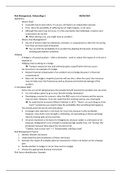
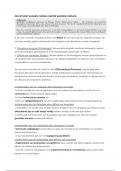
Risk Management, Videocollege 1 08/09/2020
Definitions
- What is Risk?
• A possible future even which, if it occurs, will lead to an undesirable outcome
• Thus, risk is the possibility of suffering loss (it might happen, is not sure)
• Although the event may not occur, it is the uncertainty that individuals, investors and
corporations do not like.
➔ When driving a car, you might have an accident
- What is Risk Management?
• Any set of actions taken by individuals, investors, or corporations to alter the risk arising
from their primary line(s) of business
➔ You can limit the probability of an accident by adapting driving style, driving sober,
avoiding bad weather conditions
Hedging
- A hedge is a financial position – often a derivative – used to reduce the impact of a risk one is
exposed to..
- Hedging means putting on a hedge
➔ Trying to reduce the loss and otherwise gives a payoff when the loss occurs
- Car insurance is an example of a hedge:
• Receive financial compensation if an accident occurs (hedge because it is financial
compensation)
• Basis risk: the hedge is imperfect (and we will see this is often the case): the insurance
may not fully cover the financial (as well as physical and emotional) damage of the
accident
Is risk always bad?
- Some risks are worth taking because the possible benefit exceeds the possible costs (ex ante)
• You risk taking a plane to go to your favorite holiday destination
• Developing a vaccine for corona is risky: the R&D costs a lot of money and the vaccine
may not work. However, if you do create the first working vaccine, you struck gold.
➔ As noted by the economic Milton Friedman in 1975: “There is no such thing as a free
lunch” (sometimes you need to take the probability that something bad happens)
- You should avoid risk you do not know about
• Exchange rates represent a risk factor for Coca-Cola, because it sells worldwide.
However, Coca-Cola’s core strength is marketing, not speculating on future exchange
rates by moving sales across countries.
• Oil prices represent a risk factor for Bridgestone, because rubber is a derivative of oil.
However, Bridgestone’s core strength is producing high-quality tires, not “timing” this
production because they expect the oil price to fall.
“Cobbler, stick to your last” <-> “Schoenmaker, blijf bij je taak”
Risk Management Process
1. Identify relevant risk factors
2. Understand the joint distribution of those risk factors
3. Estimate the impact of probable adverse movements in those risk factors on the strategic
plan
4. Decide whether to hedge or not (or how much to hedge)
5. Choose the appropriate financial instrument
Risk Factor Identification: Example
,Risk Factor Identification: Example
- What are the major risk factors ABC faces?
- A partial list includes changes in:
• Price of petroleum: if the price increases, they need to pay a lot more
• Interest rates: value of the projects they want to start
• Canadian dollar/US dollar exchange rates: they are buying inputs in Canada but building
in US
• Euro/US dollar exchange rates: competitor are also from Germany
• Business conditions in US (but also Canada and Germany):
➢ When demand for roads is high (in economic booming), firm will need to borrow
more and this borrowing tends to be expensive (at a higher interest rate)
➔ This correlation decreases risk!
➢ However, petroleum prices tend to be lower in boom (because good times)
➔ This correlation increases risk!
➔ All these Risk Factors are there at the same time!
Understand the joint distribution of those risk factors
- Let’s look at some historical distributions of risk factors
➔ The number of US dollar you need to pay for 1 Euro in a time period. This exchange
rate has varied a lot. There was a depreciation 25% around 2000. In 2014 a strong
depreciation of 33% in 1 year. But a 85% appreciation from 2000-2005.
The distribution of risk factors
- If you are a European company with sales in the US, you want to understand ex ante how
likely is a large appreciation of the Euro (over a given time interval).
• Each $ in sales will be worth less in €!
• What type of firm is worried about a depreciation of the Euro? Whenever the Euro
depreciates it is bad. They don’t want to be the sales will be less worth. We will later
learn how to hedge this risk.
- A simple example: Suppose Adidas sells 1 million pairs of sneakers in the US annually at a
price of 100$
• At the peak exchange rate mid-2008, these sales are worth only 100/1.6=62.5mln Euro
• At the trough exchange rate by the end of 2000, these sales are worth 100/0.9=111mln
Euro
• At the current exchange rate, these sales are worth 100/1.15=87mln Euro
,EasyJet
➔ Does a lot of hedging! Whenever the dollar appreciates, the cost increase much
more than their revenues. This was the bad event that cost them so much money
and risk.
➔ A depreciation of the pound (fewer $ for 1 pound) disproportionally increases costs
(to be paid in US$) relative to the increase in revenues (to be received in US$)
Exchange rate volatility is large and often coincides with political events
➔ How did this happens?
,Crude Oil Price
US Interest Rates
The volatility index
Understand the joint distribution of those risk factors
- In most cases, future values of risk factors are extremely hard to predict
- Based upon historical data, we can construct a probability density function (PDF), i.e., a
distribution of things that might happen with accompanying probabilities.
- Take example of US$ - Euro Exchange rate (# of US$ per 1 Euro)
• Best prediction for tomorrow’s rate is its current rate (‘random walk hypothesis’)
• Annualized long-term volatility: 11%
, • Suppose exchange rate returns follow normal distribution with mean = 0 and volatility =
11%
Estimate the impact of adverse movements in those risk factors on the strategic plan, decide whether
to hedge or not (or how much to hedge) and choose the appropriate financial instrument.
Assessing potential impact + actions
- We have identified risk factors and have seen examples of their distribution
- To do list:
• Estimate the impact of adverse movements in those risk factors on the strategic plan.
➢ Various tools (chapter 4): value-at-Risk and Cash-Flow at Risk
• Decide whether to hedge or not (chapter 3), and if yes, how much and how? (chapter 5
and following)
How to reduce risk exposure?
How can a firm solely engaged in copper extraction reduce its exposure to (large) drops in copper
prices?
1. Diversity product line: e.g. extract silver (if silver and copper prices are not perfectly
correlated)
2. Manage expenditure: e.g. increase variable relative to fixed costs
3. Reduce leverage, such that the firm has fewer obligation (recall: coupons are fixed, dividends
are more flexible).
4. Focus of this course, Use Derivatives
• Often cheapest and most flexible: a wide variety of copper derivatives is traded on
exchanges around the world
What is a derivative?
A derivative is a financial instrument with promised payoffs derived from the value of one or several
contractually specific underlyings.
, - Underlyings are risks to which economics agents (individuals and corporations) are exposed
- The most liquid derivatives are on underlyings to which many agents are exposed, such as:
stock prices, exchange rates (US$-Euro), interest rates, commodity prices.
• Liquid meaning cheaper and easier to access
• Underlying can be anything though: Hours of sun in Kansas, Snow in cm in New York
State, Total number of bankruptcies in a year, Elections, Number of houses destroyed in
hurricane, Bitcoin etc.
Derivatives come in two flavors:
- Plain Vanilla (more common and the focus of this course)
• Forwards and futures
➢ These contracts represent an obligation (=verplichting) to buy/sell some underlying
at a fixed price at some time in the future (maturity)
➢ Swaps represent a portfolio of forwards/futures
• Options
➢ These contracts represent the right to buy/sell some underlying at a fixed price some
time in the future (maturity).
- Exotic derivatives (we ignore these)
• A derivative which is more complex than commonly traded “plain-vanilla” products
• Complex determination of payoff (depending not on value of underlying at maturity, but
average, minimum or maximum) or non-standard underlying (weather, elections).
Where are derivatives traded?
1. Exchange
- E.g. Chicago Mercantille Exchange, Chicago Board Options Exchange, AEX in the Netherlands
- Cheaper but standardized contracts
2. Over-the-counter (OTC)
- Two parties agree on a trade without meeting through and organized exchange
- More expensive, but customized contracts
Strong growth in derivatives usage since beginning of 1970s, why?
- Oil crises at beginning/end of 1970s
- Increased volatility of interest rates and exchange rates (after termination of Bretton-Woods
agreement) (A higher volatility means that a security’s value can be potentially be spread out
over a larger range of values. This means that the price of the security can change
dramatically over a short time period in either direction). (Bretton-woods: which amount of
gold you could have).
- Spectacular growth in international trade and portfolio flows
- Start of exchanges specialized in trading standardized derivative products
- Derivation of the Black-Scholes Option Pricing Model
Definitions
- What is Risk?
• A possible future even which, if it occurs, will lead to an undesirable outcome
• Thus, risk is the possibility of suffering loss (it might happen, is not sure)
• Although the event may not occur, it is the uncertainty that individuals, investors and
corporations do not like.
➔ When driving a car, you might have an accident
- What is Risk Management?
• Any set of actions taken by individuals, investors, or corporations to alter the risk arising
from their primary line(s) of business
➔ You can limit the probability of an accident by adapting driving style, driving sober,
avoiding bad weather conditions
Hedging
- A hedge is a financial position – often a derivative – used to reduce the impact of a risk one is
exposed to..
- Hedging means putting on a hedge
➔ Trying to reduce the loss and otherwise gives a payoff when the loss occurs
- Car insurance is an example of a hedge:
• Receive financial compensation if an accident occurs (hedge because it is financial
compensation)
• Basis risk: the hedge is imperfect (and we will see this is often the case): the insurance
may not fully cover the financial (as well as physical and emotional) damage of the
accident
Is risk always bad?
- Some risks are worth taking because the possible benefit exceeds the possible costs (ex ante)
• You risk taking a plane to go to your favorite holiday destination
• Developing a vaccine for corona is risky: the R&D costs a lot of money and the vaccine
may not work. However, if you do create the first working vaccine, you struck gold.
➔ As noted by the economic Milton Friedman in 1975: “There is no such thing as a free
lunch” (sometimes you need to take the probability that something bad happens)
- You should avoid risk you do not know about
• Exchange rates represent a risk factor for Coca-Cola, because it sells worldwide.
However, Coca-Cola’s core strength is marketing, not speculating on future exchange
rates by moving sales across countries.
• Oil prices represent a risk factor for Bridgestone, because rubber is a derivative of oil.
However, Bridgestone’s core strength is producing high-quality tires, not “timing” this
production because they expect the oil price to fall.
“Cobbler, stick to your last” <-> “Schoenmaker, blijf bij je taak”
Risk Management Process
1. Identify relevant risk factors
2. Understand the joint distribution of those risk factors
3. Estimate the impact of probable adverse movements in those risk factors on the strategic
plan
4. Decide whether to hedge or not (or how much to hedge)
5. Choose the appropriate financial instrument
Risk Factor Identification: Example
,Risk Factor Identification: Example
- What are the major risk factors ABC faces?
- A partial list includes changes in:
• Price of petroleum: if the price increases, they need to pay a lot more
• Interest rates: value of the projects they want to start
• Canadian dollar/US dollar exchange rates: they are buying inputs in Canada but building
in US
• Euro/US dollar exchange rates: competitor are also from Germany
• Business conditions in US (but also Canada and Germany):
➢ When demand for roads is high (in economic booming), firm will need to borrow
more and this borrowing tends to be expensive (at a higher interest rate)
➔ This correlation decreases risk!
➢ However, petroleum prices tend to be lower in boom (because good times)
➔ This correlation increases risk!
➔ All these Risk Factors are there at the same time!
Understand the joint distribution of those risk factors
- Let’s look at some historical distributions of risk factors
➔ The number of US dollar you need to pay for 1 Euro in a time period. This exchange
rate has varied a lot. There was a depreciation 25% around 2000. In 2014 a strong
depreciation of 33% in 1 year. But a 85% appreciation from 2000-2005.
The distribution of risk factors
- If you are a European company with sales in the US, you want to understand ex ante how
likely is a large appreciation of the Euro (over a given time interval).
• Each $ in sales will be worth less in €!
• What type of firm is worried about a depreciation of the Euro? Whenever the Euro
depreciates it is bad. They don’t want to be the sales will be less worth. We will later
learn how to hedge this risk.
- A simple example: Suppose Adidas sells 1 million pairs of sneakers in the US annually at a
price of 100$
• At the peak exchange rate mid-2008, these sales are worth only 100/1.6=62.5mln Euro
• At the trough exchange rate by the end of 2000, these sales are worth 100/0.9=111mln
Euro
• At the current exchange rate, these sales are worth 100/1.15=87mln Euro
,EasyJet
➔ Does a lot of hedging! Whenever the dollar appreciates, the cost increase much
more than their revenues. This was the bad event that cost them so much money
and risk.
➔ A depreciation of the pound (fewer $ for 1 pound) disproportionally increases costs
(to be paid in US$) relative to the increase in revenues (to be received in US$)
Exchange rate volatility is large and often coincides with political events
➔ How did this happens?
,Crude Oil Price
US Interest Rates
The volatility index
Understand the joint distribution of those risk factors
- In most cases, future values of risk factors are extremely hard to predict
- Based upon historical data, we can construct a probability density function (PDF), i.e., a
distribution of things that might happen with accompanying probabilities.
- Take example of US$ - Euro Exchange rate (# of US$ per 1 Euro)
• Best prediction for tomorrow’s rate is its current rate (‘random walk hypothesis’)
• Annualized long-term volatility: 11%
, • Suppose exchange rate returns follow normal distribution with mean = 0 and volatility =
11%
Estimate the impact of adverse movements in those risk factors on the strategic plan, decide whether
to hedge or not (or how much to hedge) and choose the appropriate financial instrument.
Assessing potential impact + actions
- We have identified risk factors and have seen examples of their distribution
- To do list:
• Estimate the impact of adverse movements in those risk factors on the strategic plan.
➢ Various tools (chapter 4): value-at-Risk and Cash-Flow at Risk
• Decide whether to hedge or not (chapter 3), and if yes, how much and how? (chapter 5
and following)
How to reduce risk exposure?
How can a firm solely engaged in copper extraction reduce its exposure to (large) drops in copper
prices?
1. Diversity product line: e.g. extract silver (if silver and copper prices are not perfectly
correlated)
2. Manage expenditure: e.g. increase variable relative to fixed costs
3. Reduce leverage, such that the firm has fewer obligation (recall: coupons are fixed, dividends
are more flexible).
4. Focus of this course, Use Derivatives
• Often cheapest and most flexible: a wide variety of copper derivatives is traded on
exchanges around the world
What is a derivative?
A derivative is a financial instrument with promised payoffs derived from the value of one or several
contractually specific underlyings.
, - Underlyings are risks to which economics agents (individuals and corporations) are exposed
- The most liquid derivatives are on underlyings to which many agents are exposed, such as:
stock prices, exchange rates (US$-Euro), interest rates, commodity prices.
• Liquid meaning cheaper and easier to access
• Underlying can be anything though: Hours of sun in Kansas, Snow in cm in New York
State, Total number of bankruptcies in a year, Elections, Number of houses destroyed in
hurricane, Bitcoin etc.
Derivatives come in two flavors:
- Plain Vanilla (more common and the focus of this course)
• Forwards and futures
➢ These contracts represent an obligation (=verplichting) to buy/sell some underlying
at a fixed price at some time in the future (maturity)
➢ Swaps represent a portfolio of forwards/futures
• Options
➢ These contracts represent the right to buy/sell some underlying at a fixed price some
time in the future (maturity).
- Exotic derivatives (we ignore these)
• A derivative which is more complex than commonly traded “plain-vanilla” products
• Complex determination of payoff (depending not on value of underlying at maturity, but
average, minimum or maximum) or non-standard underlying (weather, elections).
Where are derivatives traded?
1. Exchange
- E.g. Chicago Mercantille Exchange, Chicago Board Options Exchange, AEX in the Netherlands
- Cheaper but standardized contracts
2. Over-the-counter (OTC)
- Two parties agree on a trade without meeting through and organized exchange
- More expensive, but customized contracts
Strong growth in derivatives usage since beginning of 1970s, why?
- Oil crises at beginning/end of 1970s
- Increased volatility of interest rates and exchange rates (after termination of Bretton-Woods
agreement) (A higher volatility means that a security’s value can be potentially be spread out
over a larger range of values. This means that the price of the security can change
dramatically over a short time period in either direction). (Bretton-woods: which amount of
gold you could have).
- Spectacular growth in international trade and portfolio flows
- Start of exchanges specialized in trading standardized derivative products
- Derivation of the Black-Scholes Option Pricing Model