Chapter one
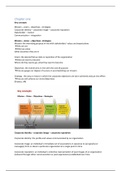
Key concepts
Mission – vision – objectives - strategies
Corporate identity – corporate image – corporate reputation
Stakeholder – market
Communication – integration
Mission – vision – objectives -strategies
Mission: the overriding purpose in line with stakeholders’ values and expectations
→Who we are
→What we value
(what bussiness they are in
Vision: the desired futrue state or aspiration of the organization
→What we want to become
Where do they wanna go, what they want to become
Objectives: the overall aims in line with the overall purpose
→How we gauge our degree of success in accomplishing our mission
Strategy : the way or means in which the corporate objectives are tob e achieved and put into effect
→How we will achieve our vision/objectives
(finance, HR)
Corperate identity – corporate image – corporate reputation
Corporate identity: the profile and values communicated by an organization
Corporate image: an individual’s immediate set of associations in sepsonse to (a) signal(s) or
message(s) from or about a particular organization at a single point in time
Corporate reputation: an individual’s collective representation of past images of an organization
(induced through either communication or past experiences) established over time.
,(advertising)
Stakeholder – market
Stakeholder: any group or individual who can affect or is affected by the achievement of the
organization’s objectives
→Relevant person/ group of people
Stakeholders: customers and employees. Customers directly related to sales, employees to work and
identity building
high or low in power and interest
Market: a defined group for whom a product or service is or may be in demand (and for whom an
organization creates and maintains products and services)
→Target group
Communication – integration
Communication: the tactics and media that are used to communicate with interna land external
groups
Integration: the act of coordinating all communication so that the corporate identity is effectively
and consistently communicated to interna land external groups
,Trends in corporate communication – in 2010s
- More active stakeholders: voicing, self-organizing, advocating
- Empowered by new media: interactive, dialogue-bused
- Stakeholders share more experiences, opinions, ideas about organizations
- Electronic word-of-mouth (eWOM) and peer-to-peer influence: challenges & oppoptunities
Chapter two
Historical deveolopmetns: late 18th century -1930s
, 1. Industrial Revolution: mass production/ consumption
> increased competition
>> rise of marketing communications
Historical devolopments: early 20th century
2. Muckraing journalism
> rise of public relations
power over people
( Ray Stannard Baker, Upton Sinclair)
Historical devolopments: 1920-1930
3. Economic depression
>development of expertise on PR and marketing
>> PR and marketing as separate external disciplines
Integration of two separate disciplines: 1980s
Marketing communication > markets, products
Public relations (PR) > publics, issues
1980s: integration (Kotler & Mindak, 1978), came up with 5 models
Key concepts
Mission – vision – objectives - strategies
Corporate identity – corporate image – corporate reputation
Stakeholder – market
Communication – integration
Mission – vision – objectives -strategies
Mission: the overriding purpose in line with stakeholders’ values and expectations
→Who we are
→What we value
(what bussiness they are in
Vision: the desired futrue state or aspiration of the organization
→What we want to become
Where do they wanna go, what they want to become
Objectives: the overall aims in line with the overall purpose
→How we gauge our degree of success in accomplishing our mission
Strategy : the way or means in which the corporate objectives are tob e achieved and put into effect
→How we will achieve our vision/objectives
(finance, HR)
Corperate identity – corporate image – corporate reputation
Corporate identity: the profile and values communicated by an organization
Corporate image: an individual’s immediate set of associations in sepsonse to (a) signal(s) or
message(s) from or about a particular organization at a single point in time
Corporate reputation: an individual’s collective representation of past images of an organization
(induced through either communication or past experiences) established over time.
,(advertising)
Stakeholder – market
Stakeholder: any group or individual who can affect or is affected by the achievement of the
organization’s objectives
→Relevant person/ group of people
Stakeholders: customers and employees. Customers directly related to sales, employees to work and
identity building
high or low in power and interest
Market: a defined group for whom a product or service is or may be in demand (and for whom an
organization creates and maintains products and services)
→Target group
Communication – integration
Communication: the tactics and media that are used to communicate with interna land external
groups
Integration: the act of coordinating all communication so that the corporate identity is effectively
and consistently communicated to interna land external groups
,Trends in corporate communication – in 2010s
- More active stakeholders: voicing, self-organizing, advocating
- Empowered by new media: interactive, dialogue-bused
- Stakeholders share more experiences, opinions, ideas about organizations
- Electronic word-of-mouth (eWOM) and peer-to-peer influence: challenges & oppoptunities
Chapter two
Historical deveolopmetns: late 18th century -1930s
, 1. Industrial Revolution: mass production/ consumption
> increased competition
>> rise of marketing communications
Historical devolopments: early 20th century
2. Muckraing journalism
> rise of public relations
power over people
( Ray Stannard Baker, Upton Sinclair)
Historical devolopments: 1920-1930
3. Economic depression
>development of expertise on PR and marketing
>> PR and marketing as separate external disciplines
Integration of two separate disciplines: 1980s
Marketing communication > markets, products
Public relations (PR) > publics, issues
1980s: integration (Kotler & Mindak, 1978), came up with 5 models