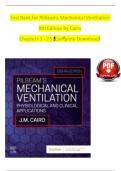
Clinical Pathophysiology Made Ridiculously
Simple: Color Edition
3rd Edition
Author(s)Aaron Berkowitz MD PhD
TEST BANK
Question 1
Reference: Ch. 1: The Cardiovascular System — Left Heart
Failure
Question Stem:
A 72-year-old patient with long-standing hypertension reports
progressive dyspnea on exertion and orthopnea. On assessment
you find bibasilar crackles and an S3 gallop. Which
pathophysiologic change best explains these findings?
Options:
A. Increased right ventricular afterload causing systemic venous
congestion
B. Elevated left ventricular end-diastolic pressure causing
pulmonary congestion
C. Decreased preload to the left ventricle causing reduced
cardiac output
,D. Primary pulmonary parenchymal disease leading to
interstitial edema
Correct Answer: B
Rationales:
• Correct (B): In left heart failure the failing left ventricle
cannot eject sufficiently, increasing LV end-diastolic
pressure which transmits backward to pulmonary veins
and capillaries, producing pulmonary congestion, crackles,
orthopnea, and an S3. (Berkowitz: physiology of backward
failure.)
• Incorrect (A): Right ventricular afterload/systemic venous
congestion produces peripheral edema and JVD, not
predominant pulmonary crackles and orthopnea.
• Incorrect (C): Decreased preload would reduce filling
pressures — it does not explain pulmonary congestion and
S3.
• Incorrect (D): Primary lung disease can cause crackles but
would not produce an S3 or orthopnea pattern strongly
linked to LV filling pressure.
Teaching Point:
Left ventricular failure raises pulmonary venous pressure
causing pulmonary edema and S3.
Citation: Berkowitz, 2023, Ch. 1: Left Heart Failure
,Question 2
Reference: Ch. 1: The Cardiovascular System — Right Heart
Failure
Question Stem:
A patient with chronic COPD develops increasing peripheral
edema, hepatomegaly, and jugular venous distension. Which
mechanism most likely produced these signs?
Options:
A. Left-sided systolic dysfunction with pulmonary edema
B. High right ventricular afterload from pulmonary hypertension
leading to RV failure
C. Increased systemic arterial resistance causing decreased RV
preload
D. Mitral regurgitation causing volume overload of the right
ventricle
Correct Answer: B
Rationales:
• Correct (B): Chronic lung disease commonly causes
pulmonary hypertension, increasing RV afterload. RV
failure then leads to systemic venous congestion
manifesting as peripheral edema, hepatomegaly, and JVD.
• Incorrect (A): Left-sided failure produces pulmonary
symptoms (e.g., crackles) rather than isolated systemic
venous congestion.
, • Incorrect (C): Increased systemic arterial resistance affects
left heart workload; it does not directly cause RV failure via
decreased preload.
• Incorrect (D): Mitral regurgitation causes left
atrial/ventricular volume overload and pulmonary
symptoms; it does not directly produce isolated right-sided
systemic venous signs.
Teaching Point:
Pulmonary hypertension increases RV afterload → systemic
venous congestion in right-sided failure.
Citation: Berkowitz, 2023, Ch. 1: Right Heart Failure
Question 3
Reference: Ch. 1: The Cardiovascular System — Preload,
Afterload, and Treatment of Heart Failure
Question Stem:
A patient with classic systolic heart failure is prescribed an ACE
inhibitor. Which immediate hemodynamic effect of ACE
inhibition is most important in improving symptoms?
Options:
A. Increased preload by sodium retention
B. Decreased afterload by lowering systemic vascular resistance
C. Increased heart rate through reflex sympathetic activation
D. Direct increase in myocardial contractility
Simple: Color Edition
3rd Edition
Author(s)Aaron Berkowitz MD PhD
TEST BANK
Question 1
Reference: Ch. 1: The Cardiovascular System — Left Heart
Failure
Question Stem:
A 72-year-old patient with long-standing hypertension reports
progressive dyspnea on exertion and orthopnea. On assessment
you find bibasilar crackles and an S3 gallop. Which
pathophysiologic change best explains these findings?
Options:
A. Increased right ventricular afterload causing systemic venous
congestion
B. Elevated left ventricular end-diastolic pressure causing
pulmonary congestion
C. Decreased preload to the left ventricle causing reduced
cardiac output
,D. Primary pulmonary parenchymal disease leading to
interstitial edema
Correct Answer: B
Rationales:
• Correct (B): In left heart failure the failing left ventricle
cannot eject sufficiently, increasing LV end-diastolic
pressure which transmits backward to pulmonary veins
and capillaries, producing pulmonary congestion, crackles,
orthopnea, and an S3. (Berkowitz: physiology of backward
failure.)
• Incorrect (A): Right ventricular afterload/systemic venous
congestion produces peripheral edema and JVD, not
predominant pulmonary crackles and orthopnea.
• Incorrect (C): Decreased preload would reduce filling
pressures — it does not explain pulmonary congestion and
S3.
• Incorrect (D): Primary lung disease can cause crackles but
would not produce an S3 or orthopnea pattern strongly
linked to LV filling pressure.
Teaching Point:
Left ventricular failure raises pulmonary venous pressure
causing pulmonary edema and S3.
Citation: Berkowitz, 2023, Ch. 1: Left Heart Failure
,Question 2
Reference: Ch. 1: The Cardiovascular System — Right Heart
Failure
Question Stem:
A patient with chronic COPD develops increasing peripheral
edema, hepatomegaly, and jugular venous distension. Which
mechanism most likely produced these signs?
Options:
A. Left-sided systolic dysfunction with pulmonary edema
B. High right ventricular afterload from pulmonary hypertension
leading to RV failure
C. Increased systemic arterial resistance causing decreased RV
preload
D. Mitral regurgitation causing volume overload of the right
ventricle
Correct Answer: B
Rationales:
• Correct (B): Chronic lung disease commonly causes
pulmonary hypertension, increasing RV afterload. RV
failure then leads to systemic venous congestion
manifesting as peripheral edema, hepatomegaly, and JVD.
• Incorrect (A): Left-sided failure produces pulmonary
symptoms (e.g., crackles) rather than isolated systemic
venous congestion.
, • Incorrect (C): Increased systemic arterial resistance affects
left heart workload; it does not directly cause RV failure via
decreased preload.
• Incorrect (D): Mitral regurgitation causes left
atrial/ventricular volume overload and pulmonary
symptoms; it does not directly produce isolated right-sided
systemic venous signs.
Teaching Point:
Pulmonary hypertension increases RV afterload → systemic
venous congestion in right-sided failure.
Citation: Berkowitz, 2023, Ch. 1: Right Heart Failure
Question 3
Reference: Ch. 1: The Cardiovascular System — Preload,
Afterload, and Treatment of Heart Failure
Question Stem:
A patient with classic systolic heart failure is prescribed an ACE
inhibitor. Which immediate hemodynamic effect of ACE
inhibition is most important in improving symptoms?
Options:
A. Increased preload by sodium retention
B. Decreased afterload by lowering systemic vascular resistance
C. Increased heart rate through reflex sympathetic activation
D. Direct increase in myocardial contractility