🗺️
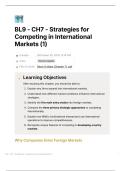
BL9 - CH7 - Strategies for
Competing in International
Markets (1)
Created @October 30, 2025 12:14 PM
Class Stuvia Copies
Files & media Block 9 slides (Chapter 7) .pdf
💡 Learning Objectives
After studying this chapter, you should be able to:
1. Explain why firms expand into international markets.
2. Understand how different market conditions influence international
strategies.
3. Identify the five main entry modes into foreign markets.
4. Compare the three primary strategic approaches to competing
internationally.
5. Explain how MNEs (multinational enterprises) use international
operations to improve competitiveness.
6. Recognize unique features of competing in developing-country
markets.
Why Companies Enter Foreign Markets
BL9 - CH7 - Strategies for Competing in International Markets (1) 1
, 1. To gain access to new customers → Growth beyond saturated home markets.
2. To achieve lower costs through economies of scale, experience, and
increased purchasing power → Economies of scale, learning curve, and
purchasing power.
3. To gain access to low-cost inputs of production → Natural resources or
cheap labor abroad.
4. To further exploit its core competencies → Extend domestic market
leadership globally (e.g., Starbucks, McDonald’s).
5. To gain access to resources and capabilities located in foreign markets →
Partnerships, acquisitions, or alliances for skills and technologies.
Why Competing Across National Borders Makes
Strategy Making More Complex/Challenges
2. Location-based value chain advantages for certain countries.
Certain activities in the value chain (like manufacturing, R&D, or logistics) are
more efficient or cheaper in specific countries due to factors like labour costs,
expertise, or infrastructure. Companies design global strategies that leverage
these location advantages.
3. Differences in government policies, tax rates, and economic conditions.
Each country has its own regulations, tax laws, trade policies, and economic
environment, which affect how companies operate and compete. Strategies
must account for compliance and cost impacts caused by these differences.
4. Currency exchange rate risks.
Fluctuations in currency exchange rates can impact costs, revenues, and
profits when companies operate internationally. Firms need to manage these
financial risks within their strategies.
5. Differences in buyer tastes and preferences for products and services.
Customers in different countries often have distinct preferences, cultural
values, or consumption habits. Companies must tailor products, marketing,
and service delivery to meet these local tastes. e.g. McDonald’s
BL9 - CH7 - Strategies for Competing in International Markets (1) 2
BL9 - CH7 - Strategies for
Competing in International
Markets (1)
Created @October 30, 2025 12:14 PM
Class Stuvia Copies
Files & media Block 9 slides (Chapter 7) .pdf
💡 Learning Objectives
After studying this chapter, you should be able to:
1. Explain why firms expand into international markets.
2. Understand how different market conditions influence international
strategies.
3. Identify the five main entry modes into foreign markets.
4. Compare the three primary strategic approaches to competing
internationally.
5. Explain how MNEs (multinational enterprises) use international
operations to improve competitiveness.
6. Recognize unique features of competing in developing-country
markets.
Why Companies Enter Foreign Markets
BL9 - CH7 - Strategies for Competing in International Markets (1) 1
, 1. To gain access to new customers → Growth beyond saturated home markets.
2. To achieve lower costs through economies of scale, experience, and
increased purchasing power → Economies of scale, learning curve, and
purchasing power.
3. To gain access to low-cost inputs of production → Natural resources or
cheap labor abroad.
4. To further exploit its core competencies → Extend domestic market
leadership globally (e.g., Starbucks, McDonald’s).
5. To gain access to resources and capabilities located in foreign markets →
Partnerships, acquisitions, or alliances for skills and technologies.
Why Competing Across National Borders Makes
Strategy Making More Complex/Challenges
2. Location-based value chain advantages for certain countries.
Certain activities in the value chain (like manufacturing, R&D, or logistics) are
more efficient or cheaper in specific countries due to factors like labour costs,
expertise, or infrastructure. Companies design global strategies that leverage
these location advantages.
3. Differences in government policies, tax rates, and economic conditions.
Each country has its own regulations, tax laws, trade policies, and economic
environment, which affect how companies operate and compete. Strategies
must account for compliance and cost impacts caused by these differences.
4. Currency exchange rate risks.
Fluctuations in currency exchange rates can impact costs, revenues, and
profits when companies operate internationally. Firms need to manage these
financial risks within their strategies.
5. Differences in buyer tastes and preferences for products and services.
Customers in different countries often have distinct preferences, cultural
values, or consumption habits. Companies must tailor products, marketing,
and service delivery to meet these local tastes. e.g. McDonald’s
BL9 - CH7 - Strategies for Competing in International Markets (1) 2