biology questions on digestion
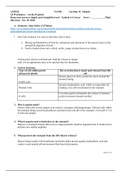
ANP242 NAME: GI Worksheet – worth 25 points Keep your answers simple and straightforward – Upload to Canvas Score: ___________/25pts Due date: Nov 29, 2020 A. Stomach: video below (5:57mins) 1. Job of the stomach is to receive the bolus, then it does: a. b. At this point, chyme is formed and held for 2 hours or longer until it is an appropriate time to be squirted into the duodenum. 2. Gastric anatomy: Type of cell within gastric pits/gastric glands The secretion that is made and released from this cell 3. How is pepsin made? 4. What is pepsin used to hydrolyze in the stomach? 5. What protects the stomach from the HCl that it releases? B. Small Intestine 1 – Structure: video below (6:30mins) 6. Major parts of small intestine Major part of small intestine Major job/function of this part 7. Delivery into the small intestine? What is being delivered to the SI? From where did it come? 8. What is the intestinal villi's primary function and the microvilli on the apical surface of the simple columnar epithelial cells? C. Small Intestine 2 – Digestion: see video below (6:44mins) 9. Chemical Digestion of Macromolecules Macromolecule Composed of what building block Chemically digested by 10. What causes trypsinogen (inactive form), to be turned into trypsin (active enzyme)? a. Enterokinase-Trypsinogen is activated by enterokinase. Enterokinase specifically cleaves the acidic propeptide from trypsinogen to yield active trypsin. D. Small Intestine 3 - Absorption: see video below (4:54mins) 11. Absorption Nutrient to be absorbed Type of transport at the enterocyte After crossing enterocyte, next enters where E. Liver: see video below (6:27mins) 12. Major function of liver: 13. The liver can store carbs or fats as: 14. Blood supply to and blood leaving the liver: Blood (which if recently eaten) is nutrient-rich but needs be detoxified enter through the Hepatic Artery Oxygen gets to the hepatocytes by entering through the All oxygen-poor blood leaves through the F. Liver - Hepatic Lobule: see video below (3:04mins) 15. Hepatic lobules are what shape? 16. Blood flows in from the corners of the lobule towards the middle of the lobule and then leaves the lobule through what vessel? G. Liver - Biliary tree: see video below (5:59mins) 17. Function of bile is? 18. How does bile leave the liver after its produced? 19. Where does bile go to be concentrated and stored? 20. How does bile get in and out of this structure (listed above)? 21. Which hormone causes bile to be released from this structure? 22. Where does the bile gets secreted into the GI tract, and how does it get there from its site of storage? a. Duodenum. It gets from its site of storage where a hormone referred as cholecystokinin is stimulated, making the gall bladder contract, thus pushing bile out through cystic ducts. 23. Where do the bile salts and fats get absorbed? Small Intestines 24. What happens to the bile salts after they get absorbed? H. Pancreas – Exocrine: see video below (9:48mins) 25. Pancreatic Secretions: Released from pancreas Function I. Colon – Absorption: see video below (9:44mins) 26. What 2 things get absorbed in the colon? a. 27. Actually, what organ is most responsible for the absorption of the above components? a. 28. What leads to diarrhea? a. 29. What leads to constipation? a. Lack of or minimal roughages/fiber in the diet 30. What do microorganisms do in our colon? a. They digest the indigestible materials hence creating gas, b. Making Vitamin K 31. What 2 by-products do these microorganisms produce? a. Gases b. Vitamin K 32. LOOK UP IN YOUR BOOK OR DIGESTION POWERPOINT: Which vitamin important in blood clotting is made by the normal bacterial residents of the colon? a. Vitamin K J. Control of the GI tract: see video below (9:55mins) 33. Enteric NS: Gastrocolic Reflex a. Stimulus: Reflex stimulus, from the stomach to the rectum. The latter mechanism depends on the stomach function and is solely responsible for the lower bowel's increased activity that increases stomach activities. b. Effector: c. What does the effector do? They are part of the body, such as muscles that produce responses to detected stimulus. 34. Hormones: Gastrin a. Stimulus: Presence of foodstuffs more so peptides, amino acids, and calcium b. Target site: Stomach c. Functions: i. Secretion of HCL in the stomach ii. Enhancing gastric mucosal growth iii. d. Inhibition to release: 35. Hormones: Secretin a. Stimulus (be specific): Gastric acid presence b. Target sites and Functions: Target Site Function • 36. Hormones: CCK (cholecystokinin) a. Stimulus (be specific): Presence of fats and ingested proteins b. Target sites and Functions: Target Site Function Small Intestine K. Carb Metabolism – Intro to Cellular Respiration: see video below (14:18mins) 37. (a) What is the basic equation for cellular respiration? (b) What does it produce? & How many are produced? a. b. 38. What is the energy currency used by biological organisms? a. 39. What are the different parts of cellular respiration? Briefly, what happens in each of these parts? What is produced? How much produced? 40. Which parts of cellular respiration require oxygen/aerobic vs. does not require oxygen/anaerobic? a. Aerobic: b. Anaerobic: L. Lipid Metabolism – Overview of Fatty Acid Oxidation: see video below (6:04mins) 41. (a) Structurally, what is a triacylglyceride or triglyceride? (b) Which parts can yield the most ATP? a. The free fatty acids yield more ATP 42. What are fatty acid chains broken down into? a. 43. How many ATPs can a 16C fatty acid yield? a. 44. LOOK UP IN YOUR BOOK OR Metabolism POWERPOINT. Why aren’t fatty acids the preferred choice over glucose for making ATP quickly? The conversion of the glucose to produce ATP is faster than with Fatty Acids and do not necessarily require oxygen M. Protein Metabolism – Overview of Amino Acid Metabolism: see video below (13:19mins) 45. How much do amino acids contribute to total energy production? 46. What is an essential vs a non-essential amino acid? a. b. 47. What can the liver use amino acids for? a. 48. What is urea? a. 49. LOOK UP IN YOUR BOOK OR Metabolism POWERPOINT (also talked a bit about in video at end). What are the 3 major factors which make proteins not a good source for producing ATP? I. Histology: Both of these images are the same part of the small intestine, the top is 40x, the bottom is 100x. Label the structure at the tip of the arrow. 1. What part of the small intestine is these images? 2. ID the structures at the tips of each of the two arrows on bottom image. Place answers on line with the arrows. Villus Microvilli 2.. Both of these images are at 40x. They are both different sections of the small intestine. The top/first image on this page is which part of the small intestine? Jejunum The bottom image is which part of the small intestine? Small intestine__________________________________ ID the structure is shown at the tip of the arrow. Place answer on line with the arrow. Base of epithelium 3. What type of epithelia is shown at the tip of the arrow? Write the answer on line with the arrow. Simple squamous 4. What type of epithelia is found in the following? (a) esophagus: (b) stomach: (c) small intestine: (d) large intestine (excluding the anal canal/anus): (e) anal canal/anus: (f) oropharynx:
Libro relacionado
- 2008
- 9780763709167
- Desconocido
Escuela, estudio y materia
- Institución
- Havard School
- Grado
- Biology (BIO101)
Información del documento
- Subido en
- 18 de enero de 2021
- Archivo actualizado en
- 18 de enero de 2021
- Número de páginas
- 14
- Escrito en
- 2020/2021
- Tipo
- Ensayo
- Profesor(es)
- Desconocido
- Grado
- A+
Temas
-
anp242 name gi worksheet – worth 25 points keep your answers simple and straightforward – upload to canvas score 25pts due date nov 29
-
2020 a stomach video below 557mins

Documento también disponible en un lote