Mental Health NU160 Exam 3 – Questions With
Appropriate Solutions
Save
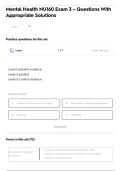
Practice questions for this set
Learn 1 /7 Study with Learn
Level 1-prevent violence
Level 2-protect
Level 3-control violence
Choose an answer
1 Levels of Intervention for Anger 2 Neuroleptic Malignant Syndrome
3 agnosia 4 Catatonia
Don't know?
Terms in this set (73)
A serious and potentially fatal side effect with
Neuroleptic Malignant
unstable vital signs, fever, confusion, muscle rigidity,
Syndrome
tremor, and incontinence
, Maladaptive behaviors and thoughts, ACTIONS,
ACT OUT
Delusions, hallucinations, illusions, speech
Type 1: Positive
problems, bizarre behaviors, agitation, catatonic
Symptoms of
behavior
Schizophrenia
Too much dopamine, brain size and structure
normal
Response to antipsychotics is usually good
Lack of adaptive mechanisms, THOUGHTS, DON'T
ACT OUT
Anergia, anhedonia, apathy, avolition, flat affect,
Type 2: Negative
won't speak unless spoken to
Symptoms of
Too little dopamine, decreased blood flow to brain,
Schizophrenia
increased size of ventricles in brain, decrease in size
of brain
Response to antipsychotics is usually poor
The inability to recognize psychosis
reality, relate to others,
and cope with life's
demands is
disrupts how your brain works, disrupting how a
Catatonia person processes and reacts to the world around
them
immobility or excessive activity with no purpose,
odd movements, rigid posture, echopraxia (mimics
Schizophrenia Subtype:
movements of others), echolalia (echoes others'
Catatonic
speech), may suffer from malnutrition, dehydration,
exhaustion, prognosis is fair
Schizophrenia Subtype: disordered thinking, speech, and behavior, unable
Disorganized to perform ADL's, early onset, prognosis is poor
organized delusions of grandeur or persecution,
Schizophrenia Subtype: auditory hallucinations, high anxiety, suspicious,
Paranoid angry, can be violent or suicidal, late onset,
prognosis is good with treatment
Appropriate Solutions
Save
Practice questions for this set
Learn 1 /7 Study with Learn
Level 1-prevent violence
Level 2-protect
Level 3-control violence
Choose an answer
1 Levels of Intervention for Anger 2 Neuroleptic Malignant Syndrome
3 agnosia 4 Catatonia
Don't know?
Terms in this set (73)
A serious and potentially fatal side effect with
Neuroleptic Malignant
unstable vital signs, fever, confusion, muscle rigidity,
Syndrome
tremor, and incontinence
, Maladaptive behaviors and thoughts, ACTIONS,
ACT OUT
Delusions, hallucinations, illusions, speech
Type 1: Positive
problems, bizarre behaviors, agitation, catatonic
Symptoms of
behavior
Schizophrenia
Too much dopamine, brain size and structure
normal
Response to antipsychotics is usually good
Lack of adaptive mechanisms, THOUGHTS, DON'T
ACT OUT
Anergia, anhedonia, apathy, avolition, flat affect,
Type 2: Negative
won't speak unless spoken to
Symptoms of
Too little dopamine, decreased blood flow to brain,
Schizophrenia
increased size of ventricles in brain, decrease in size
of brain
Response to antipsychotics is usually poor
The inability to recognize psychosis
reality, relate to others,
and cope with life's
demands is
disrupts how your brain works, disrupting how a
Catatonia person processes and reacts to the world around
them
immobility or excessive activity with no purpose,
odd movements, rigid posture, echopraxia (mimics
Schizophrenia Subtype:
movements of others), echolalia (echoes others'
Catatonic
speech), may suffer from malnutrition, dehydration,
exhaustion, prognosis is fair
Schizophrenia Subtype: disordered thinking, speech, and behavior, unable
Disorganized to perform ADL's, early onset, prognosis is poor
organized delusions of grandeur or persecution,
Schizophrenia Subtype: auditory hallucinations, high anxiety, suspicious,
Paranoid angry, can be violent or suicidal, late onset,
prognosis is good with treatment