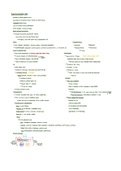
Summary Monetary and Fiscal Policy
Summary reading + lectures+ notes (all concepts)
Lecture 1
1. Mishkin F., K. Matthews and M. Giuliodori (2013). The Economics of Money, Banking, and
Financial Markets (European Edition) ch15
2. McLeay, M., Radia, A. and Thomas, R. (2014). “Money Creation in the Modern Economy.” Bank
of England Quarterly Bulletin 2014 Q1.
TOPICS
Conventional tools of monetary policy
Traditional money multiplier (MM) model
Why and how central banks (CBs) target interest rates
Money creation under interest-rate (IR) targeting
CBs are “lenders of last resort” and, as monopolists in the supply of reserves, can either target the (i)
quantity of reserves or (ii) price of reserves.
Conventional Tools of Monetary Policy
Tools: variables directly controlled by the CB:
Open market operations (OMOs)CB buys and sells eligible securities to affect the quantity of reserves
and the monetary base.
Standing facilities CB sets interest rates at which banks can borrow and deposit reserves at the CB.
Reserve requirements CB sets the required reserve ratio (the fraction of deposits that banks must hold at
the CB).
Main measures of money:
1. ‘High-Powered’ Money or “Monetary Base” (MB)
Definition of narrow/broad money reflects institutional structures of monetary systems which change over time.
2. ‘Narrow’ Monetary Aggregate (M1 and M2)
3. ‘Broad’ Monetary Aggregate (M3 and M4)
MB = currency in circulation (C) + reserves held by banks at the CB (R).
Money Supply Process
,According to traditional money multiplier (MM) model, money supply M is fully and precisely controlled by
CB through changes of MB.
MM model lies behind the “Quantity Theory of Money” (QTM) (MV=PY) and the textbook IS/LM model.
MM model is based on identities, reflecting the balance sheets of banks and the CB.
Targeting the PriceCBs can choose to target either the MB (and R) or the interest rate at which
they provide liquidity/reserves to banks. (most CBs target interest rates)
1. Why do CBs target interest rates? Criteria for choosing between different instruments:
1. Observability and Measurability: instrument should be quickly observable and measurable.
2. Controllability: instrument should be fully controlled.
3. Predictable Effect on Goals: instrument must have a stable and predictable relationship with goal.
On the basis of criteria (1) and (2) neither policy instrument is superior to the other.
, CONCLUSIONS FROM TUTORIAL ONE ON POOLE’S MODEL
• Nowadays, mainly due to criterion (3), in normal times most CBs target short-term interest rates as
policy instrument.
2. How do CBs target interest rates? (need to understand demand and supply of reserves)
Banks with a temporary overnight excess (shortage) of reserves can lend (borrow) them to (from) other banks at
the overnight interbank interest rate (i ). Overnight interbank interest rates: Euro Over Night Index Average
(EONIA) in the euro area, Fed Funds Rate (FFR) in the U.S.
Demand for Reserves
Rd = RR + ER ER are held as insurance against deposit outflows.
The cost of holding ER is the interest rate (i) that could have been earned by lending them minus the deposit rate
(id) received on these reserves if deposited at the CB.
If i > id , banks would earn more by lending to other banks. The opportunity cost of holding ER increases and
the demand of reserves Rd decreases (banks do not want to hold more reserves if the cost of holding them
increased (i)), as it is more costly for banks to deposit at the central bank). Whereas if id>i then banks would
earn more money by depositing at the central bank( higher id) than lend to each other (and earn i)
This implies a downward-sloping demand curve which becomes flat (perfectly elastic) at id
Supply of Reserves
Rs = NBR + BR where (NBR = non-borrowed, BR = borrowed reserves).
Cost of BR from the CB is the lending rate il
If i < il, then banks will not borrow from the CB and BR are zero. This is because it is cheaper to borrow from
other banks. As we have seen in the demand for reserves if i> id is not profitable to deposit ER at the CB but
rather to lend to other institutions. => Rs is vertical and equal to Rs = NBR.
, As i rises above il, any bank will borrow at il from CB and re-lend at i (arbitrage opportunity) => Rs is horizontal
(perfectly elastic) at il
Nature of OMOs is similar across countries, although details differ slightly (e.g. frequency and maturity of
repos, eligible securities, etc). ECB buys and sells eligible assets to affect reserves and, as a result, the interest
rate that European banks charge each other for overnight funds (e.g. EONIA). Implemented by NCBs.
Main form: Main Refinancing Operations (MROs) (weekly repos at week maturity).
Key ECB interest rates: (1) interest rate on MROs, (2) marginal lending rate and (3) deposit rate
3. How is money created under interest-rate (IR) targeting? (2 nd article-money creation)
In normal times, CBs set interest rates and supply reserves on demand. Banks decide how much to lend
depending on profitable lending opportunities (which depend on the interest rate set by the CB). These lending
decisions determine the amount of deposits created by the banking system. The amount of bank deposits in turn
influences how many reserves banks want to hold at the CB.
With IR target, the MM model operates in the reverse way.
Although banks create money through their lending behavior, they cannot in practice do so without limit.
In the modern economy there are three sets of constraints that restrict the amount of money banks can create:
• Banks themselves face limits on how much they can lend (e.g. market forces, risk management,
regulation).
• Money creation is constrained by the behavior of money holders (e.g. households and businesses)
• The ultimate constraint on money creation is monetary policy.
EXTRA GRAPHS TO UNDERSTAND BETTER SUPPLY AND DEMAND FOR RESERVES
Summary reading + lectures+ notes (all concepts)
Lecture 1
1. Mishkin F., K. Matthews and M. Giuliodori (2013). The Economics of Money, Banking, and
Financial Markets (European Edition) ch15
2. McLeay, M., Radia, A. and Thomas, R. (2014). “Money Creation in the Modern Economy.” Bank
of England Quarterly Bulletin 2014 Q1.
TOPICS
Conventional tools of monetary policy
Traditional money multiplier (MM) model
Why and how central banks (CBs) target interest rates
Money creation under interest-rate (IR) targeting
CBs are “lenders of last resort” and, as monopolists in the supply of reserves, can either target the (i)
quantity of reserves or (ii) price of reserves.
Conventional Tools of Monetary Policy
Tools: variables directly controlled by the CB:
Open market operations (OMOs)CB buys and sells eligible securities to affect the quantity of reserves
and the monetary base.
Standing facilities CB sets interest rates at which banks can borrow and deposit reserves at the CB.
Reserve requirements CB sets the required reserve ratio (the fraction of deposits that banks must hold at
the CB).
Main measures of money:
1. ‘High-Powered’ Money or “Monetary Base” (MB)
Definition of narrow/broad money reflects institutional structures of monetary systems which change over time.
2. ‘Narrow’ Monetary Aggregate (M1 and M2)
3. ‘Broad’ Monetary Aggregate (M3 and M4)
MB = currency in circulation (C) + reserves held by banks at the CB (R).
Money Supply Process
,According to traditional money multiplier (MM) model, money supply M is fully and precisely controlled by
CB through changes of MB.
MM model lies behind the “Quantity Theory of Money” (QTM) (MV=PY) and the textbook IS/LM model.
MM model is based on identities, reflecting the balance sheets of banks and the CB.
Targeting the PriceCBs can choose to target either the MB (and R) or the interest rate at which
they provide liquidity/reserves to banks. (most CBs target interest rates)
1. Why do CBs target interest rates? Criteria for choosing between different instruments:
1. Observability and Measurability: instrument should be quickly observable and measurable.
2. Controllability: instrument should be fully controlled.
3. Predictable Effect on Goals: instrument must have a stable and predictable relationship with goal.
On the basis of criteria (1) and (2) neither policy instrument is superior to the other.
, CONCLUSIONS FROM TUTORIAL ONE ON POOLE’S MODEL
• Nowadays, mainly due to criterion (3), in normal times most CBs target short-term interest rates as
policy instrument.
2. How do CBs target interest rates? (need to understand demand and supply of reserves)
Banks with a temporary overnight excess (shortage) of reserves can lend (borrow) them to (from) other banks at
the overnight interbank interest rate (i ). Overnight interbank interest rates: Euro Over Night Index Average
(EONIA) in the euro area, Fed Funds Rate (FFR) in the U.S.
Demand for Reserves
Rd = RR + ER ER are held as insurance against deposit outflows.
The cost of holding ER is the interest rate (i) that could have been earned by lending them minus the deposit rate
(id) received on these reserves if deposited at the CB.
If i > id , banks would earn more by lending to other banks. The opportunity cost of holding ER increases and
the demand of reserves Rd decreases (banks do not want to hold more reserves if the cost of holding them
increased (i)), as it is more costly for banks to deposit at the central bank). Whereas if id>i then banks would
earn more money by depositing at the central bank( higher id) than lend to each other (and earn i)
This implies a downward-sloping demand curve which becomes flat (perfectly elastic) at id
Supply of Reserves
Rs = NBR + BR where (NBR = non-borrowed, BR = borrowed reserves).
Cost of BR from the CB is the lending rate il
If i < il, then banks will not borrow from the CB and BR are zero. This is because it is cheaper to borrow from
other banks. As we have seen in the demand for reserves if i> id is not profitable to deposit ER at the CB but
rather to lend to other institutions. => Rs is vertical and equal to Rs = NBR.
, As i rises above il, any bank will borrow at il from CB and re-lend at i (arbitrage opportunity) => Rs is horizontal
(perfectly elastic) at il
Nature of OMOs is similar across countries, although details differ slightly (e.g. frequency and maturity of
repos, eligible securities, etc). ECB buys and sells eligible assets to affect reserves and, as a result, the interest
rate that European banks charge each other for overnight funds (e.g. EONIA). Implemented by NCBs.
Main form: Main Refinancing Operations (MROs) (weekly repos at week maturity).
Key ECB interest rates: (1) interest rate on MROs, (2) marginal lending rate and (3) deposit rate
3. How is money created under interest-rate (IR) targeting? (2 nd article-money creation)
In normal times, CBs set interest rates and supply reserves on demand. Banks decide how much to lend
depending on profitable lending opportunities (which depend on the interest rate set by the CB). These lending
decisions determine the amount of deposits created by the banking system. The amount of bank deposits in turn
influences how many reserves banks want to hold at the CB.
With IR target, the MM model operates in the reverse way.
Although banks create money through their lending behavior, they cannot in practice do so without limit.
In the modern economy there are three sets of constraints that restrict the amount of money banks can create:
• Banks themselves face limits on how much they can lend (e.g. market forces, risk management,
regulation).
• Money creation is constrained by the behavior of money holders (e.g. households and businesses)
• The ultimate constraint on money creation is monetary policy.
EXTRA GRAPHS TO UNDERSTAND BETTER SUPPLY AND DEMAND FOR RESERVES