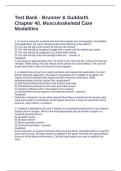
Test Bank - Brunner & Suddarth
Chapter 40. Musculoskeletal Care
Modalities
1. A nurse is caring for a patient who has had a plaster arm cast applied. Immediately
post application, the nurse should provide what teaching to the patient?
A) The cast will feel cool to touch for the first 30 minutes.
B) The cast should be wrapped snuggly with a towel until the patient gets home.
C) The cast should be supported on a board while drying.
D) The cast will only have full strength when dry. – answer D
Feedback:
A cast requires approximately 24 to 72 hours to dry, and until dry, it does not have full
strength. While drying, the cast should not be placed on a hard surface. The cast will
exude heat while it dries and should not be wrapped.
2. A patient broke his arm in a sports accident and required the application of a cast.
Shortly following application, the patient complained of an inability to straighten his
fingers and was subsequently diagnosed with Volkmann contracture. What
pathophysiologic process caused this complication?
A) Obstructed arterial blood flow to the forearm and hand
B) Simultaneous pressure on the ulnar and radial nerves
C) Irritation of Merkel cells in the patients skin surfaces
D) Uncontrolled muscle spasms in the patients forearm - answerA
Feedback:
Volkmann contracture occurs when arterial blood flow is restricted to the forearm and
hand and results in contractures of the fingers and wrist. It does not result from nerve
pressure, skin irritation, or spasms.
3. A patient is admitted to the unit in traction for a fractured proximal femur and requires
traction prior to surgery. What is the most appropriate type of traction to apply to a
fractured proximal femur?
A) Russells traction
B) Dunlops traction
C) Bucks extension traction
D) Cervical head halter - answerC
Feedback:
Bucks extension is used for fractures of the proximal femur. Russells traction is used for
lower leg fractures. Dunlops traction is applied to the upper extremity for supracondylar
fractures of the elbow and humerus. Cervical head halters are used to stabilize the
neck.
, 4. A nurse is caring for a patient who is in skeletal traction. To prevent the complication
of skin breakdown in a patient with skeletal traction, what action should be included in
the plan of care?
A) Apply occlusive dressings to the pin sites.
B) Encourage the patient to push up with the elbows when repositioning.
C) Encourage the patient to perform isometric exercises once a shift.
D) Assess the pin insertion site every 8 hours. - answerD
Feedback:
The pin insertion site should be assessed every 8 hours for inflammation and infection.
Loose cover dressings should be applied to pin sites. The patient should be encouraged
to use the overhead trapeze to shift weight for repositioning. Isometric exercises should
be done 10 times an hour while awake.
5. A nurse is caring for a patient who is postoperative day 1 right hip replacement. How
should the nurse position the patient?
A) Keep the patients hips in abduction at all times.
B) Keep hips flexed at no less than 90 degrees.
C) Elevate the head of the bed to high Fowlers.
D) Seat the patient in a low chair as soon as possible. - answerA
Feedback:
The hips should be kept in abduction by an abductor pillow. Hips should not be flexed
more than 90 degrees, and the head of bed should not be elevated more than 60
degrees. The patients hips should be higher than the knees; as such, high seat chairs
should be used.
6. While assessing a patient who has had knee replacement surgery, the nurse notes
that the patient has developed a hematoma at the surgical site. The affected leg has a
decreased pedal pulse. What would be the priority nursing diagnosis for this patient?
A) Risk for Infection
B) Risk for Peripheral Neurovascular Dysfunction
C) Unilateral Neglect
D) Disturbed Kinesthetic Sensory Perception - answerB
Feedback:
The hematoma may cause an interruption of tissue perfusion, so the most appropriate
nursing diagnosis is Risk of Peripheral Neurovascular Dysfunction. There is also an
associated risk for infection because of the hematoma, but impaired neurovascular
function is a more acute threat. Unilateral neglect and impaired sensation are lower
priorities than neurovascular status.
7. A patient was brought to the emergency department after a fall. The patient is taken
to the operating room to receive a right hip prosthesis. In the immediate postoperative
period, what health education should the nurse emphasize?
A) Make sure you dont bring your knees close together.
B) Try to lie as still as possible for the first few days.
C) Try to avoid bending your knees until next week.
D) Keep your legs higher than your chest whenever you can. - answerA
Chapter 40. Musculoskeletal Care
Modalities
1. A nurse is caring for a patient who has had a plaster arm cast applied. Immediately
post application, the nurse should provide what teaching to the patient?
A) The cast will feel cool to touch for the first 30 minutes.
B) The cast should be wrapped snuggly with a towel until the patient gets home.
C) The cast should be supported on a board while drying.
D) The cast will only have full strength when dry. – answer D
Feedback:
A cast requires approximately 24 to 72 hours to dry, and until dry, it does not have full
strength. While drying, the cast should not be placed on a hard surface. The cast will
exude heat while it dries and should not be wrapped.
2. A patient broke his arm in a sports accident and required the application of a cast.
Shortly following application, the patient complained of an inability to straighten his
fingers and was subsequently diagnosed with Volkmann contracture. What
pathophysiologic process caused this complication?
A) Obstructed arterial blood flow to the forearm and hand
B) Simultaneous pressure on the ulnar and radial nerves
C) Irritation of Merkel cells in the patients skin surfaces
D) Uncontrolled muscle spasms in the patients forearm - answerA
Feedback:
Volkmann contracture occurs when arterial blood flow is restricted to the forearm and
hand and results in contractures of the fingers and wrist. It does not result from nerve
pressure, skin irritation, or spasms.
3. A patient is admitted to the unit in traction for a fractured proximal femur and requires
traction prior to surgery. What is the most appropriate type of traction to apply to a
fractured proximal femur?
A) Russells traction
B) Dunlops traction
C) Bucks extension traction
D) Cervical head halter - answerC
Feedback:
Bucks extension is used for fractures of the proximal femur. Russells traction is used for
lower leg fractures. Dunlops traction is applied to the upper extremity for supracondylar
fractures of the elbow and humerus. Cervical head halters are used to stabilize the
neck.
, 4. A nurse is caring for a patient who is in skeletal traction. To prevent the complication
of skin breakdown in a patient with skeletal traction, what action should be included in
the plan of care?
A) Apply occlusive dressings to the pin sites.
B) Encourage the patient to push up with the elbows when repositioning.
C) Encourage the patient to perform isometric exercises once a shift.
D) Assess the pin insertion site every 8 hours. - answerD
Feedback:
The pin insertion site should be assessed every 8 hours for inflammation and infection.
Loose cover dressings should be applied to pin sites. The patient should be encouraged
to use the overhead trapeze to shift weight for repositioning. Isometric exercises should
be done 10 times an hour while awake.
5. A nurse is caring for a patient who is postoperative day 1 right hip replacement. How
should the nurse position the patient?
A) Keep the patients hips in abduction at all times.
B) Keep hips flexed at no less than 90 degrees.
C) Elevate the head of the bed to high Fowlers.
D) Seat the patient in a low chair as soon as possible. - answerA
Feedback:
The hips should be kept in abduction by an abductor pillow. Hips should not be flexed
more than 90 degrees, and the head of bed should not be elevated more than 60
degrees. The patients hips should be higher than the knees; as such, high seat chairs
should be used.
6. While assessing a patient who has had knee replacement surgery, the nurse notes
that the patient has developed a hematoma at the surgical site. The affected leg has a
decreased pedal pulse. What would be the priority nursing diagnosis for this patient?
A) Risk for Infection
B) Risk for Peripheral Neurovascular Dysfunction
C) Unilateral Neglect
D) Disturbed Kinesthetic Sensory Perception - answerB
Feedback:
The hematoma may cause an interruption of tissue perfusion, so the most appropriate
nursing diagnosis is Risk of Peripheral Neurovascular Dysfunction. There is also an
associated risk for infection because of the hematoma, but impaired neurovascular
function is a more acute threat. Unilateral neglect and impaired sensation are lower
priorities than neurovascular status.
7. A patient was brought to the emergency department after a fall. The patient is taken
to the operating room to receive a right hip prosthesis. In the immediate postoperative
period, what health education should the nurse emphasize?
A) Make sure you dont bring your knees close together.
B) Try to lie as still as possible for the first few days.
C) Try to avoid bending your knees until next week.
D) Keep your legs higher than your chest whenever you can. - answerA